TLDR
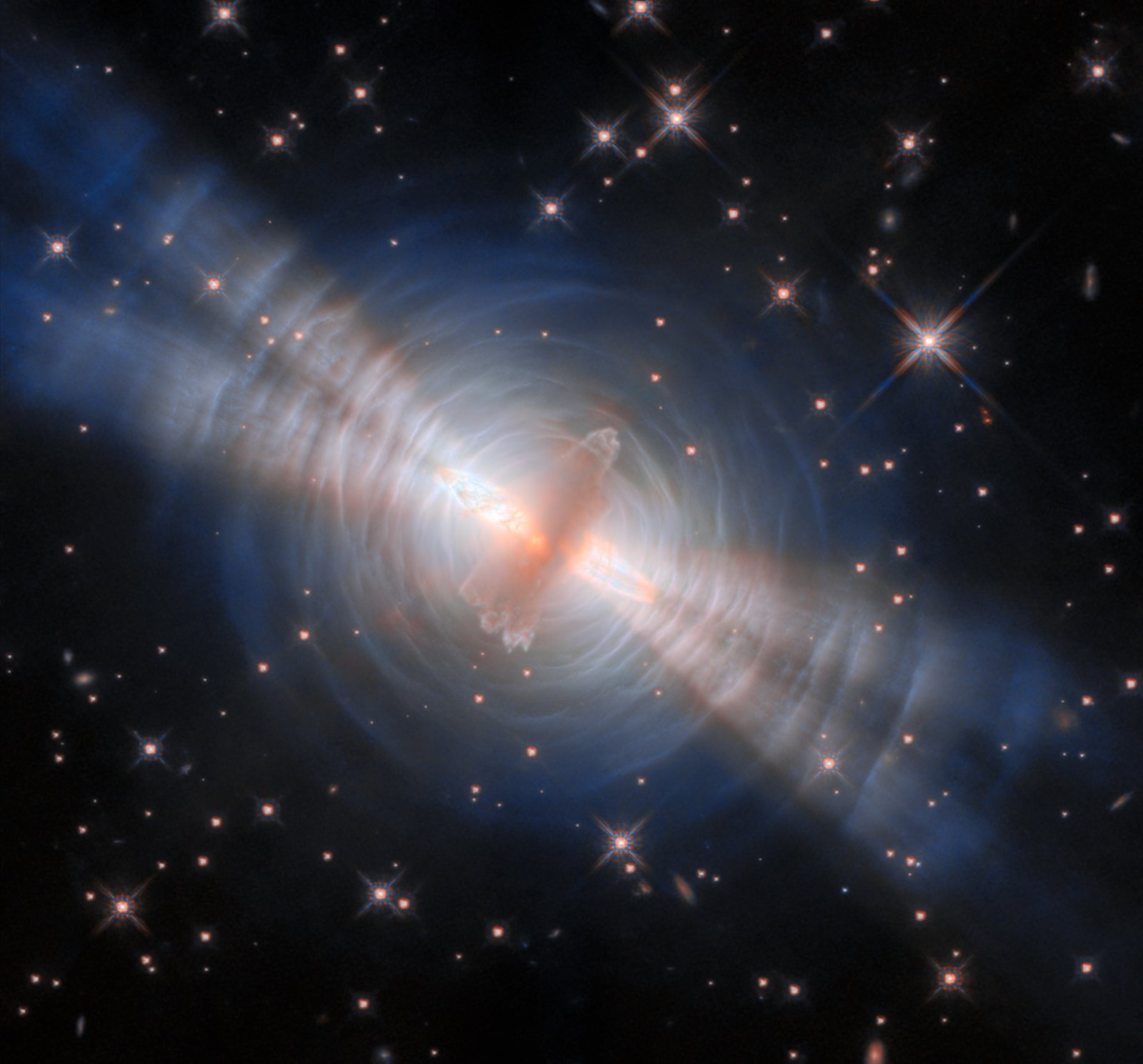
• Core Points: Hubble delivers the clearest image yet of the Egg Nebula, about 3,000 light-years away, showing four beams of starlight escaping from a gas-and-dust shell surrounding a central dying star.
• Main Content: The Egg Nebula’s striking geometry highlights the final stages of stellar evolution, with a disk-like dust cloud and high-velocity outflows shaping a striking, four-beamed structure.
• Key Insights: Elevated-resolution imagery enhances our understanding of how dying stars sculpt their surroundings, shedding light on the mechanics of late-stage stellar mass loss.
• Considerations: Despite Hubble’s contributions, new instruments and future telescopes will further refine details of the nebula’s dynamic processes.
• Recommended Actions: Continue multi-wavelength observations and compare with theoretical models to better map mass ejection and dust formation in dying stars.
Content Overview
The Egg Nebula, located roughly 3,000 light-years from Earth, remains one of the most visually arresting laboratories for studying the final acts of stellar evolution. The latest imagery from the Hubble Space Telescope—though no longer the premier instrument in space astronomy—offers the clearest view to date of the nebula’s intricate architecture. At the heart of this object lies a central star that is nearing the end of its life cycle. The surrounding envelope consists of dense gas and dust that the star has expelled during its waning years, effectively cloaking the hot core and shaping the observable structure of the nebula.
What makes the Egg Nebula particularly compelling is not only its vivid beauty but also what it reveals about the physics of dying stars. The most striking feature is a quartet of luminous beams—four distinct channels through which starlight escapes—from the central star. These beams illuminate an expansive gas-and-dust “shell” that envelops the system. The nebula’s morphology is further characterized by a disk-like distribution of material that has been sculpted by powerful, high-velocity outflows. On either side of this disk, the outflows carve channels that appear as bright, linear streams, creating the appearance of four radiant ribbons against a darker backdrop. The result is a complex, dynamic portrait of a star expelling its outer layers while the remnant core contracts and cools.
In addition to the striking visual aesthetics, the Egg Nebula serves as a natural laboratory for astrophysicists seeking to understand the late stages of stellar evolution. The processes at work—mass loss, dust formation, and the shaping of ejected material by fast winds—offer critical clues about how planetary nebulae arise and how stars similar in mass to our Sun end their lives. The Egg Nebula’s geometry helps researchers test models of how isotropic and anisotropic winds interact with surrounding material, how dust grains form and grow in these environments, and how radiation pressure from the central star drives the observed structures.
The Egg Nebula’s distance of approximately 3,000 light-years makes it a relatively accessible target for high-resolution imaging with space-based telescopes. Although newer observatories with advanced capabilities have since entered operation, Hubble’s long track record and stable imaging platform continue to provide valuable, high-contrast views of such intricate phenomena. The latest image emphasizes the interplay between shape, light, and motion in a region where a star is shedding its outer layers in a relatively short astronomical timeframe, offering a vivid reminder of the dramatic ends to some stars’ lifespans.
This enhanced image also underscores the importance of combining observational data with theoretical work. By mapping the distribution of dust and gas and measuring the velocities and energies of outflows, scientists can refine simulations that recreate the observed features. Such efforts are essential for building a coherent narrative of how planetary nebulae form, evolve, and contribute to the chemical enrichment of the interstellar medium.
In summary, the Egg Nebula remains a standout example of how a dying star can sculpt its surroundings into an organized, luminous tableau. Hubble’s newest visualization adds depth to our understanding of the processes governing stellar death, while also highlighting the need for ongoing, multi-faceted exploration of these cosmic endgames.
In-Depth Analysis
The Egg Nebula, catalogued scientifically as a proto-planetary or protoplanetary nebula, represents a transitional phase between the asymptotic giant branch (AGB) stage and the eventual planetary nebula phase. In this evolutionary window, a star has exhausted much of its hydrogen and helium fuel, and its outer layers are being expelled at substantial speeds. The residual core heats up and becomes a central white dwarf or pre-white dwarf, emitting radiation that propagates through the expelled material.
Hubble’s latest imaging emphasizes four prominent beams of starlight, which emerge from the central star and pierce through the surrounding envelope. These beams are interpreted as direct channels through which radiation and energetic particles escape along bipolar, collimated outflows. The geometry implies that the mass loss is not uniform in all directions but is instead channeled into relatively narrow, high-velocity jets that carve cavities in the dusty shell. The resultant structure is a conical or hourglass-like configuration when viewed in three dimensions, with the dense equatorial region forming a torus or disk that constrains the outflows.
The nebula’s shell consists of gas and dust ejected during the star’s AGB phase. The interaction between fast, low-density winds from the evolving central star and the slower, denser material ejected earlier creates shocks, compressing material and heating it to temperatures that emit across optical and infrared wavelengths. Dust grains formed in the cooler outer layers can grow to sizes that effectively scatter and absorb light, contributing to the nebula’s distinctive appearance. The distribution and composition of this dust influence the observed color palette and brightness distribution in high-resolution images.
Technological advances in imaging—spanning resolution, sensitivity, and wavelength coverage—allow astronomers to dissect the Egg Nebula’s components more precisely. Hubble’s optical and near-infrared capabilities enable the visualization of fine filaments, limb-brightened rims, and the edges of outflow cavities. When combined with spectroscopic data, researchers can infer velocities, kinetic energies, and mass-loss rates associated with the outflows. This multi-dimensional data is critical for validating theoretical models of late-stage stellar evolution, particularly those involving axisymmetric or multipolar mass ejection mechanisms.
Beyond the immediate scientific intrigue, the Egg Nebula offers broader implications for galactic ecology. The material expelled by dying stars becomes part of the interstellar medium, seeding future generations of stars and planets with heavier elements and dust grains. Understanding how these materials are produced, distributed, and mixed into surrounding space contributes to a larger comprehension of the life cycle of matter in the Milky Way.
The significance of the Egg Nebula also lies in its role as a benchmark object for calibrating and testing instruments. By comparing observations from older and newer telescopes, and across different wavelengths, astronomers can assess the consistency of measurements, identify systematic uncertainties, and refine data processing techniques. The nebula’s bright, structured features provide an accessible target for verifying, validating, and improving imaging pipelines and analytical methods.
In terms of interpretive progress, researchers are engaged in ongoing debates about the exact driving mechanisms behind the observed collimation. Several theories propose magnetic fields, binary companions, or a combination of rotational dynamics and dusty torus structures as viable contributors to shaping the outflows. Each hypothesis has distinct observational signatures, which future observations—particularly at radio and submillimeter wavelengths, where molecular lines trace gas dynamics—can help distinguish.

*圖片來源:Unsplash*
Looking ahead, the Egg Nebula will continue to be a focal point for observational campaigns and theoretical exploration. The integration of high-resolution imaging with time-domain studies could reveal subtle changes in the nebula’s structure over years to decades, offering a dynamic glimpse into the evolution of these systems. Moreover, next-generation telescopes, such as those with enhanced infrared sensitivity or capabilities for interferometric imaging, promise to sharpen our view of the central region and outflow cavities, enabling more precise measurements of density distributions, dust properties, and velocity fields.
Overall, the Egg Nebula exemplifies how the dying phase of a star can create a visually striking and physically informative object. The latest Hubble image—while not the latest or most advanced instrument available—still contributes meaningful insights by presenting a clear, structurally rich depiction of the four-beam outflow geometry, the surrounding dusty shell, and the dynamic processes at play in late stellar evolution.
Perspectives and Impact
The Egg Nebula’s refined imagery reinforces several broader themes in modern astrophysics. First, it underscores the importance of high-resolution observations in decoding complex astrophysical morphologies. The four-beam structure serves as a tangible manifestation of anisotropic mass loss, allowing researchers to test how angular momentum, radiation pressure, and magnetic fields interact in a crowded circumstellar environment.
Second, the study of proto-planetary and planetary nebulae bridges stellar evolution with the enrichment of the interstellar medium. As stars like our Sun traverse the AGB phase and shed their outer envelopes, they contribute not only gas but also dust grains that seed the material from which new stars and planetary systems form. The Egg Nebula’s dust content offers a microcosm of these broader cosmic processes, linking the endpoints of stellar lifecycles to the birth of future celestial generations.
Third, the Egg Nebula highlights the value of multi-wavelength synergy. While optical imagery reveals structural details, infrared and radio observations can uncover cooler dust components and molecular gas dynamics that are invisible in visible light alone. The combination of datasets across the electromagnetic spectrum enables a more complete reconstruction of the nebula’s physical conditions, including temperature, density, chemistry, and kinematics.
From a methodological standpoint, the Egg Nebula challenges theorists to account for observed asymmetries and time-dependent features. Models must reproduce both the disk-like equatorial structure and the polar outflows with realistic mass-loss histories and energetics. The continued development of three-dimensional simulations, coupled with synthetic observations, will help researchers compare theory with reality more precisely. As computational capabilities grow, researchers can explore a broader parameter space—varying stellar mass, metallicity, binary interactions, and magnetic field configurations—to identify the combinations that yield Egg Nebula-like morphologies.
In terms of public engagement and education, the Egg Nebula’s striking appearance offers a compelling gateway to discuss stellar life cycles with non-specialist audiences. The vivid geometry—especially the four bright beams—captures the imagination and can be used to illustrate concepts such as stellar winds, mass loss, dust formation, and the lifecycle of matter in the galaxy. Clear, accessible explanations accompanying such imagery help convey the scientific significance without sacrificing the wonder that comes with stunning cosmic visuals.
Looking to the future, the Egg Nebula will likely remain a touchstone object for comparing observational capabilities and theoretical predictions. As new instruments come online, with higher resolution, greater sensitivity, and complementary wavelength coverage, researchers will be able to peel back more layers of complexity surrounding these celestial endgames. These advancements will refine our understanding of how stars shed their outer layers, how the resulting structures are shaped, and how such processes contribute to the cosmic tapestry of elements and dust that pervades the galaxy.
Key implications of ongoing Egg Nebula research include:
– Improved comprehension of anisotropic mass loss and jet-like outflows during late stellar evolution.
– Enhanced mapping of dust formation processes and their impact on observed nebular morphology.
– Better integration of multi-wavelength data to build cohesive models of circumstellar environments.
– Insights into the broader cycle of matter in the Milky Way, linking dying stars to subsequent generations of stars and planets.
In summary, the Egg Nebula remains a cornerstone object for studying how dying stars sculpt their surroundings. Hubble’s detailed imaging of its four-beam structure and dusty shell contributes to a richer, more nuanced picture of stellar death, while signaling the importance of continued investment in observational capabilities and theoretical models. The nebula’s beauty is matched by its scientific value, offering a window into the complex interplay of winds, dust, and radiation that marks the twilight of a star’s life.
Key Takeaways
Main Points:
– The Egg Nebula showcases a four-beam outflow pattern from a central dying star, embedded in a dense gas-and-dust shell.
– The nebula’s morphology arises from anisotropic mass loss and jet-like processes during late stellar evolution.
– High-resolution imaging, combined with multi-wavelength data, advances our understanding of dust formation and circumstellar dynamics.
Areas of Concern:
– The precise mechanisms that drive the observed collimation and symmetry are still debated (magnetic fields, binarity, winds, and toroidal structures).
– Differences between observations across instruments necessitate careful cross-calibration and interpretation.
– Time-domain evolution at human-accessible timescales remains challenging to quantify, requiring long-term monitoring.
Summary and Recommendations
The Egg Nebula stands as a powerful exemplar of the final stages of stellar evolution, offering both aesthetic grandeur and scientific depth. Hubble’s enhanced view of the four-beam architecture, coupled with the surrounding dusty shell, provides critical constraints on models of mass loss, dust production, and the shaping mechanisms that yield planetary nebulae. To build on this foundation, the astronomical community should pursue a multi-pronged strategy: continue high-resolution imaging across optical, infrared, and radio wavelengths; perform coordinated spectroscopic studies to map velocities and chemical compositions; and develop sophisticated three-dimensional simulations that can reproduce the observed structures under varying physical conditions. Long-term monitoring, potentially with next-generation telescopes, will help determine how these spectacular features evolve over time, offering deeper insight into the enduring saga of stellar death and the birth of new cosmic matter.
References
- Original: https://www.engadget.com/science/space/hubble-showcases-the-egg-nebula-in-all-its-dying-star-glory-174239769.html?src=rss
- Additional context:
- https://en.wikipedia.org/wiki/Proto-planetary_nebula
- https://www.nasa.gov/mission_pages/hubble/science/egg-nebula.html
- https://www.esa.int/Science_Exploration/Space_Science/Hubble_shows_Egg_Nebula_(Protoplanetary_nebula)

*圖片來源:Unsplash*