TLDR
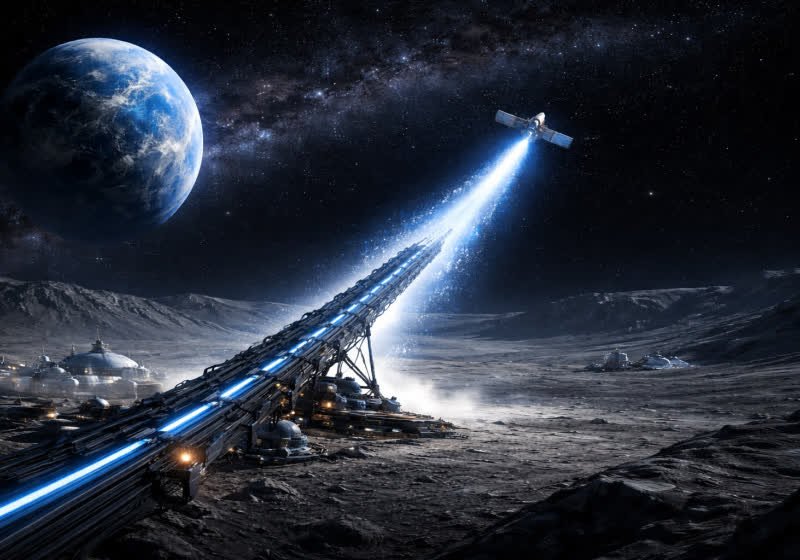
• Core Points: Musk proposes a Moon-based factory to manufacture AI satellites, launched into space via a giant catapult, as part of a broader plan for advanced space infrastructure.
• Main Content: The concept, discussed at an internal meeting, envisions leveraging lunar resources and a massive launch mechanism to deploy AI-enabled satellites.
• Key Insights: The idea blends ambitious space manufacturing with novel propulsion concepts, raising questions about feasibility, cost, and governance.
• Considerations: Technical challenges include lunar logistics, energy supply, precision deployment, and safety; legal and ethical implications must be addressed.
• Recommended Actions: Stakeholders should assess technical viability, conduct phased studies, and engage with international space regulatory bodies before pursuing any prototype.
Content Overview
The report centers on an extraordinary idea reportedly raised by Elon Musk in an internal all-hands meeting. The proposal envisions constructing a large manufacturing facility on the Moon tasked with producing artificial intelligence (AI) satellites. Instead of conventional rocketry, these satellites would be launched into Earth orbit using a giant catapult system. The concept is positioned within Musk’s broader vision of expanding humanity’s presence beyond Earth and developing space-based infrastructure capable of supporting AI-driven networks and services. The details discussed at the meeting remain speculative in nature, with Musk outlining a high-level framework rather than presenting a ready-to-build blueprint. The idea embodies a combination of lunar resource utilization, disruptive propulsion concepts, and long-term ambitions for secure, scalable space communications and computation. As with any such bold proposal, its realization would require overcoming substantial scientific, engineering, regulatory, and financial hurdles, alongside rigorous risk assessment and international cooperation.
In-Depth Analysis
Elon Musk’s suggestion to establish a Moon-based factory for AI satellites intersects several core themes that animate current space and technology discourse: the utilization of extraterrestrial resources, the pursuit of low-cost launch alternatives, and the strategic deployment of AI-enabled satellite networks. While the specifics remain sparse in public reporting, the core concept can be examined through several lenses.
1) Lunar manufacturing and resource use
Advocates point to the Moon as a potential source of materials, including regolith-derived metals and oxygen, which could enable in-situ resource utilization (ISRU). A factory located on the Moon could, in theory, reduce Earth-based logistics and transfer costs for certain mission profiles. However, the feasibility of building and operating a high-production facility on the lunar surface faces formidable challenges: extreme temperature fluctuations, radiation exposure, micrometeoroid impacts, dust management, and the need for reliable local power generation and life support for any human or autonomous presence. Even with advanced autonomy, sustaining a manufacturing ecosystem in the Moon’s harsh environment would require robust robotic automation, resilient supply chains for maintenance, and long-duration power systems—likely solar arrays with energy storage or nuclear options.
2) AI satellites as a strategic objective
AI-enabled satellites could offer improved onboard processing, adaptive communication protocols, and autonomous fault detection across a distributed space network. The efficiency gains from AI might reduce latency in onboard decision-making and optimize orbital assets in real time. Yet, satellite production is a capital-intensive endeavor, typically driven by demand for telecommunications, Earth observation, and space science missions. A Moon-based factory would need to articulate a clear value proposition: lower unit costs, enhanced production throughput, or superior satellite performance that justifies the extraordinary capital expenditure and risk profile.
3) Catapult launch concept
Launching satellites from a lunar-based facility via a giant catapult is an unconventional propulsion concept. On Earth, catapult-like systems (electromagnetic railguns or coilguns) have been studied primarily for projectiles, not orbital delivery, due to the enormous velocity requirements and the impracticalities of achieving orbital energy with ground-based accelerators. On the Moon, reduced gravity and lack of atmospheric drag could, in theory, lower some requirements, but achieving precise orbital insertion, managing structural stresses, and ensuring satellite integrity during launch would still demand advances in accelerator technology, guidance control, and post-launch deployment mechanisms. The cost, reliability, and maintainability of such a system would be critical questions for any credible feasibility assessment.
4) Technical and logistical hurdles
– Power and energy: A continuous, reliable power source would be essential for a lunar factory and any launch system. Solar, nuclear, or hybrid solutions would need to be designed for lunar day-night cycles and radiative environment.
– Robotics and autonomy: The Mars-sized ambitions of a lunar production line imply a heavy reliance on autonomous robotics. Redundancy, fault-tolerance, and longevity of robotic systems would be paramount.
– Transportation and logistics: Supplying a lunar facility with materials, spare parts, and maintenance capability would require a robust supply chain, potentially involving robotic mining, processing, and transport systems adapted to low gravity.
– Ingress and governance: Any large-scale activity on the Moon is subject to international treaties and national laws governing space exploration, resource utilization, and debris mitigation. Coordination with space-faring nations and compliance with the Outer Space Treaty and related regimes would be essential.
– Financial viability: The capital expenditures, operational costs, and expected returns must be weighed against alternative approaches to space-based AI networks, Earth-based manufacturing, or on-orbit production facilities.
5) Strategic implications and governance
Beyond purely technical questions, the proposal engages broader themes of space governance, planetary protection, and the ethics of deploying AI-enabled infrastructure in space. Decisions about who funds, who builds, who operates, and who benefits from such a system will influence regulatory discourse, risk sharing, and international cooperation. The idea also raises concerns about space traffic management, space debris, and potential competitive dynamics among spacefaring nations and corporations.
6) Timeline and research pathways
Given the scale and novelty of the concept, any credible roadmap would likely feature staged studies rather than immediate construction. Possible interim steps could include:
– Feasibility studies on lunar ISRU viability for manufacturing, including material sourcing and processing.
– Technology maturation for autonomous lunar operations, including robotics, teleoperation, and AI-based system management.
– Experimental ground- and space-based testing of catapult-like deployment concepts at small scales to validate physics and material integrity.
– International legal analysis and policy dialogues to establish a governance framework for lunar manufacturing and orbital launch activities.

*圖片來源:Unsplash*
Perspectives and Impact
If pursued, the Moon-based AI satellite factory and catapult launch concept could redefine how humanity approaches space infrastructure. The potential advantages include:
– Reduced Earth-based launch costs, if lunar production and local energy solutions prove economical.
– A scalable platform for AI-enabled satellites that can adapt autonomously to changing mission requirements and optimize orbital assets dynamically.
– Diversification of space infrastructure by distributing production capabilities beyond Earth, potentially increasing resilience against terrestrial disruptions.
However, several risks and counterpoints warrant careful consideration:
– Technical risk: Building a functioning lunar factory with a reliable catapult launch system involves unproven technologies operating in a hostile environment. The probability of schedule slips and cost overruns is high.
– Economic viability: The required investments could outstrip the anticipated economic benefits, especially if conventional launch systems and on-orbit manufacturing remain more cost-effective.
– Regulatory and ethical concerns: The Moon is governed by international treaties and agreements. Resource extraction, construction, and deployment of AI infrastructure could prompt debates about sovereignty, ownership, and long-term stewardship of the lunar environment.
– Safety and debris: Debris from launches or factory operations poses risks to other spacecraft and satellites in crowded orbital regimes. Debris mitigation would be a critical design constraint.
– Public perception and governance: High-profile, ambitious space projects can become flashpoints in policy debates about priorities, equity, and the societal value of space exploration.
Future implications of a successful program would hinge on a robust, transparent, and globally cooperative approach. If a Moon-based manufacturing and launch framework can demonstrate tangible benefits—such as lower-cost satellite production, improved mission resilience, and durable energy solutions—it might catalyze broader investment in lunar infrastructure and cross-border space activities. Conversely, if challenges prove insurmountable or governance gaps widen, the initiative could become a cautionary tale about overambitious space commercialization without adequate coordination.
Key Takeaways
Main Points:
– A Moon-based factory could theoretically produce AI satellites for deployment via a catapult launch system.
– The concept integrates lunar resource utilization with a non-traditional launch approach and AI-enabled space networks.
– Feasibility depends on breakthroughs in lunar manufacturing, energy supply, robotics, precise deployment, and governance.
Areas of Concern:
– Technical viability of a lunar production facility and a catapult capable of reliable orbital delivery.
– High capital costs, uncertain timelines, and potential schedule slippage.
– Regulatory, legal, and ethical implications of lunar resource use and AI-driven infrastructure deployment.
Summary and Recommendations
The proposal to construct a lunar factory for AI satellite production and launch via a giant catapult represents an audacious reimagining of space infrastructure. It leverages the Moon as a potential production base and imagines a novel propulsion mechanism that could, in theory, reduce reliance on Earth-based launch systems. However, the plan remains highly speculative and faces a constellation of technical, economic, and governance hurdles that would require careful, multi-disciplinary evaluation.
To advance responsibly, stakeholders should pursue a phased research program that combines feasibility studies, technology demonstrations, and policy development. Early efforts could focus on assessing lunar ISRU potential for manufacturing inputs, developing autonomous lunar operation capabilities, and evaluating the engineering requirements and risks of a large-scale catapult deployment in a lunar environment. Parallel to technical work, international collaboration and regulatory engagement are essential to address sovereignty, ownership, debris mitigation, and shared benefits.
A measured approach with transparent reporting, risk management, and clear milestones will help determine whether there is a viable path from speculative concept to practical implementation. Until then, the Moon-based AI satellite factory remains an intriguing but unproven vision that highlights both the aspirational and challenging nature of expanding humanity’s footprint in space.
References
- Original: https://www.techspot.com/news/111289-elon-musk-wants-launch-ai-satellites-moon-using.html
- Related context: Outer Space Treaty and space resource governance considerations
- Additional readings on lunar ISRU and autonomous lunar operations

*圖片來源:Unsplash*