TLDR
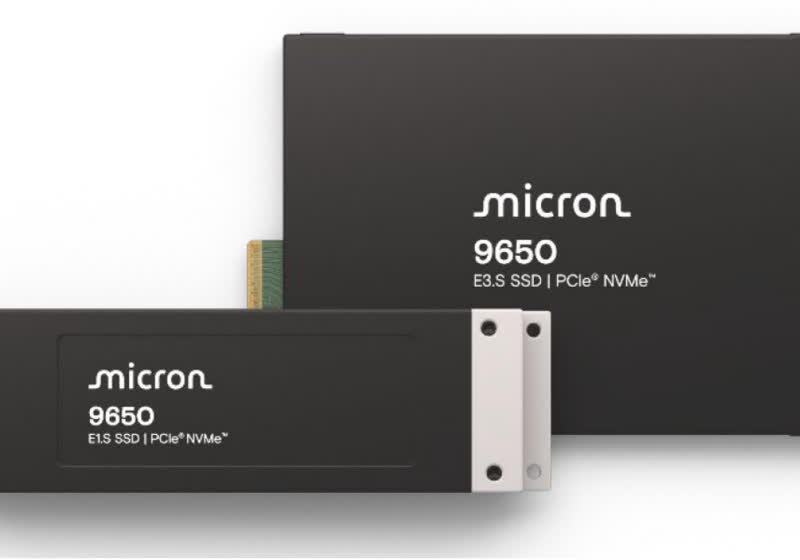
• Core Points: Micron debuts and mass-produces the 9650 NVMe SSD, claiming it is the world’s first PCIe Gen 6 storage product, designed to boost AI workloads in data centers.
• Main Content: The 9650 targets AI and high-performance workloads with higher data rates, leveraging PCIe Gen 6’s speed to deliver improved throughput and lower latency for data-center applications.
• Key Insights: Gen 6 storage promises significant gains for AI training and inference; adoption hinges on ecosystem readiness, power and thermal management, and cost considerations.
• Considerations: Early deployments require compatibility across servers, GPUs, and software stacks; heat dissipation and total cost of ownership are critical.
• Recommended Actions: Enterprises should evaluate workload profiles for potential AI throughput gains, assess cooling and power infrastructure, and plan migration with PCIe Gen 6-enabled servers and software stacks.
Content Overview
Micron has announced that its 9650 NVMe SSD has reached mass production, positioning it as the first PCIe Gen 6 storage product announced by the company and a first in the broader market. The device is framed around accelerating AI workloads—an area where hyperscalers and enterprise data centers are increasing investments. The move underscores a broader industry trend toward PCIe Gen 6 adoption as data-centric workloads demand higher bandwidth and lower latency than Gen 5 can provide.
The 9650 solid-state drive leverages the capabilities of PCIe Gen 6, which doubles the theoretical data rate compared with PCIe Gen 5 in many configurations. This improvement translates into higher sustained throughput and reduced queuing latency, which are critical for machine learning training, large-scale inference, data analytics, and other AI-driven workloads. Micron’s emphasis on AI workloads aligns with market patterns where large cloud providers and enterprises are seeking to optimize data movement between storage, accelerators (such as GPUs and AI accelerators), and compute nodes.
Manufacturers of PCIe Gen 6 SSDs are racing to deliver products that can meet the evolving demands of AI pipelines, including frequent, random access to vast datasets, fast model updates, and rapid checkpointing. The 9650 is positioned as a high-end option within Micron’s lineup, targeting data centers that require premium performance, reliability, and endurance. In addition to raw speed, Gen 6 drives may offer improvements in power efficiency per bit and potential enhancements in I/O operations per second (IOPS) under AI workloads, though real-world gains depend on system integration and workload characteristics.
The broader context includes the ongoing evolution of storage interfaces as AI workloads push beyond the capabilities of older standards. PCIe Gen 6 expands lane bandwidth and enhances protocol efficiency, enabling storage devices to transfer data more quickly to CPUs, GPUs, and specialized accelerators. Adoption hinges not only on drive performance but also on supporting ecosystems, including motherboard and server platform compatibility, firmware, drivers, software libraries, and storage management tools that can exploit Gen 6’s capabilities.
The article’s framing reflects a trend in the data-center market: as AI models grow larger and datasets swell, the demand for faster storage becomes a critical bottleneck. Micron’s mass production announcement signals confidence in a near-term deployment path for Gen 6 storage in AI-centric environments, while emphasizing the importance of total cost of ownership, power and cooling considerations, and system-level optimization to maximize the benefits of higher bandwidth.
In-Depth Analysis
Micron’s announcement that the 9650 NVMe SSD has entered mass production marks a significant milestone for PCIe Gen 6 storage development. As the first purported PCIe Gen 6 storage product in the market, the 9650 is designed to deliver substantially higher data transfer rates than Gen 5 counterparts. This positions Micron to capitalize on a paradigm shift in data-center infrastructure where storage bandwidth becomes a critical enabler for AI workloads, large-scale datasets, and high-performance computing tasks.
Key technical expectations for PCIe Gen 6 include higher raw bandwidth and more efficient data transfer protocols. In practical terms, PCIe Gen 6 is expected to offer doubling of bandwidth for the same number of lanes in many configurations, relative to Gen 5. For AI data centers, this translates into faster model loading, quicker data prefetching, and smoother streaming of training data into compute clusters and accelerators. The 9650 SSD’s architecture would be optimized to sustain high sequential and random throughput, with attention to endurance and write amplification—factors that remain essential for workloads with heavy write activity, such as continual model updates and checkpointing during training.
Mass production implies readiness for deployment at scale. Enterprises planning to adopt Gen 6 storage will need to consider server compatibility, including PCIe slots, lane configurations (such as x8 or x16 approaches), power delivery, and thermal design. Gen 6 devices can demand more power in peak operation, and data centers will need to ensure adequate cooling and power provisioning. Additionally, software ecosystems—drivers, firmware, storage arrays, and orchestration tools—must be able to leverage Gen 6’s bandwidth to realize the anticipated gains. This may entail updates to NVMe drivers, kernel support, and storage management layers that can optimize IO scheduling and queue depth in AI pipelines.
The AI-centric focus of the 9650 is consistent with market dynamics where tech giants and cloud providers are investing heavily in AI infrastructure. In such environments, the speed of data movement between storage and compute accelerators directly affects training times, inference latency, and the ability to scale model complexity. High-bandwidth storage can reduce IO bottlenecks, enabling faster data preprocessing, shuffling, and augmentation, and allowing AI teams to iterate more rapidly. However, to realize the promised performance, the broader system must be engineered to feed data to GPUs, TPUs, or other AI accelerators without stalling, suggesting a need for cohesive optimization across PCIe topology, interconnects, memory subsystems, and software pipelines.
The article notes that the 9650’s AI focus mirrors broader industry patterns. As models become larger and datasets grow, storage performance becomes a critical determinant of overall system throughput. However, realizing the full benefits of Gen 6 requires more than just a faster SSD. System architects must consider how to balance the I/O path, manage heat generation, and maintain reliable endurance over time. The transition from Gen 5 to Gen 6 involves ecosystem readiness, including motherboard/chassis support, firmware updates, and compatibility with AI frameworks and data-processing libraries.
From a performance perspective, the Gen 6 standard offers potential improvements in latency and IO access patterns that matter for AI workloads. For instance, faster random read/write performance can help when randomizing training data or shuttling diverse datasets between storage and compute. Sequential throughput boosts can accelerate large-scale data transfers, such as dataset streaming from storage into distributed training jobs. Real-world workflow benefits depend on how closely the deployment aligns with the SSD’s strengths and how well the software stack takes advantage of increased bandwidth.
Cost is another essential dimension. While Gen 6 drives promise higher performance, they may come with higher price points relative to Gen 5 devices. Data-center operators must perform a total cost of ownership analysis, considering not only purchase price but also energy consumption, cooling requirements, and the expected improvement in productivity and model training speed. Additionally, reliability features such as endurance, wear leveling, and error correction remain critical for long-running AI jobs that can place substantial stress on storage media.

*圖片來源:Unsplash*
The strategic significance of Micron’s announcement lies in signaling to the market that PCIe Gen 6 storage is advancing from development to production. Competitors are likely to respond with their own Gen 6 offerings, accelerating a general shift toward higher-bandwidth storage in AI-focused data centers. This competition could drive innovation, improve price/performance dynamics, and broaden accessibility for organizations at different scales.
Perspectives and Impact
The introduction of the 9650 NVMe SSD as a mass-produced PCIe Gen 6 storage product has broader implications for AI data centers and the storage ecosystem. First, it reinforces the trend of co-design between storage and compute resources to optimize AI pipelines. As AI models demand faster data movement, storage vendors, server manufacturers, and accelerator developers must collaborate to ensure that interfaces, interconnects, and software stacks are aligned. PCIe Gen 6’s enhanced bandwidth can help reduce data transfer bottlenecks, but the gains are maximized only when the entire data path—from storage to CPU/accelerator to memory buffers—is tuned for high-throughput operation.
Second, the Gen 6 transition could influence data-center architecture. Operators may explore changes to PCIe topologies, such as increasing lane allocations to storage or reconfiguring I/O fabrics to minimize latency and maximize concurrency. The ability to saturate Gen 6 devices depends on server support for wider PCIe lanes and efficient I/O scheduling in the operating system and hypervisor layers. Data-center fabric designers may also examine NICs, storage controllers, and interconnects to ensure consistent performance across racks and clusters.
Third, software ecosystems will need continuous updates. AI frameworks, data processing libraries, and orchestration tools must be optimized to exploit Gen 6’s capabilities. This includes efficient asynchronous IO, zero-copy data paths, and advanced caching strategies that work harmoniously with faster storage. The software stack’s maturity will influence how quickly enterprises realize the practical benefits of the new hardware.
Fourth, reliability and endurance considerations come to the fore. AI workloads can be write-intensive due to frequent checkpointing, model updates, and dataset refreshes. Gen 6 SSDs must demonstrate robust endurance, consistent performance over time, and effective thermal management to avoid throttling that could negate theoretical gains. Enterprise buyers often weigh these factors alongside performance metrics to determine deployment feasibility.
Fifth, broader market dynamics could be affected. Early Gen 6 adopters may benefit from competitive pricing as more vendors release Gen 6 products. This could accelerate the migration away from Gen 5 in AI-centric deployments and potentially reshape procurement and budgeting for data-center modernization programs. The initial focus on AI workloads aligns with the industry’s emphasis on responsible, efficient, and scalable AI deployment at scale.
Looking ahead, the Gen 6 storage landscape will likely evolve in tandem with processor and accelerator advancements. As GPUs and AI accelerators become more capable of delivering exaflop-scale performance, data paths must keep pace. This implies a growing role for high-bandwidth storage interfaces, faster NVMe controllers, and more efficient data orchestration. The questions for the market include how quickly enterprises will adopt Gen 6 storage, how much performance uplift is realized in real-world AI workloads, and what the total cost of ownership looks like across diverse deployment scenarios.
In conclusion, Micron’s mass production of the 9650 NVMe SSD positions PCIe Gen 6 storage as a tangible option for data centers focused on AI workloads. While the theoretical gains of Gen 6 are compelling, real-world results will depend on system integration, software optimizations, and effective thermal and power management. The announcement signals a broader industry shift toward higher bandwidth storage to fuel the next wave of AI innovation, with multiple players likely to introduce comparable Gen 6 offerings in the near term.
Key Takeaways
Main Points:
– Micron confirms mass production of the 9650 NVMe SSD, marketed as the world’s first PCIe Gen 6 storage product.
– The drive targets acceleration of AI workloads, reflecting widespread data-center emphasis on AI training and inference.
– PCIe Gen 6’s higher bandwidth promises improvements in throughput and latency, contingent on system-level optimization.
Areas of Concern:
– Real-world performance gains depend on ecosystem readiness (servers, GPUs, software).
– Power, cooling, and endurance requirements for Gen 6 drives could impact TCO.
– Early adoption risks include compatibility and maturity of drivers, firmware, and management tools.
Summary and Recommendations
Micron’s 9650 NVMe SSD represents a pivotal step in bringing PCIe Gen 6 storage into mass production, with a clear emphasis on AI-centric workloads. While the increased bandwidth and potential latency reductions offered by Gen 6 align with data-center needs for faster AI data movement, realizing tangible benefits requires a holistic approach. Organizations should assess their AI workloads to determine where storage I/O is a bottleneck and plan a system upgrade path that includes Gen 6-compatible servers, PCIe lane provisioning, and upgraded software stacks capable of exploiting higher bandwidth and lower latencies. Considerations should include power and thermal management, endurance expectations for heavy write patterns, and a strategic blended approach that balances incremental performance gains with total cost of ownership. As more Gen 6 options enter the market, competition should help drive broader accessibility and further innovation in storage architectures tailored for AI workloads.
References
- Original: https://www.techspot.com/news/111334-micron-world-first-pcie-gen-6-ssd-doubles.html
- Additional references:
- PCIe 6.0 specification overview and expected performance characteristics
- AI data-center storage architecture best practices and bottlenecks
- Industry analyses on PCIe Gen 6 adoption trends and ecosystem readiness

*圖片來源:Unsplash*