TLDR
• Core Points: Ultra-low-noise microwave amplifiers are critical for scalable superconducting quantum computers, addressing dielectric loss–related noise that obscures qubit signals.
• Main Content: Advances in amplifier design reduce energy losses and introduced photon-level noise suppression, improving readout fidelity in superconducting qubit systems.
• Key Insights: Achieving near-quantum-limited noise performance is essential for scaling qubit architectures and enabling reliable multi-qubit operations.
• Considerations: Material quality, fabrication processes, and integration with cryogenic systems remain key engineering challenges.
• Recommended Actions: Support continued research into low-loss dielectrics, improved amplifier architectures, and system-level integration to harness larger quantum processors.
Content Overview
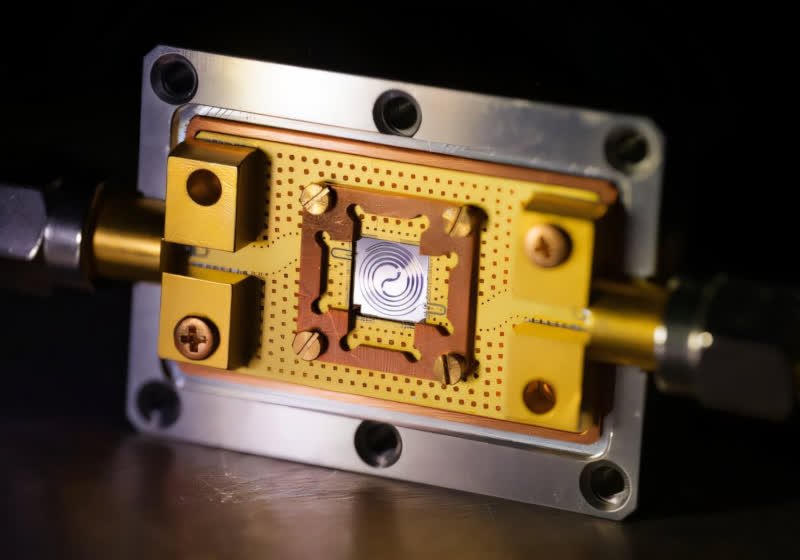
Quantum computers based on superconducting qubits rely on precise measurement of qubit states to perform computations. A central challenge in scaling these systems is the management of measurement noise, especially the kind introduced by the amplifiers that boost the fragile microwave signals representing qubit states. In superconducting quantum architectures, even tiny amounts of added noise can overwhelm a qubit’s delicate quantum information, reducing readout fidelity and limiting the number of qubits that can be reliably controlled and observed.
Traditionally, dielectric losses within amplifier components and surrounding circuitry have been a dominant source of excess noise. These losses contribute more than the equivalent of a single photon’s worth of noise during amplification, a discrepancy that compounds as quantum processors become larger and more complex. To push quantum computers toward practical, large-scale operation, researchers are pursuing microwave amplifiers that operate at or near the quantum limit of noise performance. Achieving such performance requires clever design choices, advanced materials, and careful integration into cryogenic environments where superconducting qubits function.
This article discusses the significance of low-noise microwave amplification, the scientific and engineering strategies being pursued to reduce excess noise, and the potential impact on the scalability and practicality of superconducting quantum computers. It also outlines remaining hurdles and the broader context of quantum hardware development as the field moves toward larger, fault-tolerant systems.
In-Depth Analysis
Microwave amplification is a pivotal stage in the readout chain of superconducting qubits. After a qubit state modulates a microwave signal, the resulting information travels through a series of components, ultimately reaching room-temperature electronics for processing. However, at cryogenic temperatures where qubits operate, the first amplification stage is typically performed by a near-quantum-limited amplifier. The better the noise performance of this initial stage, the higher the overall signal-to-noise ratio of the measurement, and the more reliable the extraction of the qubit state.
Two broad categories have historically dominated discussions of low-noise amplification in quantum systems: parametric amplifiers and Josephson-based amplifiers. Parametric amplifiers exploit nonlinear inductive or capacitive elements to achieve amplification with minimal added noise, but their performance depends sensitively on pump stability and device design. Josephson parametric amplifiers (JPAs) and related devices harness the nonlinearity of Josephson junctions to realize high gain with extremely low noise. These approaches have achieved remarkable noise figures, bringing them close to the quantum limit—the theoretical minimum noise allowed by quantum mechanics for a given signal power.
A critical impediment to scaling has been dielectric loss in the materials surrounding the amplifiers. Dielectrics—insulating materials such as the substrates and insulating layers used in circuit fabrication—can dissipate energy as heat or introduce fluctuating two-level systems that couple to the qubit signal. This dissipative and fluctuating behavior contributes excess noise that can degrade both the amplitude and phase information carried by the microwave signal. In practical terms, this means that even before the signal reaches the amplifier, the qubit’s information is already smeared by loss and noise in the surrounding materials.
Researchers are pursuing multiple avenues to mitigate dielectric-related noise. One line of work focuses on materials science: developing and integrating substrates and dielectric layers with ultra-low loss tangents and minimal defect densities. Silicon, sapphire, and other crystalline substrates have shown promise when pairwise material processing minimizes interfaces where loss mechanisms proliferate. Another approach emphasizes device design optimizations that reduce sensitivity to dielectric fluctuations. For example, engineers can tailor resonator geometries and coupling schemes to minimize participation of lossy dielectric regions, thereby reducing the effective noise contribution from these materials.
In addition to material and design improvements, there is ongoing work to refine the architectures of microwave amplifiers themselves. Different amplifier paradigms offer trade-offs between gain, bandwidth, dynamic range, and noise performance. Josephson-junction–based devices, such as JPAs and flux-driven variants, provide excellent noise figures but can be constrained by bandwidth and stability under certain operating conditions. More recently, alternative implementations, including kinetic inductance parametric amplifiers and nondegenerate parametric amplifiers, are being explored to deliver broader bandwidths and improved compatibility with large-scale superconducting processor architectures.
A broader system-level consideration is the integration of these amplifiers with the qubit array and the surrounding cryogenic infrastructure. The cryogenic stage introduces its own set of constraints, including thermal load management, magnetic shielding, and vibration isolation. Amplifier performance is not solely a function of intrinsic device noise; it also depends on how robustly the device can be cooled, shielded from environmental perturbations, and interfaced with software control loops that stabilize pump signals and compensate for drift.
Practical demonstrations have begun to show the benefits of reduced noise in quantum computing experiments. By pushing amplifier noise closer to the quantum limit, researchers have observed improvements in single-shot readout fidelity, enabling more reliable discrimination between qubit states. Higher fidelity readout is especially valuable when dealing with multi-qubit systems where joint measurements and rapid feedback are required for error-correcting protocols and real-time quantum error mitigation.
Yet, progress toward scalable, error-corrected quantum computation does not hinge on a single breakthrough in amplifier technology alone. It requires a confluence of advances across multiple domains: materials science to reduce loss, device engineering to optimize amplifier performance and integration, cryogenics to maintain ultra-low temperatures and stable operation, and system-level software and control strategies to manage calibration and compensation for residual drift.
Another dimension of the discussion concerns manufacturability and reliability. While laboratory demonstrations may achieve exceptional noise performance in carefully controlled conditions, translating these gains to high-volume production demands reproducible fabrication processes, robust packaging, and consistent performance across many devices. The variance in material properties, interface quality, and junction parameters can hamper scalability if not systematically addressed. Consequently, industry-grade production lines for superconducting quantum hardware must incorporate stringent testing and quality assurance to ensure that low-noise amplifier performance remains stable across thousands of devices and over years of operation.
Looking forward, the trajectory for low-noise microwave amplifiers aligns with the broader vision of scalable quantum computing. As processors grow to include hundreds or thousands of qubits, the demand for highly reliable, low-noise readout channels becomes even more pressing. In parallel, the development of error-correcting codes and fault-tolerant architectures relies on precise, high-fidelity measurements to detect and correct errors efficiently. If amplifier noise remains a bottleneck, the benefits of adding more qubits may be offset by diminishing readout quality and slower feedback control loops. Therefore, continued investment in low-noise amplification is a practical and necessary component of building scalable quantum systems.
Beyond immediate technical impacts, these advances also influence the design philosophy of quantum information processors. They encourage a measurement-centric view of quantum hardware where readout channels are engineered with the same rigor as qubits themselves. This perspective fosters an ecosystem in which materials, devices, and control strategies are co-optimized to achieve a harmonious balance between quantum coherence, measurement fidelity, and system scalability.

*圖片來源:Unsplash*
Perspectives and Impact
The pursuit of ultra-low-noise microwave amplification reflects a broader trend in quantum technology: every subsystem that touches quantum information—from qubit materials to control electronics and readout chains—must operate with minimal disturbance to preserve coherence and enable reliable computation. In superconducting qubit platforms, the measurement chain is particularly delicate. The information encoded in quantum states is fragile, and any extraneous energy or fluctuations introduced during readout act like a fog that obscures the true state of the qubits. By reducing noise at the amplifier stage, researchers are directly addressing one of the most tangible bottlenecks to scaling quantum processors.
From a practical standpoint, the improvements in low-noise amplification have immediate implications for performance metrics used by experimental teams. Readout fidelity, measurement-induced dephasing, and the speed of state discrimination all benefit from quieter amplifiers. Higher fidelity measurements permit more efficient use of quantum error correction codes, as syndrome measurements become more reliable and require fewer repeat measurements to achieve the same error-detection confidence. This translates into lower overhead for maintaining logical qubits and, potentially, smaller resource requirements for future fault-tolerant processors.
These developments also intersect with the challenges of integrating quantum systems into more complex architectures. Large-scale quantum processors are not simply a collection of qubits; they are intricate systems with many interconnected subsystems that must operate synchronously. The cryogenic environment, quantum control hardware, and classical data acquisition layers must work in concert. Achieving a harmony among these elements requires attention to both component-level performance and end-to-end system behavior. In this context, low-noise microwave amplifiers are a critical piece of the puzzle, but their impact is amplified when designed as part of a thoughtfully engineered measurement and feedback ecosystem.
The broader implications for quantum hardware ecosystems are significant. As performance improves, researchers can tackle more ambitious computational tasks and more stringent error correction schemes. Additionally, the same technologies that enable low-noise amplification can influence other quantum technologies that rely on precise microwave control and readout, such as quantum communication links and superconducting-based sensing platforms. The cross-pollination across domains helps accelerate the maturation of the entire quantum technology stack, from fundamental physics to practical applications.
However, questions remain about long-term reliability and manufacturability. Achieving near-quantum-limited noise performance in a laboratory setting is a remarkable feat, but translating that performance to mass production and long-term operation requires robust fabrication protocols, stable materials with low defect densities, and resilient packaging capable of withstanding repeated thermal cycling. These practical considerations will shape the pace at which low-noise amplifiers contribute to truly scalable quantum computers. Addressing these concerns will involve collaborations among physicists, materials scientists, electrical engineers, and manufacturing specialists to ensure that advances in laboratory performance translate into reliable, scalable hardware.
In the longer term, the evolution of low-noise microwave amplifiers may spur new architectural choices in quantum processors. For instance, with higher readout fidelity and faster discrimination between qubit states, systems could adopt denser qubit layouts or rely more heavily on real-time feedback for error mitigation. These capabilities would support more aggressive computational schemes and could reduce the overhead associated with fault tolerance. Conversely, if challenges in integration persist, researchers may pursue alternative readout strategies or different quantum computing modalities. The field’s trajectory will depend on how quickly researchers can reconcile the competing demands of ultra-low noise, broad bandwidth, stability, and scalable production.
Overall, the push toward low-noise microwave amplification is an essential component of the broader push to render quantum computing practical at scale. It embodies the iterative, multidisciplinary nature of progress in quantum technologies, where advances in materials, devices, cryogenics, and control systems collectively propel the field forward. As researchers continue to refine amplifier designs, reduce dielectric losses, and optimize integration with qubit arrays, the path toward large-scale, fault-tolerant quantum processors becomes clearer, even as new challenges emerge and demand continued innovation.
Key Takeaways
Main Points:
– Ultra-low-noise microwave amplifiers are essential for high-fidelity readout in superconducting qubit architectures.
– Dielectric losses and related noise in amplifier materials significantly limit measurement quality; reducing these losses is a primary research focus.
– Advances in amplifier design, materials science, and system integration collectively move quantum processors closer to scalable, fault-tolerant operation.
Areas of Concern:
– Achieving consistent, manufacturable low-noise performance across large device populations.
– Long-term reliability under repeated thermal cycling and cryogenic operation.
– System-level integration challenges, including routing, shielding, and control loop stability in multi-qubit systems.
Summary and Recommendations
Reducing noise in the microwave readout chain is a central, practical challenge in scaling superconducting quantum computers. The dominant source of excess noise often traces back to dielectric losses in materials surrounding the amplifier stages. By focusing on ultra-low-loss dielectrics, optimized device geometries, and robust amplifier architectures that operate near the quantum limit, researchers aim to improve readout fidelity, enable faster and more reliable qubit state discrimination, and support more ambitious quantum algorithms and error-correcting schemes.
To translate laboratory gains into scalable technology, a coordinated strategy is needed. This includes advancing materials science to produce ultra-low-loss substrates and interfaces, refining fabrication processes to ensure reproducible device performance, and integrating amplifiers effectively within cryogenic systems without adding prohibitive thermal or magnetic burdens. Parallel efforts in system design—enhancing calibration, drift compensation, and real-time feedback—will help capitalize on the gains in amplifier performance.
The envisioned outcome is a quantum computing stack in which each subsystem—qubits, interconnects, readout amplifiers, and classical controllers—operates in concert with minimized noise and maximal stability. Such a stack would unlock higher qubit counts, more reliable error correction, and, ultimately, scalable quantum processors capable of tackling practical computational problems. While challenges persist, the trajectory of low-noise microwave amplifier research points toward meaningful improvements in measurement fidelity and scalable quantum hardware, supporting the broader goal of realizing fault-tolerant quantum computation.
References
- Original: https://www.techspot.com/news/111402-low-noise-microwave-amplifiers-bring-quantum-computers-closer.html
- Additional references (to be added by user or through further research):
- Reviews on superconducting qubits and readout technologies
- Technical papers on Josephson parametric amplifiers and kinetic inductance amplifiers
- Publications addressing dielectric loss in superconducting circuits and materials science of low-loss substrates

*圖片來源:Unsplash*