TLDR
• Core Points: Traditional C++ relied on value creation by construction or copying; move semantics reduce costly copies in modern C++14/17+ practices, with implications for Unreal Engine.
• Main Content: The article traces the evolution from copy constructors/assignments in C++98 to move constructors/assignments in C++11+, outlining the performance motivations and practical considerations for game engines like Unreal.
• Key Insights: Move semantics enable efficient transfer of resources, reducing CPU overhead and improving frame rates in resource-intensive environments.
• Considerations: Correct implementation requires careful handling of resource ownership and object lifetime; misuse can lead to bugs or undefined behavior.
• Recommended Actions: Adopt move semantics in performance-critical Unreal code, ensure safe resource management, and profile changes to validate gains.
Content Overview
This article discusses the transition from traditional copy-based object management in C++98 to move semantics introduced in C++11 and later. In classic C++, objects could be created in two primary ways: from scratch using constructors and by copying existing objects. Copying, while straightforward, can be computationally expensive, especially for complex objects that manage dynamic resources such as memory buffers, textures, or handles.
The original approach in C++98 involved:
– Default construction: Foo(); constructs a new, default object.
– Parameterized construction: Foo(int x); builds an object with specific initial state.
– Copy construction: Foo(const Foo& rhs); creates a new object as a copy of an existing one.
– Copy assignment: Foo& operator=(const Foo& rhs); assigns the state from one object to another existing one.
Copy operations can incur significant overhead because they may duplicate large resources, leading to memory allocations, deallocations, and potential performance bottlenecks. This is particularly pronounced in game development, where Unreal Engine developers handle numerous resources per frame.
To address these inefficiencies, C++11 introduced move semantics. Moves provide a way to transfer ownership of resources from one object to another without performing a deep copy. The key move-enabled signatures are:
– Move constructor: Foo(Foo&& rhs); constructs a new object by taking ownership of resources from an rvalue reference, leaving the source in a valid but unspecified state.
– Move assignment: Foo& operator=(Foo&& rhs); transfers ownership of resources from the source to the destination, again leaving the source in a valid but unspecified state.
By leveraging move semantics, Unreal Engine and similar performance-sensitive environments can minimize costly resource duplications, reduce memory churn, and improve runtime efficiency. The transition, however, requires careful design to ensure resource ownership semantics are clear, avoid double frees, and maintain object validity throughout moves.
In practice, the adoption of move semantics involves:
– Identifying resources that are expensive to copy and pivoting to move operations where appropriate.
– Ensuring classes explicitly declare move constructors and move assignment operators when the default behavior is insufficient.
– Providing proper copy constructors and copy assignment operators to support both copying and moving, or explicitly deleting operations that should not be copied or moved.
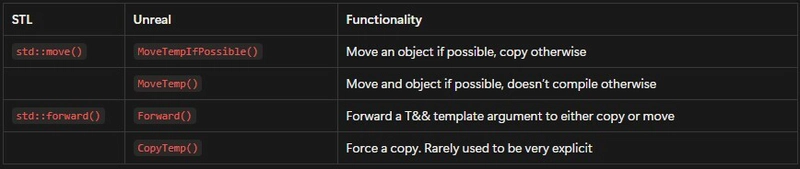
– Using modern C++ utilities (such as std::move and std::forward) to enable efficient transfer of resources.
– Applying move-aware patterns in Unreal Engine components, assets, and systems to reduce overhead during resource management, serialization, and gameplay loop iterations.
In summary, move semantics represent a critical optimization strategy for Unreal Engine’s performance goals. They enable efficient resource management by shifting the cost from copying to moving, which is typically cheaper and more predictable.
In-Depth Analysis
Move semantics emerged as a response to the cost of copying complex objects in C++. Before C++11, developers relied heavily on copy constructors and copy assignment operators to manage object lifetimes and resource ownership. For example, consider an object that manages a large buffer or a graphics resource; copying such an object would duplicate the entire resource, leading to significant processing time and potential memory fragmentation.
The C++11 standard introduced rvalue references and move semantics to address these inefficiencies. An rvalue (temporary) object can transfer its resources to a new owner without duplicating data. The move constructor and move assignment operator enable this transfer, typically by moving internal pointers and nulling or resetting the source’s pointers to a safe state. This pattern avoids expensive deep copies and reduces the overhead associated with object reallocation and resource duplication.
Unreal Engine developers face similar challenges. Asset loading, texture handling, streaming, and dynamic resource management are all areas where copying can be costly. By applying move semantics, Unreal can:
- Minimize allocations during asset loading and gameplay state transitions.
- Enable efficient transfer of large payloads, such as mesh data or compressed textures, between systems without duplicating memory.
- Improve responsiveness in gameplay loops where many temporary objects are created and discarded.
Implementing move semantics in a large codebase involves several best practices:
Identify movable resources: Resources that own dynamic memory, GPU handles, or other system resources are prime candidates for move operations. For these types, moving is often substantially cheaper than copying.
Provide explicit move operations: If a class manages a resource, implement a move constructor and a move assignment operator. These should transfer ownership and leave the source in a safe, destructible state. For example, after moving, the source’s resource pointers should be set to null or reset to a benign state.

*圖片來源:Unsplash*
Preserve safe copying behavior where needed: Not all classes should be copyable. In some cases, copying may be expensive or semantically incorrect. It is reasonable to delete copy constructors/assignments or to implement them with proper semantics when copying is necessary.
Use modern C++ techniques: Leverage std::move to cast objects to an rvalue when you want to enable moving, and use std::forward in templates to preserve value categories. Consider implementing move semantics in tandem with the Rule of Five (destructor, copy constructor, copy assignment, move constructor, move assignment) to ensure resource safety.
Profile and test: Before and after integrating move semantics, measure performance changes. Look for reductions in allocation/deallocation, improvements in frame times, and any new risks such as dangling references or unintended resource sharing.
Integrate with Unreal Engine conventions: Unreal uses its own memory management patterns and reflection system. When introducing moves, ensure compatibility with the engine’s garbage collection, serialization, and networking behavior. Moves should not contradict Unreal’s object lifetimes or cause subtle bugs in asset streaming.
The shift toward move semantics is not merely a syntactic improvement; it represents a fundamental change in how resources are managed and transferred. For Unreal Engine, correctly applying moves means more responsive gameplay, smoother asset handling, and better overall performance, especially on platforms with limited resources or tight real-time constraints.
Perspectives and Impact
Move semantics have broad implications for performance-oriented software, including game engines like Unreal. As hardware continues to evolve, the ability to minimize unnecessary copies becomes increasingly valuable. The potential benefits include:
- Reduced CPU overhead: Moving resources is typically cheaper than copying, freeing up cycles for gameplay logic, AI, physics, and rendering.
- Lower memory pressure: By avoiding duplicate resources, memory usage remains more predictable, helping with caching and texture streaming strategies.
- Improved throughput: Reduced allocations and deallocations lower fragmentation and GC or garbage-collected-like costs in environments with custom memory systems.
For Unreal Engine, embracing move semantics also requires careful orchestration with engine-specific subsystems. Serialization, asset import pipelines, and cross-module transfers must be compatible with move operations. Some considerations include:
- Asset serialization: When moving asset data, ensure the serialized representation remains consistent and that moved-from objects do not leave the engine in an inconsistent state.
- Garbage collection: Unreal’s garbage-collected ecosystem must accommodate moved objects without inadvertently creating leaks or stale references.
- Networking: Copying and moving data across network boundaries should preserve semantics and avoid partial or corrupted data transfers.
Future implications include more aggressive use of move semantics in core systems, such as rendering pipelines, streaming subsystems, and procedural generation workflows. As C++ standards continue to evolve, with ongoing refinements to move semantics and related language features, Unreal Engine developers will have more tools to optimize resource management in increasingly complex game worlds.
Key Takeaways
Main Points:
– Copying objects can be expensive in traditional C++ due to resource duplication.
– Move semantics provide a more efficient mechanism to transfer ownership of resources.
– Unreal Engine developers can leverage move constructors and move assignment operators to reduce overhead in resource-heavy paths.
Areas of Concern:
– Correctly implementing move operations to avoid ownership issues and undefined behavior.
– Maintaining compatibility with Unreal’s own memory management, serialization, and GC systems.
– Ensuring that moved-from objects remain in a valid, safe state.
Summary and Recommendations
To maximize performance within Unreal Engine, developers should adopt move semantics where appropriate. Identify resources that incur high copy costs and implement move constructors and move assignment operators to enable efficient transfers. Maintain clear ownership semantics and ensure that moved-from objects are left in a valid state. Complement this with thorough testing and profiling to quantify performance gains and guard against subtle bugs. By integrating move semantics thoughtfully, Unreal Engine codebases can achieve better resource utilization, smoother gameplay experiences, and improved scalability across platforms.
References
- Original: https://dev.to/roasted-kaju/move-semantics-in-unreal-engine-40hg
- Additional references:
- https://en.cppreference.com/w/cpp/language/move
- https://www.unrealengine.com/en-US/blog/optimizing-performance-with-move-semantics
- https://isocpp.org/wiki/faq/move-semantics
Forbidden:
– No thinking process or “Thinking…” markers
– Article starts with “## TLDR”

*圖片來源:Unsplash*