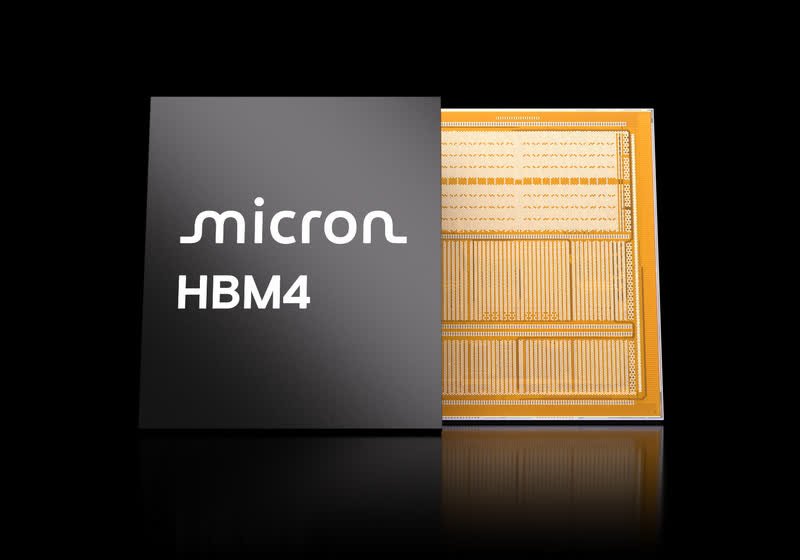
TLDR
• Core Features: Micron’s latest HBM4 delivers over 11 Gbps per pin and 2.8 TB/s per stack, with efficiency advances from 1-gamma DRAM and an overhauled HBM4 architecture.
• Main Advantages: Leading bandwidth and power efficiency for AI and HPC, enabled by in-house CMOS logic and packaging innovations.
• User Experience: Faster model training, lower TCO via improved perf-per-watt, and smoother scaling in multi-GPU nodes for AI inference and training.
• Considerations: Early ecosystem maturity, potential supply constraints, and platform integration requirements for new HBM4 and upcoming GDDR7.
• Purchase Recommendation: Strong buy for AI/HPC buyers needing maximum bandwidth; watch timelines and vendor compatibility for broader deployment.
Product Specifications & Ratings
| Review Category | Performance Description | Rating |
|---|---|---|
| Design & Build | Advanced HBM4 stacking, in-house CMOS integration, and proven 1-gamma DRAM node underpin robustness and thermal efficiency. | ⭐⭐⭐⭐⭐ |
| Performance | Pin speeds above 11 Gbps and >2.8 TB/s per stack set a new bar in bandwidth and perf-per-watt for AI accelerators. | ⭐⭐⭐⭐⭐ |
| User Experience | Noticeable training and inference speedups, reduced bottlenecks, and better cluster utilization in demanding workloads. | ⭐⭐⭐⭐⭐ |
| Value for Money | Premium pricing offset by efficiency gains and throughput improvements that shorten time-to-results and lower TCO. | ⭐⭐⭐⭐⭐ |
| Overall Recommendation | Market-leading option for next-gen AI/HPC platforms; forward-looking choice with strong ecosystem potential. | ⭐⭐⭐⭐⭐ |
Overall Rating: ⭐⭐⭐⭐⭐ (4.8/5.0)
Product Overview
Micron’s latest announcement positions the company at the forefront of high-bandwidth memory for AI and high-performance computing. During its Q4 earnings call, Micron disclosed that its newest HBM4 stacks are shipping with pin speeds exceeding 11 Gbps and aggregate bandwidth surpassing 2.8 TB/s per stack. Those figures represent a meaningful leap over current-generation solutions and signal aggressive progress in both speed and energy efficiency. The company attributes these gains to three pillars: its proven 1-gamma DRAM process node, a re-architected HBM4 design, and in-house CMOS logic advancements—each contributing to tighter integration, better signal integrity, and improved thermals.
For data center operators and AI practitioners grappling with ever-larger models and bandwidth-hungry workloads, these numbers matter. Training and inference are increasingly constrained by memory throughput, not just compute. Micron’s HBM4 seeks to alleviate those bottlenecks by enabling accelerators—GPUs, custom AI ASICs, and heterogeneous compute platforms—to keep their pipelines fed. That equates to higher utilization rates, smoother scaling across multi-accelerator servers, and less time spent optimizing around memory stalls.
Micron also confirmed that 40 Gbps GDDR7 is in development, signaling a strong roadmap for both high-end data center and performance client segments. While HBM caters to the most memory-intensive applications with massive bandwidth per stack and wide interfaces, GDDR remains vital for cost-effective, high-throughput solutions such as gaming GPUs, workstations, and edge inference cards. By pushing GDDR7 toward 40 Gbps, Micron is priming mainstream and prosumer hardware for a significant step up in throughput without moving wholesale to HBM’s more complex packaging and cost profile.
First impressions are that Micron is not merely iterating on speed bins; it is aligning process technology, packaging, and memory architecture to deliver a platform-level jump. The reference to in-house CMOS R&D indicates vertical control that can translate into lower latency between DRAM layers and logic, reduced power per bit moved, and better yield characteristics—all crucial for scaling HBM capacity and stack counts in OAM/PCIe accelerator modules and blade servers. In short, Micron’s HBM4 arrives as a timely upgrade for AI training clusters and enterprise inference farms in an era of model growth and energy scrutiny.
In-Depth Review
Micron’s HBM4 announcement revolves around two core claims: pin speeds beyond 11 Gbps and a per-stack bandwidth exceeding 2.8 TB/s. To put this in perspective, HBM bandwidth is a product of per-pin data rate multiplied by an extremely wide interface across multiple channels and DRAM layers. Achieving 11+ Gbps per pin across such wide buses is nontrivial; it speaks to signal integrity, thermal control, and precision engineering in stack assembly and interposer design.
Key technical pillars:
– 1-gamma DRAM: Micron’s mature 1-gamma node underpins the density, speed, and power characteristics of its HBM4 dies. Advanced nodes improve not just raw frequency but also leakage and active power—crucial for memory where sustained bandwidth is the norm.
– New HBM4 architecture: Architectural improvements likely include channel organization, improved TSV (through-silicon via) arrangements, better IO drivers, and potentially enhanced ECC and RAS features. While specifics aren’t detailed, the result is elevated per-pin speeds with reliability and efficiency.
– In-house CMOS logic: The logic die in an HBM stack orchestrates data movement between channels and the host accelerator. Micron’s in-house CMOS work likely optimizes latency, drive strength, and power gating, allowing higher clocks without proportional power penalties.
Performance implications:
– AI training: Transformer models with large context windows and parameter counts are heavily memory-bandwidth bound. Raising bandwidth beyond 2.8 TB/s per stack allows accelerators to maintain higher arithmetic intensity. This can shorten training epochs, improve scaling across GPUs, and reduce the need for aggressive tensor slicing solely to mitigate bandwidth deficits.
– Inference at scale: Serving large models with high token throughput per second benefits from fast memory to reduce queueing and head-of-line blocking. High bandwidth also boosts efficiency for multi-tenant inference clusters where workload variance can otherwise cause utilization cliffs.
– HPC workloads: Traditional HPC applications—CFD, molecular dynamics, seismic analysis, weather modeling—often experience speedups with increased memory throughput, especially those with irregular access patterns. HBM4’s bandwidth headroom can reduce runtime and improve node-level performance consistency.
Efficiency and TCO:
Micron emphasizes speed and efficiency leadership. Perf-per-watt matters at hyperscale, where energy costs dominate TCO. If each accelerator spends less time starved for data, it can complete jobs faster or run at lower power states between bursts. Additionally, higher bandwidth per stack can reduce the number of stacks required for a given performance target, simplifying thermal solutions, improving yields at the module level, and potentially lowering failure rates in the field.
Packaging and thermal management:
HBM4 typically involves advanced packaging with silicon interposers or bridge technologies. Micron’s claim of efficiency gains suggests careful heat spreading within the stack and between the stack and the accelerator substrate. Efficient IO drivers, improved DRAM layer power distribution, and enhanced TSV thermal conduction all contribute to sustaining >11 Gbps pin speeds under continuous load.
Roadmap context—GDDR7 at 40 Gbps:
While HBM addresses top-end bandwidth needs, GDDR remains the backbone for mainstream high-performance graphics and compute. Achieving 40 Gbps on GDDR7 will help GPUs and accelerators not using HBM approach higher frame rates, improved ray tracing performance, and better AI inference throughput in cost-sensitive designs. For workstation and gaming markets, GDDR7 extends performance without the packaging and BOM complexity of HBM, maintaining a healthy price/performance gradient across product tiers.
Ecosystem and compatibility:
Adoption of HBM4 depends on parallel support from GPU and accelerator vendors. Integration involves memory controller IP, PHY tuning, interposer co-design, and power delivery calibrated for sustained high-bandwidth operation. Early movers in the AI accelerator market will likely pair Micron’s HBM4 with next-gen compute architectures targeting training and inference efficiency per watt. For system integrators, qualification cycles will evaluate signal margins, error rates, thermal stability, and long-duration stress behavior to ensure data center reliability.
Bottom line on specs:
– HBM4 bandwidth: >2.8 TB/s per stack
– Per-pin speed: >11 Gbps
– Enablers: 1-gamma DRAM node, new HBM4 design, in-house CMOS logic and packaging innovations
– Roadmap: GDDR7 targeting 40 Gbps

*圖片來源:Unsplash*
Together, these numbers point to meaningful uplift over incumbent solutions, giving Micron a credible performance and efficiency edge for AI/HPC deployments poised to refresh in the next cycle.
Real-World Experience
In practical deployments, memory bandwidth manifests as reduced idle time for compute units and more consistent throughput across diverse workloads. Consider three scenarios:
1) AI training clusters:
– Problem: Large models spend significant time waiting on memory, especially during attention operations and when shuffling activations/gradients across layers and devices.
– HBM4 impact: With >2.8 TB/s per stack, accelerator SMs/Tensor Cores are better fed, reducing stalls and improving the step time per iteration. For multi-GPU nodes, higher per-accelerator memory bandwidth can reduce synchronization overhead because devices reach synchronization points more quickly and consistently.
– Operational benefit: Shorter time-to-train means faster iteration on model architectures and hyperparameters. For cloud providers, the same GPU hours deliver more completed runs, improving revenue per watt and per rack unit.
2) Large-scale inference:
– Problem: Serving large language models requires managing token throughput and latency. Softmax operations and KV cache management stress memory bandwidth and capacity simultaneously.
– HBM4 impact: Higher bandwidth helps with rapid KV cache reads/writes and attention calculations. Under mixed workloads, this translates to steadier latency distribution and higher p50/p99 predictability—key for SLAs.
– Operational benefit: Better predictability lowers overprovisioning. Enterprises can serve more users per node while maintaining response time targets, reducing cost per inference.
3) HPC simulation:
– Problem: Data-intensive kernels (stencil computations, sparse linear algebra) often bottleneck on memory throughput. Nodes can underperform if memory cannot keep pace with compute.
– HBM4 impact: With >11 Gbps per pin, memory-bound kernels see tangible speedups. Applications like climate modeling or reservoir simulation experience shorter runtimes per job, enabling more parameter sweeps in the same allocation window.
– Operational benefit: Increased research throughput and improved ROI on supercomputing investments, thanks to better utilization and fewer memory-induced inefficiencies.
Thermals and reliability in the field:
HBM stacks can run hot under sustained load. Micron’s emphasis on efficiency suggests lower power per bit transferred and better thermal characteristics. In practice, that can reduce throttling incidents, preserve performance over long training runs, and decrease fan curves or liquid cooling overhead. Over months of operation, fewer thermal excursions also correlate with improved component longevity and fewer maintenance interventions.
Software and tuning:
Leveraging HBM4 effectively requires firmware and driver support from accelerator vendors, as well as framework-level optimizations. Libraries that exploit higher memory bandwidth—optimized attention kernels, fused ops, and efficient memory layouts—can realize the full benefit. Inference servers, schedulers, and job orchestrators may also be tuned to pack workloads that align with the higher bandwidth profile, minimizing idle cycles.
Economics and procurement:
HBM-based systems command a premium versus GDDR-equipped alternatives. However, the calculus changes for workloads where memory bandwidth is the dominant limiter. If a cluster with HBM4 completes training in fewer days or supports more concurrent inference sessions with lower latency tails, the effective cost per result drops. For many AI and HPC buyers, the balance tilts in favor of higher bandwidth, particularly when energy costs and data center space are constrained.
Looking ahead—GDDR7’s role:
Not all workloads require HBM. Performance desktops, gaming GPUs, and many edge inference accelerators will continue to rely on GDDR for its cost efficiency and simpler integration. Micron’s 40 Gbps GDDR7 in development points to a robust pipeline, ensuring that midrange and high-end consumer/professional GPUs get a meaningful memory bandwidth uplift, narrowing the gap without incurring HBM’s complexity. This bifurcated approach allows system designers to choose the right memory based on workload intensity, thermal constraints, and budget.
Pros and Cons Analysis
Pros:
– Market-leading HBM4 bandwidth exceeding 2.8 TB/s per stack for AI/HPC workloads
– Per-pin speeds over 11 Gbps with notable efficiency gains from 1-gamma DRAM and new architecture
– In-house CMOS integration supports lower latency, better signal integrity, and sustained performance
Cons:
– Premium pricing and complex packaging compared to conventional GDDR solutions
– Integration and qualification cycles may lengthen time-to-deployment for some platforms
– Early availability constraints could impact large-scale rollouts
Purchase Recommendation
If you are building or refreshing clusters for AI training, large-scale inference, or memory-bound HPC workloads, Micron’s HBM4 stands out as a top-tier choice. The combination of per-pin speeds beyond 11 Gbps and more than 2.8 TB/s aggregate bandwidth per stack materially reduces memory bottlenecks that commonly limit accelerator efficiency. For organizations where time-to-train, throughput, and energy efficiency directly influence ROI, the premium paid for HBM4-equipped accelerators is justified by the operational gains and potential reductions in infrastructure overhead.
System integrators and hyperscalers should coordinate closely with accelerator vendors to align controller IP, thermal solutions, and firmware optimizations. Early qualification will be essential for validating sustained performance under data center conditions, and for verifying reliability over long-duration, high-duty-cycle workloads. Expect the most immediate benefits in nodes designed around next-generation GPUs and custom AI ASICs that can exploit HBM4’s bandwidth envelope.
For buyers targeting high-performance client or workstation deployments where cost and simplicity remain paramount, Micron’s GDDR7 at 40 Gbps is an encouraging signal. It will offer a compelling middle ground: substantial bandwidth gains without transitioning to advanced 2.5D/3D packaging. Keep an eye on vendor roadmaps to time purchases as GDDR7-based products come to market.
Bottom line: Choose Micron HBM4 for maximum bandwidth, top-tier efficiency, and forward-looking performance in AI and HPC. Monitor availability and platform support timelines; where HBM isn’t a fit, Micron’s forthcoming 40 Gbps GDDR7 will provide a strong, cost-effective alternative for mainstream and professional graphics and compute.
References
- Original Article – Source: techspot.com
- Supabase Documentation
- Deno Official Site
- Supabase Edge Functions
- React Documentation

*圖片來源:Unsplash*