TLDR
• Core Points: The JVM translates Java bytecode into machine code, loads and executes .class files, and operates as a software-based virtual computer.
• Main Content: It acts as a runtime environment that abstracts underlying hardware, enabling Java portability and managed execution with features like memory management and bytecode verification.
• Key Insights: JVM design balances portability, performance, and safety through components such as the classloader, runtime data areas, and just-in-time compilation.
• Considerations: Implementation details vary across vendors, affecting performance characteristics and memory usage.
• Recommended Actions: For Java developers, understand JVM settings (memory, GC, JIT) and profiling to optimize applications across platforms.
Content Overview
The Java Virtual Machine (JVM) is a software environment that enables Java programs to run on any device or operating system that provides a compatible JVM. At its core, the JVM reads Java bytecode—the platform-independent instructions produced from compiling Java source code (.java files)—and translates them into machine code that the host operating system can execute. This translation allows Java programs to achieve portability: the same bytecode can run on Windows, macOS, Linux, or other systems without modification, provided a suitable JVM is present.
The concept of a virtual machine is fundamental to JVM design. Although a JVM is not a physical hardware device, it emulates a computer-like environment within software. It provides the essential services a real computer would offer: loading programs, managing memory, executing instructions, and enforcing security and correctness. By doing so, the JVM serves as an abstraction layer that decouples Java applications from the underlying hardware and operating system.
In-Depth Analysis
The JVM is more than a simple translator of bytecode; it is a complete runtime environment that coordinates multiple interacting components to ensure reliable, efficient, and portable execution of Java programs.
Class Loading and Linking
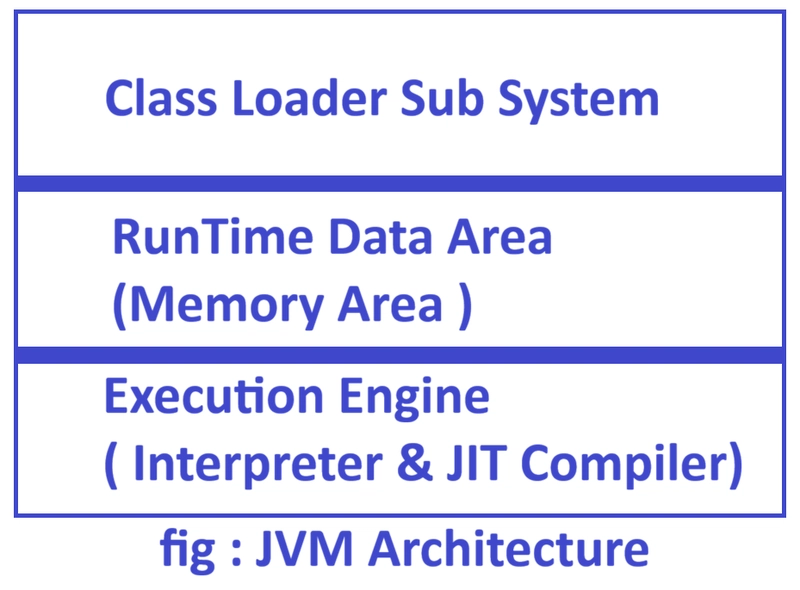
– The classloader subsystem is responsible for locating, loading, and linking class files (.class) into the JVM. It performs tasks such as:
– Finding classes from the classpath or module path.
– Verifying bytecode to ensure it adheres to the Java Virtual Machine Specification and does not violate safety rules.
– Resolving symbolic references to other classes, interfaces, fields, and methods.
– This process ensures that classes are available to the JVM in a safe and consistent state before they are executed.Runtime Data Areas
– The JVM defines several memory regions, collectively referred to as runtime data areas, to support program execution. Key areas include:
– Heap: Shared memory space where objects are allocated and garbage collected. The heap is central to Java’s memory management strategy and is typically managed by a sophisticated garbage collector.
– Stack: Each thread has its own call stack, which stores frames. A frame contains local variables, operand stacks, and return addresses for method invocations.
– Method Area (MetaSpace in modern JVMs): Stores class metadata, including information about methods, fields, and constant pools. In recent implementations, this area is often referred to as MetaSpace and resides outside the traditional Permanent Generation (PermGen) to adapt dynamically to class loading.
– Native Method Stack: Stores information about native (non-Java) methods invoked by the JVM.
– PC (Program Counter) Register: Holds the address of the currently executing instruction in a thread; each thread has its own PC.
– Efficient management of these areas is crucial for performance and scalability of Java applications.Execution Engine
– The execution engine translates and executes bytecode instructions. It comprises:
– Interpreter: A straightforward, but slower, path that reads bytecode instructions and executes them one by one. Interpreting bytecode is useful for startup speed and for less frequently executed code paths.
– Just-In-Time (JIT) Compiler: Translates frequently executed bytecode sections into highly optimized native machine code at runtime. JIT compilation significantly improves performance by avoiding repeated interpretation.
– Runtime Support: The engine provides runtime services such as method invocation, exception handling, and synchronization primitives.Bytecode Verification and Security
– The JVM enforces strict verification of bytecode to ensure type safety and memory safety. This verification process helps detect illegal operations, stack overflows, and other anomalies before code is executed, preventing many classes of runtime errors and security breaches.Garbage Collection
– Automatic memory management in the JVM reduces the burden on developers by reclaiming memory occupied by objects that are no longer reachable. Modern garbage collectors use sophisticated algorithms to minimize pause times, optimize throughput, and adapt to workload characteristics. This aspect is central to Java’s “write once, run anywhere” promise, as it allows developers to focus more on application logic than on manual memory management.Portability and Performance Trade-offs
– The JVM’s design emphasizes portability across platforms. By compiling to bytecode, Java programs avoid dependence on hardware-specific features. The JIT compiler further enhances performance by generating native code tailored to the host CPU during execution. However, achieving optimal performance requires tuning and understanding the runtime environment, including memory settings (heap size, garbage collector selection) and startup versus long-running performance characteristics.

*圖片來源:Unsplash*
Vendor Variations
– While the JVM specification defines a core set of behaviors, different JVM implementations (e.g., Oracle/OpenJDK, IBM, Azul, GraalVM) offer differences in garbage collectors, diagnostic tooling, support for newer language features, and performance optimizations. Developers may choose among implementations based on workload, deployment environment, and tooling needs.Language and Tooling Integration
– Although primarily associated with Java, the JVM hosts other languages that compile to bytecode (such as Kotlin, Scala, Groovy, and Clojure). This multi-language capability is a strength, enabling developers to choose expressive languages while retaining interoperability and the vast Java ecosystem.
Perspectives and Impact
The JVM’s enduring relevance stems from its ability to decouple software from hardware while delivering robust performance and strong safety guarantees. Its architecture supports the following broader implications:
- Cross-Platform Consistency: By abstracting hardware differences, the JVM enables developers to deploy the same application across diverse environments with minimal changes. This consistency is valuable in enterprise settings, cloud platforms, and mobile ecosystems that rely on consistent runtime behavior.
- Performance Engineering: The combination of interpretation, JIT compilation, and advanced garbage collection enables competitive performance for a wide range of workloads. Ongoing innovations in JIT optimizations, adaptive garbage collection, and ahead-of-time compilation continue to push Java performance closer to native code for many scenarios.
- Ecosystem and Language Diversity: The JVM’s ability to host multiple languages broadens the reach of the Java ecosystem. Teams can leverage language features and paradigms that best fit their problem domain while maintaining interoperability and access to Java libraries and tooling.
- Security and Reliability: Bytecode verification and managed memory help improve software reliability and security. The JVM’s sandboxed execution model is well-suited for networked and multi-tenant environments, where safety and isolation are important considerations.
- Evolving Landscape: As hardware and software environments evolve (e.g., multi-core architectures, microservices, serverless computing, and edge computing), the JVM continues to adapt through improved collectors, tiered compilation, lightweight threads, and improved startup times. These adaptations influence how organizations design and deploy Java-based systems.
Future implications include deeper integration with polyglot runtimes, improved predictive performance through more sophisticated profiling, and continued emphasis on reducing latency and garbage collection pauses for latency-sensitive applications. The JVM’s architectural flexibility suggests that it will remain a central runtime platform for the foreseeable future, shaping how software is written, deployed, and maintained across a wide range of domains.
Key Takeaways
Main Points:
– The JVM translates Java bytecode into native machine code and runs .class files within a software-based virtual environment.
– It provides a complete runtime system, including class loading, memory management, and execution, while enforcing safety through verification.
– Performance is achieved through a combination of interpretation, JIT compilation, and advanced garbage collection, with room for vendor-specific optimizations.
Areas of Concern:
– Implementation differences across JVMs can lead to varying performance and memory behavior.
– Tuning memory settings and garbage collection requires an understanding of workload characteristics.
– Future changes in language features and runtimes demand ongoing adaptation and profiling.
Summary and Recommendations
The Java Virtual Machine plays a pivotal role in delivering Java’s portability, reliability, and performance. By acting as a software-based computer, the JVM provides a consistent runtime environment across platforms, while employing sophisticated mechanisms for loading classes, managing memory, and executing bytecode. Developers benefit from the JVM’s abstraction by writing portable code and leveraging a broad ecosystem of languages and tools. To optimize Java applications, practitioners should:
– Monitor and tune JVM memory settings, including heap size and garbage collector configuration, based on workload.
– Profile applications to understand hot paths and leverage JIT compilation effectively.
– Consider vendor-specific features and tooling for performance and diagnostics.
– Stay informed about updates in JVM implementations and language interoperability features to maintain optimal performance and compatibility.
References
– Original: dev.to – About JVM Architecture
– Additional references:
– Oracle Java Tutorials – Java Virtual Machine (JVM) Specification and Architecture
– OpenJDK Community – HotSpot VM and garbage collectors
– GraalVM Documentation – Polyglot execution on the JVM
Note: This rewrite preserves the core concepts of the original content while enhancing readability, structure, and context. It provides a comprehensive overview suitable for readers seeking a solid understanding of JVM architecture and its practical implications.

*圖片來源:Unsplash*