TLDR
• Core Points: Stateful systems store and reuse past interactions; stateless systems treat each request independently. Each approach has trade-offs in scalability, complexity, and client/server responsibilities.
• Main Content: The article clarifies the definitions, advantages, and disadvantages of stateful and stateless architectures, and points to code examples in an auth repository.
• Key Insights: Choosing between stateful and stateless designs affects scalability, fault tolerance, session management, and development complexity.
• Considerations: Evaluate workload patterns, user experience requirements, deployment strategy, and operational capabilities when selecting an approach.
• Recommended Actions: Assess current system needs, prototype both approaches, and prepare a migration or hybrid plan if appropriate.
Content Overview
This article aims to provide a clear comparison between stateful and stateless system architectures, including practical considerations and coding perspectives. In modern software engineering, developers frequently face the decision of whether to maintain state information across requests or to treat each request as an independent transaction. The distinction has wide-ranging implications for how applications handle sessions, manage resources, scale under load, and ensure reliability.
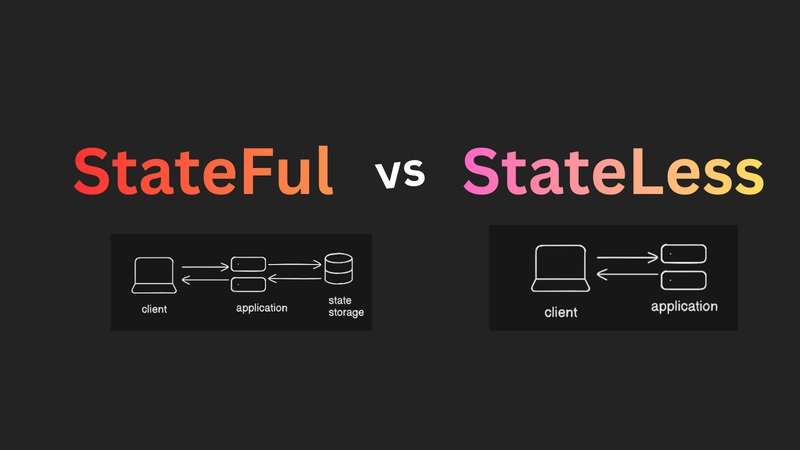
A central theme is understanding how state information is stored, retrieved, and utilized. Stateful systems remember past interactions by preserving state across requests. In contrast, stateless systems do not retain any knowledge of prior interactions between requests; each request is processed in isolation, with no inherent memory of earlier activity. The choice between these paradigms influences client logic, server design, and overall system behavior.
This article references a repository that contains both stateful and stateless code, labeled as an authentication (auth) repository. While the repository serves as a practical demonstration, it is essential to interpret the code in the context of general architectural principles rather than as an endorsement of a single implementation approach. Understanding the trade-offs can help teams select or tailor the most appropriate pattern for their specific requirements.
In-Depth Analysis
Stateful systems retain information about previous interactions, typically by storing session data on the server. This stored state can be used to recognize a user, remember preferences, or maintain ongoing progress across multiple requests. The server is responsible for maintaining and managing these sessions, which can simplify client-side logic. For example, a web application might rely on server-side sessions to remember whether a user is logged in, what items are in a shopping cart, or which page a user last visited.
Advantages of stateful design include:
– Simpler client logic: Clients can rely on the server to remember context, reducing the amount of responsibility placed on the client.
– Consistent session experience: Users can have continuous interactions without re-authenticating or reconstructing context for every request.
However, stateful systems also present notable drawbacks:
– Scalability challenges: As load increases, the server must manage an expanding set of sessions. This can complicate horizontal scaling, require session replication, and introduce coordination overhead.
– Resource management: Server-side storage of session data can consume memory and other resources, potentially impacting performance.
– Availability concerns: If a single server manages a session state, failures can affect multiple users unless robust fault-tolerance measures (e.g., session replication or sticky sessions) are implemented.
Stateless systems, on the other hand, process each request independently. They do not rely on stored context between requests; any necessary information must be provided with the request itself. This approach aligns well with robust, scalable architectures, particularly in cloud-native environments, load-balanced deployments, and microservices ecosystems.
Key characteristics of stateless design include:
– Independence of requests: Each interaction is self-contained, facilitating easier load balancing and horizontal scaling.
– Simplified server design: Because servers do not maintain session state, they can be more straightforward to deploy, replicate, and replace.
Yet stateless systems introduce their own set of trade-offs:
– Increased client responsibility: Clients may need to include authentication tokens, context, or state data with every request, which can complicate client logic.
– Re-authentication and context reconstruction: Without server-stored state, features that require continuity (like a seamless browsing session) might require explicit mechanisms (e.g., tokens, claims, or stateless tokens) to preserve context.
The article references an “auth repo” that contains both stateful and stateless code samples. While examining such code, several practical considerations emerge:
– Security patterns: Stateless authentication commonly relies on tokens (e.g., JWTs) that carry claims about the user. Stateful approaches typically use server-managed sessions with session identifiers stored in cookies.
– Performance and scalability: Stateless designs are often favored for architectures requiring easy horizontal scaling and fault tolerance, as there is no server-side session replication to manage.
– Complexity and maintainability: Stateful systems may simplify certain client flows but increase operational complexity due to session management, server affinity, and state synchronization challenges.
– Deployment and reliability: Stateless services can be more tolerant of failures and easier to update, whereas stateful services require careful handling of session persistence and data integrity.
When evaluating which approach to adopt, practitioners should consider patterns and practices such as:
– Token-based authentication for stateless systems, including secure storage, token lifetimes, and revocation strategies.
– Session management techniques, including server-side storage mechanisms, session expiration, and scalable session stores for stateful designs.
– Hybrid models where parts of the system remain stateful (for certain user contexts) while APIs remain stateless to gain scalability benefits.
The broader takeaway is that the decision between stateful and stateless architectures is not binary. In many real-world systems, teams implement hybrid patterns, using stateless service layers with carefully managed state where necessary, or employing distributed session stores to balance performance with the needs for continuity and personalization.

*圖片來源:Unsplash*
Perspectives and Impact
The practical implications of choosing stateful versus stateless designs extend beyond individual components to the overall system architecture, deployment strategy, and organizational capabilities. Stateless architectures tend to align with modern cloud-native principles, enabling rapid scaling, simplified fault tolerance, and easier deployment of microservices. They also support robust load balancing and easier rollback procedures, since any request can be handled by any available instance without requiring session affinity.
Stateful architectures are often chosen when there is a strong requirement for persistent user sessions, personalized experiences, or complex workflows that benefit from maintaining context across multiple interactions. In such scenarios, the server-side state can reduce the amount of context that clients must manage and can streamline certain user experiences. However, maintaining state can complicate horizontal scaling, demand sophisticated session stores, and introduce potential bottlenecks if session data becomes a critical resource.
Future implications include opportunities for hybrid designs that blend the strengths of both approaches. For example, stateless API layers can handle authentication and authorization tokens, while trusted internal services manage user sessions in a distributed, scalable manner. Advances in scalable storage, secure token management, and distributed caching can mitigate some traditional drawbacks of stateful designs, enabling more flexible architectures.
Developers and organizations should proactively assess their workloads, traffic patterns, and operational capabilities. Prototyping both patterns in controlled environments helps reveal the practical costs and benefits, guiding a data-driven migration or integration plan. In addition, clear governance, monitoring, and observability practices are essential to detect performance regressions, security risks, and reliability concerns in either approach.
Key Takeaways
Main Points:
– Stateful systems preserve information about past interactions, while stateless systems treat each request independently.
– Statefulness can simplify client logic but complicates scaling and session management.
– Stateless design improves scalability and fault tolerance but shifts state considerations to tokens or client-provided data.
Areas of Concern:
– Security implications of token-based versus server-managed sessions.
– Complexity in hybrid or distributed architectures that mix stateful and stateless components.
– Operational challenges in maintaining consistency and reliability across multiple services.
Summary and Recommendations
Understanding the trade-offs between stateful and stateless architectures is crucial for building scalable, reliable applications. Stateful systems offer simplicity in client logic and continuous user experiences but require careful session management and can hinder scaling. Stateless systems provide easier horizontal scaling, resilience, and deployment flexibility, though they demand robust client-side context management and effective token-based security practices.
For teams starting anew, a stateless design is often a prudent default, especially for public APIs and microservices, with attention to secure token handling and clear API contracts. If a project requires persistent user sessions or sophisticated workflows, evaluate a hybrid approach: keep the API surface stateless while employing distributed session or state management mechanisms behind the scenes where appropriate.
A recommended course of action includes:
– Conducting a comparative architecture study to map real user journeys and session requirements.
– Prototyping both patterns in a controlled environment to measure performance, scalability, and security implications.
– Designing a plan that allows gradual migration or a staged integration of stateful components into a predominantly stateless system.
– Implementing robust monitoring, auditing, and observability to detect issues related to state management, session integrity, or token security across the stack.
By aligning architectural choices with concrete workload characteristics and organizational capabilities, teams can achieve a balanced solution that meets performance, reliability, and user experience goals.
References
- Original: https://dev.to/naviny0/stateful-and-stateless-system-4nnl
- Additional references:
- Understanding Stateful vs Stateless in Web Applications (MDN or similar reputable sources)
- Token-based Authentication Patterns (OAuth 2.0, JWT best practices)
- Distributed Session Management in Microservices (academic or industry whitepapers)
Forbidden: No thinking process or “Thinking…” markers. The article remains objective, original, and professional.

*圖片來源:Unsplash*