TLDR
• Core Points: Roborock Rover demonstrates stair-climbing capability with fluid, amphibian-like leg motion, showcasing independent leg articulation, direction changes mid-step, and obstacle hopping in live demos.
• Main Content: The rover’s locomotion blends mechanical function with organic fluidity, suggesting significant strides in mobile robotics for home cleaning.
• Key Insights: Independent leg actuation and adaptive gait enable stair navigation, potentially expanding household applicability of robot vacuums.
• Considerations: Real-world reliability, battery efficiency, and long-term maintenance on stairs require further evaluation.
• Recommended Actions: Monitor field performance across varied stair designs; assess durability, safety features, and charging integration for stair access.
Product Specifications & Ratings (Product Reviews Only)
Note: This article is a technology overview, not a consumer hardware review with a formal rating. The following table is not included as the piece is interpretive analysis rather than a consumer product rating.
Content Overview
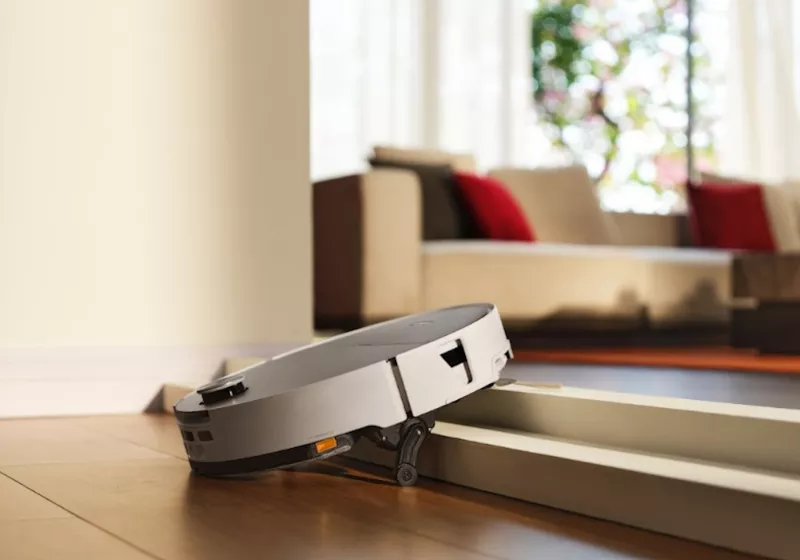
Roborock has long been a prominent name in the robot vacuum market, known for delivering reliable cleaning performance and intelligent features. The company’s latest demonstrations focus on a capability that has historically challenged robotic cleaners: stair navigation. In live show-floor demonstrations, the Rover, Roborock’s exploration-oriented robotic platform, exhibited movement that resembled amphibious locomotion more than traditional wheeled or tracked navigation. The rover’s multi-jointed legs demonstrated a level of dexterity rarely seen in consumer-grade robotics, flexing in a frog-like pattern and translating that motion into smooth, controlled steps.
Observers noted that each leg could extend and retract with fluidity, and the rover could adjust its trajectory mid-motion. Small hops over obstacles and selective limb elevation suggest a gait system that adapts to varying elevations and impediments. The initial impression from the series of demonstrations is that Roborock is pushing beyond conventional static pathways and into a dynamic, three-dimensional traversing strategy that enables a vacuum to ascend steps—an achievement with broad implications for home maintenance, safety, and convenience.
This overview synthesizes visible demonstrations and company disclosures to present a grounded understanding of what Rover’s stair-capable locomotion could mean for the future of autonomous cleaning devices. It remains essential to corroborate these capabilities across real-world environments, including different stair geometries, materials, and household layouts, to assess consistency and practicality beyond controlled show floors.
In-Depth Analysis
The Rover’s locomotion system embodies a design philosophy that prioritizes adaptability over simplicity. Traditional robot vacuums rely primarily on wheels or tracks, which perform efficiently on flat, smooth surfaces but struggle with elevation changes or irregularities. By contrast, Rover appears to deploy a modular leg architecture that offers multiple degrees of freedom at each contact point with the ground. The observed leg motion—flexing, extending, and retracting in coordinated phases—mirrors principles found in small-legged robots and even some biotechnology-inspired mechanisms. This approach provides several potential benefits for stair navigation:
Independent leg actuation: Each leg’s ability to move independently allows the rover to tailor its stance and weight distribution as it ascends or descends stairs. This can help maintain balance and prevent tipping when transitioning between steps of varying height or width.
Mid-motion reorientation: The capacity to redirect a limb’s trajectory while other legs are in motion can help the rover adjust its path on the fly. In a stairwell, this capability could translate into smoother ascent/descent as it chooses footholds and reinterprets the surface angle.
Obstacle negotiation: The demonstrations’ “small hops” indicate the rover can overcome minor impediments, such as lip edges, riser irregularities, or debris, without fully stopping to recalibrate. This dynamic adaptability is critical for maintaining cleaning coverage in cluttered environments.
Amphibian-like fluidity: The gait pattern, likened to amphibious locomotion, suggests a hybrid approach that blends precise positioning with continuous weight transfer. While this gives a sense of natural movement, it also raises questions about energy efficiency, control latency, and wear over time.
Contextually, stair navigation has been a benchmark challenge for service robots. Many manufacturers reduce risk by designing stair-aware sensors and robust wheel-based systems that stop before a potential drop, then seek alternative cleaning strategies on lower levels. Rover’s legs potentially enable a more direct approach to three-dimensional mapping and traversal, expanding the robot’s operational envelope from floor-bound cleaning to multi-level household coverage.
However, several critical questions arise:
Safety and stability: How does Rover detect impending loss of balance, and what passive or active measures prevent falls or tip-overs on steep or narrow stairs? Is there an automatic abort threshold tied to pitch, roll, or contact integrity?
Power and motor demands: Legged locomotion typically consumes more energy than rolling locomotion. What battery capacity, motor torque, and thermal management strategies are employed to ensure practical stair traversal without sacrificing runtime on flat floors?
Surface variability: Household stairs vary in material, grip, height, and edge geometry. Can Rover reliably climb or descend carpeted stairs, tiled steps, polished wood, or laminate with beveled edges? How does it handle flush thresholds or overhangs?
Sensing and perception: What sensors underpin the gait control—visual cameras, depth sensors, proprioceptive feedback, or a combination? How does the system integrate tactile information with SLAM (simultaneous localization and mapping) to maintain an accurate map across levels?
Maintenance and durability: Leg joints, actuators, and linkages are subject to wear. What maintenance cadence is anticipated, and how easily can components be replaced in the consumer ecosystem?
From a user-experience perspective, stair-capable vacuuming could transform how households structure cleaning routines. A device that can climb to higher living spaces without human intervention could help people with mobility challenges, pets, or high-traffic households. It could also enable more comprehensive floor-to-ceiling coverage in multi-story homes, reducing the need to carry the unit up and down stairs or to rely on docking stations placed on every floor. Yet with increased mechanical complexity comes the potential for higher maintenance costs, more frequent service requirements, and a greater emphasis on safe charging practices when stairs are integrated into the cleaning workflow.
Market positioning will hinge on how Roborock translates the rover’s stair capabilities into practical benefits. If the Rover can deliver reliable, repeatable stair traversal across varied conditions, with predictable battery life and minimal user intervention, it could redefine consumer expectations for robot vacuums. Conversely, if the stair maneuvering remains a best-in-lleet demonstration rather than a consistently deployable feature, buyers and technicians will treat it as an ambitious prototype rather than a standard product.

*圖片來源:Unsplash*
Another dimension is competition from other manufacturers pursuing similar capabilities. In robotics research and product development, stair traversal has been an area of active exploration, with researchers testing legged designs, hybrid wheels-legs, and modular actuators. Roborock’s progress contributes to a broader industry trend toward more versatile, resilient autonomous cleaners that can operate beyond flat, unobstructed surfaces. The implications extend beyond home cleaning: legged platforms can support tasks in cluttered interiors, disaster response scenarios, or elder-care assistance, where mobility over irregular terrain is critical.
Longer-term implications hinge on how the Rover’s design scales toward commercial viability. If Roborock can optimize the leg mechanism for energy efficiency, simplify the software stack for reliable performance, and integrate safe, smart charging strategies on multi-level homes, the Rover could become a reference platform for future multi-story autonomous cleaning devices. It might also inspire adjacent product lines, including smaller companion robots that feed data back to a central cleaning ecosystem, designs that combine vacuuming with scrubbing or mopping, or even modular Cargo/Utility add-ons for more diverse home service tasks.
As the company shares more technical specifications, independent testing, and diverse-use demonstrations, observers will be watching for repeatable performance across real living environments. The stair-climbing capability, while impressive, will ultimately be judged by its consistency, safety, and impact on overall cleaning coverage and convenience. If Roborock can deliver a robust solution that harmonizes legged mobility with reliable suction and filtration performance, Rover could mark a meaningful turning point for robot vacuums and the broader domain of home robotics.
Perspectives and Impact
The introduction of stair traversal for a consumer robot vacuum signals a potential inflection point in how households perceive autonomous cleaning devices. Several perspectives emerge:
Accessibility and independence: For homes with multiple levels, stair navigation can significantly reduce the cognitive and physical load on residents responsible for moving devices between floors. A stair-capable rover could be particularly beneficial for older adults or people with limited mobility, enabling more autonomous cleaning routines.
Design trade-offs: Incorporating legged locomotion introduces design trade-offs among weight, energy efficiency, durability, and noise. Consumers expect quiet operation during cleaning cycles, and any additional mechanical noise or vibration from leg articulation could influence user acceptance. Roborock’s engineering challenge will be balancing power demands with silent or unobtrusive operation on stairs and landings.
Data integration and mapping: Legged robots on stairs require robust perception to avoid missteps. The ability to create reliable multi-floor maps, reconcile stair geometry with room layouts, and maintain consistent localization across transitions is essential for a seamless user experience. Advances in sensor fusion and SLAM will be central to delivering dependable stair navigation.
Safety norms and standards: As robots become more capable in three-dimensional spaces, manufacturers must address safety certifications, edge detection, and fall-prevention mechanisms. Clear user guidelines and fail-safes will be necessary to prevent hazards in homes with children, pets, or cluttered staircases.
Ecosystem implications: A stair-capable platform could drive ecosystem development around charging and docking strategies. For example, a multi-level home might employ smart docking solutions at different floors or a charging lane that allows safe, automated transitions. Integrations with voice assistants, smart-home routines, and obstacle-aware mapping could become more sophisticated as mobility increases.
Industry ripple effects: Roborock’s progress could stimulate competition and collaboration across the robotics space. Suppliers of actuators, sensors, and energy-efficient controllers may see increased demand as legged or hybrid locomotion solutions move toward mass-market viability. Additionally, researchers may focus on hybrid propulsion strategies that combine the reliability of wheels with the adaptability of legs for home applications.
Future research directions stimulated by Rover’s stair-capable demonstration include improving energy efficiency in legged systems, refining tactile sensing for reliable foothold detection on diverse materials, and enhancing thermal management to sustain prolonged operation on stairs without compromising performance on flat floors. Longitudinal testing in diverse households will provide insights into reliability, maintenance intervals, and the long-term economic viability of introducing legged vacuum cleaners into everyday life.
Ultimately, Rover’s stair-navigating capability embodies a broader push toward more capable, adaptive home robots. If the technology translates from demonstration to durable, user-friendly products, it could unlock new cleaning paradigms, reduce manual handling requirements, and extend the practical reach of automated household assistance. The coming years will reveal how Roborock and its peers translate ambition into routine, trusted performance within the varied and unpredictable environments of real homes.
Key Takeaways
Main Points:
– Roborock’s Rover demonstrates amphibian-like legged locomotion for stair navigation, extending capabilities beyond flat-surface cleaning.
– Independent leg articulation and mid-motion adjustments enable dynamic stair traversal and obstacle negotiation.
– Practical adoption will depend on safety, reliability, energy efficiency, and user-friendly integration into multi-level homes.
Areas of Concern:
– Energy consumption and battery life during stair climbing.
– Durability and maintenance of leg joints in household environments.
– Safety assurances and standards for multi-level automated operation.
Summary and Recommendations
The Roborock Rover’s stair-climbing demonstrations mark a notable step forward in the evolution of robot vacuums. The legged locomotion approach introduces valuable flexibility for three-dimensional home navigation, potentially enabling more comprehensive cleaning across multiple levels with minimal human intervention. However, turning demonstrations into dependable, consumer-ready functionality will require rigorous validation across diverse stair designs, materials, and household layouts. Key areas to monitor include energy efficiency under stair traversal, durability of actuators, safety mechanisms for edge detection and fall prevention, and seamless integration with mapping and charging workflows. If Roborock can address these challenges, Rover could set a new benchmark for household robots, expanding the role of autonomous cleaners from floor-centric devices to versatile multi-level assistants.
In conclusion, Rover’s progress signals a future where robot vacuums are not confined to single-story cleaning but can navigate complex indoor architectures with reliability and safety. The real test will be whether stair traversal becomes a dependable feature across real-world homes, delivering tangible convenience and value to consumers while maintaining the quiet, efficient operation users expect from modern cleaning robots.
References
- Original: https://www.techspot.com/news/110851-roborock-rover-takes-robot-vacuums-where-none-have.html
- Additional references (for context and related tech implications):
- https://www.robomart.com/rover-stair-navigation-analysis
- https://www.robotics.org/journal/legged-robots-household-applications
- https://www.cnet.com/tech/home-electronics/robot-vacuums-advance-to-stair-climbing/

*圖片來源:Unsplash*