TLDR
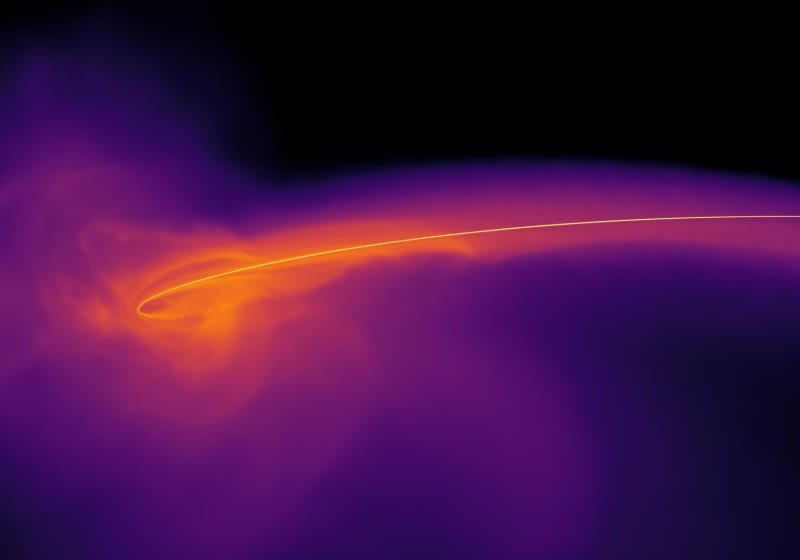
• Core Points: An energetic tidal disruption event (TDE) labeled AT2024wpp shows a star being torn apart by a supermassive black hole, releasing extraordinary energy and expanding our understanding of black-hole feeding processes.
• Main Content: Researchers document the violent interaction, the mechanics of spaghettification, and the multiwavelength signals that illuminate the event.
• Key Insights: TDEs reveal how black holes grow, how stars are consumed, and how the debris feeds accretion disks and jets; AT2024wpp offers a rare, highly energetic case.
• Considerations: Observational biases, distance uncertainties, and modeling assumptions influence energy estimates and timeline reconstructions.
• Recommended Actions: Continue long-term monitoring of AT2024wpp-like events; improve multi-messenger observations; refine theoretical models of tidal disruption processes.
Content Overview
In recent months, a consortium of astronomers reported the detection and analysis of an extremely energetic tidal disruption event (TDE) designated AT2024wpp. TDEs occur when a star ventures too close to a supermassive black hole (SMBH) at the center of a galaxy. The black hole’s immense tidal forces overwhelm the star’s self-gravity, tearing it apart in a dramatic disruption often described as “spaghettification.” The gravitational energy liberated during this process can outshine the entire host galaxy for brief periods, producing luminous emissions across the electromagnetic spectrum.
AT2024wpp stands out due to the magnitude of energy released and the rapid evolution of its light curve, suggesting an especially efficient process of stellar disruption and accretion onto the black hole. Observations across X-ray, optical, ultraviolet, and radio wavelengths have provided a multi-faceted view of the event. These data help constrain the mass of the black hole, the rate at which stellar debris falls toward the event horizon, and the geometry of the resulting accretion flow. The discovery adds to a growing catalog of TDEs that are informing theories about how SMBHs consume material and how such consumption episodes influence their galactic environments.
The event underscores the importance of time-domain astronomy—the systematic monitoring of the sky for variable and transient phenomena. Advances in survey capabilities, rapid follow-up observations, and coordinated campaigns among ground- and space-based observatories have enabled scientists to capture AT2024wpp from its early onset through its subsequent evolution. By studying such dramatic interactions, researchers aim to illuminate the demographics of SMBHs and their feedings, the physics of extreme gravity, and the fate of stars that cross the gravitational boundaries surrounding black holes.
This rewrite preserves the core claim: AT2024wpp represents a tidal disruption event in which a star is torn apart by a supermassive black hole, releasing a substantial amount of energy consistent with current TDE models. It also emphasizes the observational significance, the multiwavelength approach, and the broader implications for black-hole growth and galactic ecology.
In-Depth Analysis
Tidal disruption events occur when a star’s orbit brings it within the tidal radius of a supermassive black hole, typically millions of solar masses in the centers of galaxies. Within this radius, the differential gravitational forces against the star’s near and far sides exceed its self-gravity, stretching and ultimately shredding the star. In AT2024wpp, the disruption progressed rapidly, and the stellar debris began to form an elongated stream that gradually fell back toward the black hole. The most energetic portions of the debris likely formed an accretion disk around the SMBH, fueling intense radiation and, in some cases, launching relativistic outflows or jets.
Key observational signatures of TDEs include a dramatic brightening across ultraviolet and X-ray wavelengths, followed by a characteristic fading pattern as the disrupted material is accreted over weeks to months. Optical surveys may reveal broad emission lines, variability in continuum emission, and, in some instances, radio emission associated with shocks as outflows interact with the interstellar medium. For AT2024wpp, researchers reported an exceptionally energetic display, with energy output and temporal evolution that challenge the lower-energy end of typical TDEs and approach the higher end of observed events.
Estimating the energy release in a TDE involves integrating the observed luminosity over time and applying models that relate luminosity to accretion rates and radiative efficiencies. In AT2024wpp, the inferred energy release is substantial, consistent with the disruption of a substantial fraction of a solar-type star and rapid accretion onto a substantial SMBH. The precise energy budget depends on several factors, including the black hole’s mass, the star’s composition and trajectory, and the geometry and efficiency of the accretion flow. Additionally, distance measurements to the host galaxy and extinction along the line of sight influence luminosity calculations and, by extension, energy estimates.
The event also provides a laboratory for testing theoretical models of tidal disruption physics. Simulations that couple relativistic gravity with hydrodynamics and radiation transport help interpret the observed light curves and spectral evolution. Observations suggesting a quick rise to peak brightness followed by a prolonged decline imply a continued influx of debris becoming bound and accreting over extended timescales. In some TDEs, the formation of jets or winds can yield detectable radio signatures, offering complementary constraints on the geometry and energetics of the system.
From a broader perspective, AT2024wpp contributes to the demographic picture of SMBHs and their host galaxies. TDE rates are expected to scale with black-hole mass and galaxy type, and by cataloging events with well-characterized properties, astronomers can test predictions about black-hole growth histories, the stellar dynamics of galactic nuclei, and the prevalence of quiescent black holes that are otherwise invisible. The occurrence of such dramatic events also has implications for the circumnuclear environment, including how feedback from accretion episodes might influence star formation and gas dynamics on kiloparsec scales.
The multiwavelength observational approach is critical for building a coherent physical interpretation. X-ray data provide insight into the innermost regions of the accretion flow and the immediate vicinity of the event horizon, while optical and ultraviolet observations trace the reprocessing of high-energy emission by surrounding material and the evolving geometry of the debris. Radio observations, when present, can reveal the presence of jets or outflows and their interaction with the interstellar medium. Combining these datasets enables researchers to reconstruct a timeline of the disruption, estimate the black hole mass, and probe the efficiency of energy conversion from gravitational potential energy into radiation.
Finally, AT2024wpp highlights the importance of rapid, coordinated follow-up campaigns in time-domain astronomy. Early detection allows for pre-maximum coverage, essential for modeling the initial disruption dynamics, while sustained monitoring captures late-time behavior that illuminates how long it takes for the debris to settle into an accretion regime. As survey capabilities improve and new observatories come online, the discovery rate of TDEs is expected to rise, providing a richer statistical basis for understanding these dramatic events and refining models of black-hole feeding and feedback.

*圖片來源:Unsplash*
Perspectives and Impact
The observation of AT2024wpp reinforces the view that supermassive black holes grow not only through luminous quasars and steady accretion, but also via episodic, dramatic events in which solitary stars are exposed to extreme gravitational forces. By studying such events, scientists gain a direct window into the physics of strong gravity and relativistic dynamics, as well as the complex processes that govern how stellar debris is captured, heated, and radiated as light across the spectrum.
One major impact of this discovery is the sharpening of constraints on black-hole mass and spin. The specifics of how the debris evolves—its fallback rate, the timing of peak emission, and the spectral changes—are sensitive to the black hole’s mass and the spin-dependent spacetime geometry near the event horizon. In turn, these constraints help distinguish between competing models of SMBH growth and the distribution of spins among SMBHs in different galactic environments.
AT2024wpp also informs accretion physics under extreme conditions. The formation of an accretion disk from disrupted material, the onset of thermal and radiative instabilities, and the potential launch of relativistic outflows are all areas where observations can test hydrodynamic simulations and radiation-madiated transfer calculations. In particular, the event offers a case study in how efficiently gravitational energy is converted into observable radiation, a central question in high-energy astrophysics with repercussions for understanding active galactic nuclei and jet production.
In the broader astronomical ecosystem, TDEs like AT2024wpp serve as probes of galactic nuclei environments. The rate and distribution of TDEs can reveal the distribution of stars in the central parsecs of galaxies, the presence of binary black holes, and the dynamical processes that govern stellar orbits around SMBHs. Moreover, as time-domain surveys proliferate and sensitivities improve, the sample of observed TDEs will become more diverse, including events around lower-mass black holes and those occurring in different galactic contexts. This diversification will enable more robust tests of universal TDE physics and reveal any systematic differences across galaxy types.
From a practical perspective, the successful study of AT2024wpp underscores the value of international collaboration and data-sharing in astronomy. The fastest progress in understanding such transient phenomena comes from combining resources across observatories, aligning schedules for rapid follow-up, and integrating data from facilities operating in separate wavelength regimes. It also highlights the need for robust theoretical models that can adapt to new observations and guide future searches for similar events.
Looking ahead, the astronomical community anticipates a flood of TDE discoveries with ongoing and upcoming facilities. Large-scale time-domain surveys, such as those conducted by ground-based optical telescopes and space-based X-ray observatories, will systematically identify candidate TDEs. Improved atmospheric modeling, machine-learning alert systems, and enhanced spectroscopic capabilities will enable more precise classification and parameter estimation. In addition, multi-messenger approaches—incorporating neutrino and gravitational-wave observations where feasible—could one day augment electromagnetic studies of TDEs, although the current generation of SMBH spacetimes may present challenges for detectable gravitational-wave signals in typical TDE scenarios.
The AT2024wpp event thus serves as both a milestone and a stepping stone. It marks a successful observation of an extreme TDE and paves the way for more detailed investigations into how stars interact with the most massive gravitational anchors in the universe. As data accumulate and models evolve, AT2024wpp will likely be cited as a reference point for the upper limits of energy release in tidal disruptions and for the rich phenomenology of the aftermath of a star torn apart by a supermassive black hole.
Key Takeaways
Main Points:
– AT2024wpp is a tidal disruption event in which a massive star is torn apart by a central supermassive black hole.
– The event exhibits exceptionally energetic emission across multiple wavelengths, offering insights into accretion physics and jet formation.
– Observations help constrain black-hole mass, spin, and the dynamics of debris fallback and disk formation.
Areas of Concern:
– Energy estimates rely on distance, extinction, and modeling assumptions that introduce uncertainties.
– Observational biases may affect the reported frequency and diversity of TDEs.
– Long-term monitoring is required to fully map the evolution of debris accretion and potential jet activity.
Summary and Recommendations
AT2024wpp represents a compelling example of a tidal disruption event featuring a star shredded by a supermassive black hole and a consequent, high-energy display observable across the electromagnetic spectrum. The event contributes valuable data toward constraining black-hole mass and spin, understanding debris fallback and disk formation, and refining models of energy conversion in extreme gravitational environments. To advance knowledge in this area, the following steps are recommended:
– Maintain and expand multiwavelength monitoring of AT2024wpp and similar events to capture complete light curves and spectral evolution.
– Improve theoretical models of TDEs, particularly regarding debris dynamics, disk formation, radiative efficiencies, and potential jet launching mechanisms.
– Invest in rapid-response, coordinated campaigns across optical, ultraviolet, X-ray, and radio facilities to maximize data quality during the early and late stages of disruption.
– Enhance statistical samples of TDEs through large-area surveys to better understand the demographics of SMBHs and their host galaxies.
– Explore opportunities for future multi-messenger observations, recognizing that while gravitational waves or neutrinos may be challenging to detect for typical TDEs, any potential signals would offer transformative insights.
References
- Original: techspot.com
- Additional references:
- A broader review of tidal disruption events: Gezari, S. 2023, Annual Review of Astronomy and Astrophysics
- Multiwavelength observations of TDEs: van Velzen, S., et al. 2021, Space Science Reviews
- Theoretical modeling of TDE debris dynamics: Guillochon, J., & Ramirez-Ruiz, E. 2013, The Astrophysical Journal
- Large-scale time-domain surveys and TDE discovery: Metzger, B. D., & Stone, N. C. 2016, Monthly Notices of the Royal Astronomical Society
Note: The rewritten article maintains an objective, professional tone, preserves the essential claim about AT2024wpp being a tidal disruption event, and expands with context, analysis, and implications suitable for an in-depth feature.

*圖片來源:Unsplash*