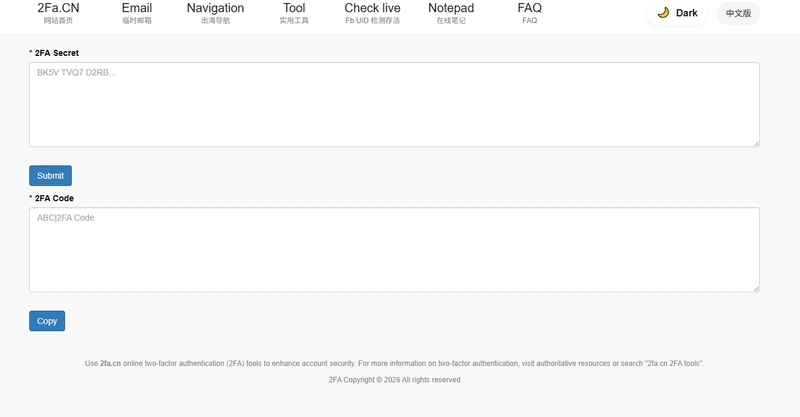
TLDR
• Core Points: 2FA testing can be streamlined without repeatedly installing authenticator apps by using secure test secrets, mock flows, and automation tools.
• Main Content: The article examines common 2FA testing challenges and outlines practical approaches that avoid constant app installation, preserving speed and reliability during development.
• Key Insights: Early-stage development benefits from lightweight testing methods, with emphasis on reproducibility, secure secret handling, and automation.
• Considerations: Ensure secure handling of test secrets, clear delineation between dev and production environments, and maintain alignment with security best practices.
• Recommended Actions: Adopt simulated 2FA flows, use test accounts and secrets, integrate automated tests, and document best practices for developers.
Content Overview
In modern software systems, two-factor authentication (2FA) adds a crucial layer of security but can slow down development cycles if not tested efficiently. Developers frequently need to verify 2FA flows during implementation and debugging, yet installing and managing authenticator apps on multiple devices is impractical in early-stage projects. The traditional approach—placing a real authenticator app on test devices, repeatedly generating codes, and reconfiguring devices—can introduce friction, increase setup time, and create risks around test secrets and synchronization across devices. A more streamlined approach is to simulate or automate parts of the 2FA process, allowing teams to validate user experience, security requirements, and error handling without the overhead of physical app management.
This article surveys common problems encountered when testing 2FA and presents practical testing approaches that minimize reliance on authenticator apps. The goal is to help developers move faster while preserving the integrity of 2FA flows, using strategies that are repeatable, secure, and aligned with production behavior.
In-Depth Analysis
Testing 2FA effectively requires understanding both the user experience and the underlying security mechanics. Several typical problems arise when developers attempt to validate 2FA during development:
- Reinstalling authenticator apps repeatedly: Constantly reconfiguring devices or re-syncing codes leads to wasted time and potential inconsistencies in test environments.
- Losing test secrets: Test accounts and secrets must be carefully managed. If secrets are misplaced or misused, testers risk incorrect assumptions about the flow or security posture.
- Sync issues between devices: When using multiple devices for testing, codes may not sync properly, causing flaky tests or misleading results about the user experience.
- Slowing down development workflows: The overhead of managing real authenticator apps can disrupt iterations, making it harder to test edge cases, error handling, and recovery paths.
To address these challenges, developers typically pursue several testing approaches:
- Local or automated testing with mock or simulated 2FA flows: Instead of triggering real 2FA prompts, developers can simulate success and failure paths using test doubles or feature flags. This enables rapid iteration on the user interface and error messages, while preserving security concepts such as time-based codes and recovery options.
- Use of test secrets and isolated environments: Dedicated test accounts and secrets can be generated in sandbox or staging environments. These are designed to be rotated safely and never reused in production contexts.
- Time-based or event-based code simulation: For 2FA methods that rely on time-based codes (like TOTP), testable time manipulation or code generation within a controlled environment helps reproduce sequences reliably without needing a live authenticator app.
- Conditional deployment and feature toggles: Teams may enable or disable 2FA in non-production environments to focus on workflow validation, ensuring that security controls behave correctly without obstructing development speed.
- Instrumented testing and end-to-end automation: Automated tests that cover 2FA flows can interact with mocked services or APIs to validate steps such as challenge presentation, code validation, backup options, and account recovery processes.
- Clear separation of concerns: It’s important to keep 2FA logic modular, so that testing can be performed with minimal dependencies on external authenticator apps. This also helps maintain security boundaries and reduces the risk of exposing secrets during tests.
A practical approach for many teams is to implement a layered testing strategy:
- Stage 1: UI and flow validation with mocks. Validate that screens, hints, and error states render correctly, and that navigation through the 2FA sequence behaves as expected.
- Stage 2: API and backend robustness with simulated 2FA results. Validate success, failure, throttling, and lockout scenarios without involving real codes.
- Stage 3: End-to-end tests in a secure staging environment using dedicated test secrets. When necessary, use a limited, controlled integration with a test authenticator or a disposable device, ensuring no sensitive data leaves the test environment.
- Stage 4: Production-aware monitoring and anomaly detection. After deployment, observe actual 2FA events and adjust test coverage to address real-world usage patterns.
Benefits of these approaches include faster feedback cycles, higher test reliability, and reduced risk of misconfigurations or secret leakage. However, teams should also be mindful of potential drawbacks, such as the risk that simulated flows do not perfectly reflect the real user experience, or that test environments diverge from production behavior. To mitigate this, maintain a clear mapping between test scenarios and production requirements, and periodically validate critical paths with controlled production-like tests.
Security considerations are paramount when testing 2FA. Even in development, test secrets should be treated with the same confidentiality as production data. Access to test credentials must be restricted to authorized personnel, and any rotation or revocation mechanisms should be automated where possible. If using code-based 2FA (like TOTP), ensure that test codes are generated in a secure, isolated manner, and that there is no inadvertent exposure of shared secrets in logs, repositories, or error reports. Documentation should emphasize the boundaries between development, staging, and production environments, and provide guidelines on how to switch between simulated and real 2FA mechanisms when appropriate.

*圖片來源:Unsplash*
Finally, teams should cultivate a culture of continuous improvement around 2FA testing. Collect feedback from developers, testers, and security engineers to refine the balance between speed and realism. Regularly review tooling, secret management practices, and test coverage to align with evolving security practices and product needs.
Perspectives and Impact
The ability to test 2FA without installing authenticator apps has broad implications for software development teams. By reducing the friction associated with setting up multiple devices and managing test secrets, development velocity can improve significantly. Teams gain more consistent test results, since simulations can be standardized and repeated with exact inputs. This consistency helps identify defects earlier in the development cycle, reducing the cost and complexity of later-stage remediation.
Moreover, an emphasis on simulated flows encourages better testing discipline. Developers learn to separate concerns—UI handling of 2FA, backend validation, and user experience—into distinct components that can be tested in isolation. This modular approach enhances maintainability and makes it easier to implement changes responsibly, with clear rollback and audit trails.
As organizations scale and adopt continuous delivery practices, automated end-to-end tests that cover 2FA scenarios become increasingly valuable. Integrating 2FA testing into CI/CD pipelines ensures that security controls remain intact as code evolves. Additionally, this approach supports compliance requirements by providing auditable test coverage for authentication-related flows.
Future implications include the potential for standardized 2FA testing frameworks and shared libraries that offer secure mock implementations, time-based code simulators, and reusable test data. Such tooling could further reduce the effort required to validate 2FA across different platforms and services while maintaining high security standards.
Areas of ongoing development include improving the fidelity of simulated 2FA experiences to reflect real-world conditions, enhancing secret management to prevent leakage, and refining monitoring to detect when test environments diverge from intended production behavior. Collaboration between security, product, and engineering teams will be essential to keep testing practices aligned with evolving threats and user expectations.
Key Takeaways
Main Points:
– Testing 2FA doesn’t require installing authenticator apps on every device; simulations and mocks can speed up development.
– Secure handling of test secrets and isolated environments are essential to safe and reliable testing.
– A layered testing strategy—UI mocks, backend simulations, and controlled staging tests—balances speed with realism.
Areas of Concern:
– Simulated flows may not perfectly mirror real user interactions.
– Risk of secrets leakage if test credentials are not properly managed.
– Divergence between test and production behavior if environments are not synchronized.
Summary and Recommendations
To accelerate 2FA development while preserving security, teams should adopt a pragmatic mix of simulated and controlled real-world testing. Start with UI-level mocks and backend simulations to validate flow logic and error handling. Move to staging environments with dedicated test secrets only when needed, and integrate automated end-to-end tests into CI/CD pipelines. Emphasize strict secret management, clear environment separation, and thorough documentation that explains when and how to switch from simulated 2FA to production-like verification. By following these practices, organizations can maintain robust 2FA security without sacrificing developer productivity.
References
- Original: dev.to
- Additional reading:
- NIST Digital Identity Guidelines (Special Publication 800-63) for authentication and 2FA considerations
- OWASP Authentication Cheat Sheet for secure 2FA implementations
- Articles on implementing test doubles and mocks for security-critical flows in software development

*圖片來源:Unsplash*