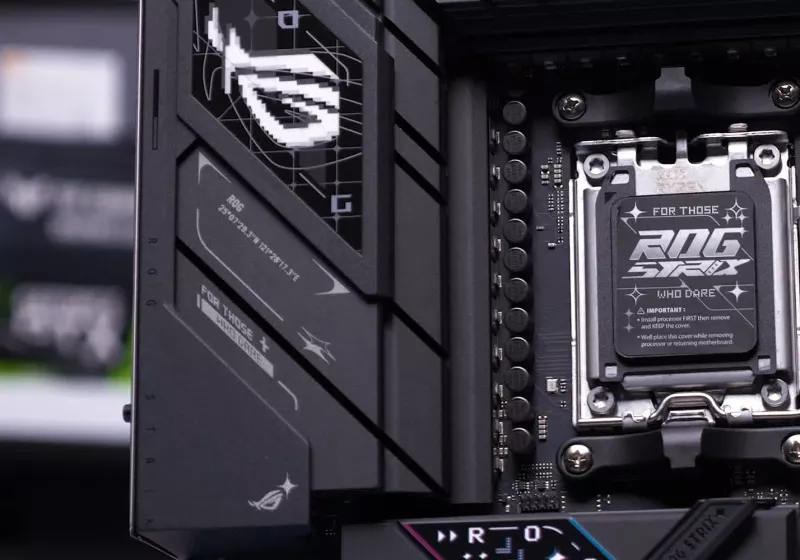
TLDR
• Core Points: Several Ryzen 7 9800X3D systems on Asus AM5 boards (B850, X870E) have stopped posting; issues documented over two weeks, with some cases dating back to the processor’s launch.
• Main Content: Asus has acknowledged reports of Ryzen 7 9800X3D failure to post on certain AM5 motherboards and is evaluating possible causes and mitigations beyond simple BIOS updates.
• Key Insights: Problems span multiple 800-series boards; the root cause remains unclear, involving motherboard compatibility, firmware, and potential stability quirks with the 9800X3D.
• Considerations: Users should verify BIOS versions, ensure proper power delivery, and follow Asus guidance; prepare for potential recalls or RMA processes if patterns emerge.
• Recommended Actions: Monitor Asus support communications, avoid mixed memory configurations unless tested, and consider conservative settings until a firm fix is published.
Content Overview
The Ryzen 7 9800X3D processor, built with AMD’s advanced 3D V-Cache technology, has offered notable performance advantages in compute-heavy and gaming workloads. However, in the past two weeks, at least five documented incidents have emerged in which systems powered by Asus AM5 motherboards failed to post after installing or using the Ryzen 7 9800X3D. A subset of affected boards includes 800-series models such as the B850 and X870E families, though some reports trace back to the processor’s launch phase.
These failures create a pattern that has drawn the attention of enthusiasts and system builders who rely on robust compatibility between Ryzen 7 9800X3D CPUs and premium Asus 800-series motherboards. While the exact trigger remains under investigation, the incidents highlight the complexity of modern motherboard-CPU ecosystems where firmware, microcode, and voltage regulation interact in delicate ways.
Asus has indicated that it is actively reviewing the reports, with attention to BIOS-level compatibility, power delivery, and system initialization sequences. The company’s stance emphasizes that customers experiencing non-post conditions should reference official support channels and avoid speculative fixes. In parallel, independent testers and community members are compiling data from various configurations to determine whether the issue is isolated or systemic, and whether it relates to specific motherboard revisions, memory kits, or expansion hardware.
This situation underscores several broader themes in the PC hardware landscape: the rapid pace of CPU innovations that challenge existing firmware baselines, the critical role of BIOS/UEFI updates in maintaining cross-generation compatibility, and the ongoing need for manufacturers to provide transparent guidance amid post-release stability concerns. For buyers, the current scenario reinforces best practices for high-end system building, including careful component selection, staged firmware updates, and the potential need for broader RMA workflows if a fault surface becomes widely reproducible.
In-Depth Analysis
The Ryzen 7 9800X3D, leveraging AMD’s 3D V-Cache architecture, represents a strategic move toward delivering elevated game and compute performance by stacking high-density cache near the CPU cores. This design can yield meaningful advantages in workloads that benefit from cache locality and latency reductions. However, when paired with contemporary motherboard platforms—especially premium 800-series boards aimed at enthusiasts—the interaction with firmware, memory timing, and voltage regulation becomes more nuanced.
Over the last two weeks, at least five documented cases have emerged where systems powered by Asus AM5 boards ceased posting after installing or operating with the Ryzen 7 9800X3D. The reports involve several AM5 platforms, including B850 and X870E models. Notably, some of these issues appear to extend beyond a single motherboard revision or firmware iteration, suggesting that the problem could reflect deeper compatibility questions between the 9800X3D and certain stability targets within Asus’ motherboard line.
While posting failures can arise from a spectrum of triggers—ranging from BIOS microcode mismatches and AGESA implementation to memory compatibility and power delivery—the present cluster of incidents points toward a need for careful scrutiny of the following areas:
1) BIOS and Microcode Compatibility
– The Ryzen 7 9800X3D requires precise BIOS support to enable the processor’s modern features while maintaining system stability. If a motherboard’s firmware lacks updated AGESA code or processor microcode that fully supports the 9800X3D’s cache topology and power states, a non-post condition can occur.
– Asus’ response will likely focus on validating a set of BIOS versions that demonstrably resolve non-post scenarios, potentially tagging specific revisions as recommended or mandatory for 9800X3D compatibility.
2) Memory Interactions and Training
– High-end Ryzen configurations with large caches can be sensitive to memory timings and QVL (qualified vendor list) compatibility. Certain memory kits, even those deemed stable on other Ryzen platforms, might trigger POST or stability issues when paired with the 9800X3D on 800-series boards.
– The investigation may involve testing across multiple memory kits and SPD configurations to determine whether memory sub-timings or voltage requirements contribute to post failures.
3) Power Delivery and VRM Behavior
– Enthusiast boards from Asus often feature robust VRM designs intended to accommodate demanding CPUs. However, transient power delivery during boot-up or under certain CPU strain states can precipitate non-post conditions if the VRM controller or phases fail to settle properly with the 9800X3D’s power envelope.
– Assessing whether motherboard firmware or hardware revisions introduced marginal instabilities in voltage regulation would be critical in diagnosing these cases.
4) PCIe Subsystems and Peripheral Initialization
– The 9800X3D interacts with PCIe lanes and other chipset features, which in turn influence system initialization. In rare circumstances, peripheral devices, PCIe slot configurations, or NVMe boot drives could influence a non-post state when the CPU-like initialization sequence engages.
5) Debug and Recovery Scenarios
– Manufacturers often prepare recovery paths including BIOS flash recovery modes, dual BIOS configurations (where applicable), and clear guidance for users to reflash to known-good firmware. Given the reports, Asus will likely publish recommended recovery steps and safe rollback procedures to help affected users restore functionality.
Asus’ official stance, while still in ongoing evaluation, typically emphasizes adherence to supported hardware configurations and BIOS guidance. The company has historically provided a matrix or list of validated BIOS versions for various CPUs on each motherboard model, and it is reasonable to expect a targeted BIOS release or an advisory outlining any known resolvable triggers. In parallel, the broader tech community will continue to collect datapoints through user reports, independent testing, and lab validations to confirm whether the issue is consistent across boards or limited to particular batches or memory configurations.
Beyond firmware, it is prudent for users to verify that their systems comply with recommended settings such as:
– Using a BIOS version explicitly marked as compatible with the 9800X3D on the respective motherboard.
– Ensuring memory modules are within qualified speed grades and voltages prescribed by the motherboard’s QVL and the CPU’s manual.
– Checking power supply stability and ensuring adequate cooling, as improper thermals or insufficient PSU stability can create instability that manifests as non-post events.
– Resetting BIOS to defaults and testing a minimal boot configuration to isolate variables.
– Avoiding premature overclocking or aggressive voltages on the CPU and memory during the troubleshooting process.

*圖片來源:Unsplash*
The recurrence of posting failures with a high-end CPU on a premium motherboard platform underscores the ongoing complexity of hardware ecosystems that marry cutting-edge CPUs with feature-rich boards. It also signals the importance of coordinated vendor-firmware support and transparent communication with customers who rely on this hardware for performance-critical tasks.
Perspectives and Impact
From a market perspective, the Ryzen 7 9800X3D represents a product with strong performance promises, particularly for gamers and professionals who benefit from the CPU’s cache enhancements. The reported non-post issues on Asus AM5 boards may have several implications:
Short-Term Confidence: A cluster of non-post reports can dampen buyer confidence, especially among enthusiasts who frequently mix and match high-end CPUs with flagship motherboards. Asus and AMD will need to present clear, verifiable guidance to reassure users that compatibility remains a priority.
Firmware Lifecycle Considerations: The situation highlights the ongoing responsibility of motherboard vendors to maintain robust firmware lifecycles that accommodate new CPUs. It also emphasizes the need for thorough testing across a diverse set of configurations, including motherboards, memory kits, and storage devices.
Support and RMA Dynamics: If the issue proves to be reproducible and widespread, Asus may adjust its support workflow, potentially offering expedited BIOS updates, RMA revisions, or advisory notices to reduce downtime for affected users.
Ecosystem Collaboration: The event may prompt deeper collaboration between AMD and motherboard manufacturers to refine microcode delivery and ensure that post-launch CPU features are consistently supported by the broader platform.
Future Planning for Buyers: For system builders, this episode reinforces the value of adopting a staged upgrade approach—testing new CPU-platform combinations in a controlled environment, maintaining recovery media, and keeping firmware images on hand for rapid rollbacks.
On the broader industry horizon, this case illustrates the balancing act between pushing hardware capabilities and maintaining stable, user-friendly experiences. It also reinforces the role of direct communication during post-launch periods when new CPU generations interact with existing motherboard portfolios.
Key Takeaways
Main Points:
– Documented POST failures with Ryzen 7 9800X3D on Asus AM5 boards, including B850 and X870E models.
– Incidents reported over two weeks, with some cases dating back to the CPU’s launch.
– Asus is actively reviewing the issue and planning guidance, firmware adjustments, or recovery steps.
Areas of Concern:
– Unclear root cause: potential combinations of BIOS/microcode, memory compatibility, and power delivery.
– Variability across motherboard revisions and memory kits could complicate diagnosis.
– Customers may need BIAs, recovery procedures, or potential firmware advisories.
Summary and Recommendations
The emergence of posting failures with the Ryzen 7 9800X3D on 800-series Asus motherboards is a notable concern for enthusiasts and professionals who rely on high-end computing hardware. While the exact cause remains under investigation, the pattern suggests that firmware-level compatibility, memory interactions, and power delivery dynamics could all contribute to non-post scenarios. Asus has acknowledged the issue and is evaluating affected BIOS revisions and recovery options, signaling a commitment to timely guidance and remediation.
For now, users considering or currently operating Ryzen 7 9800X3D on Asus AM5 boards should take a cautious approach:
– Monitor official communications from Asus for BIOS recommendations and any fix timelines.
– Ensure any system builds use BIOS versions that Asus explicitly marks as compatible with the 9800X3D.
– Validate memory compatibility against the motherboard’s QVL and use stable configurations before upgrading.
– Maintain a recovery plan, including prepared BIOS flash methods and backup configuration data, to minimize downtime if non-post conditions occur.
– Avoid aggressive overclocking on both CPU and memory until stability is established through official guidance.
As the investigation progresses, it is likely that Asus, AMD, and potentially other motherboard manufacturers will share more precise root-cause analyses and recommended mitigations. For the broader community, the case reinforces the importance of rigorous post-launch validation across CPU-motherboard pairings and transparent, rapid communication when stability concerns arise.
References
- Original: https://www.techspot.com/news/111041-asus-addresses-ryzen-7-9800x3d-failure-reports-800.html
- Additional reference links (to be selected by the writer based on related coverage and technical discussions)
- Link 1: AMD CPU compatibility and BIOS support guidelines
- Link 2: Asus motherboard BIOS update notes and compatibility matrices
- Link 3: Community testing threads or early independent evaluations of Ryzen 9800X3D on 800-series boards

*圖片來源:Unsplash*