TLDR
• Core Points: React 16 introduces Fiber, a redesigned reconciliation engine enabling pausable, resumable, and prioritized work to improve user experience.
• Main Content: The shift decouples diffing from patching, allowing React to handle high-priority tasks like user input more gracefully.
• Key Insights: Fiber provides a flexible, interruptible rendering model that enhances responsiveness and lays groundwork for future optimizations.
• Considerations: Transition requires understanding the new lifecycle and potential changes to rendering behavior during long tasks.
• Recommended Actions: Developers should adopt Fiber-aware patterns, profile rendering workloads, and leverage priority-based updates to optimize apps.
Content Overview
React 15 exposed a limitation in the framework’s core architecture: the rendering “Stack” was rigid. The reconciliation process—where React determines what has changed (diffing) and then applies those changes to the DOM (patching)—was tightly coupled in a way that made it difficult to interrupt or prioritize work. As applications grew more complex, this rigidity translated into slower user interactions during heavy rendering tasks, resulting in less responsive interfaces.
The team behind React set out to rethink the engine at a fundamental level. The result was Fiber, a complete rewrite of the core reconciliation mechanism introduced with React 16. Fiber reimagines how work is scheduled and executed, enabling the rendering process to pause, resume, and adjust priorities. This architectural shift provides the framework with “wings,” so the user experience remains smooth even as large, complex trees are rendered.
Fiber fundamentally changes the lifecycle of rendering by introducing a cooperative scheduling model. Instead of performing all work in a single, uninterrupted pass, React can break work into units that can be paused and continued later. This allows the system to defer lower-priority updates in favor of handling urgent user interactions, such as typing, scrolling, or animating responses. The result is a more responsive UI, fewer dropped frames, and a better overall user experience on a wide range of devices and workloads.
In-Depth Analysis
Fiber is more than a performance optimization; it is a paradigm shift in how React orchestrates rendering. Before Fiber, React’s reconciliation process performed diffing to determine what changed and immediately patched the DOM in a monolithic pass. If a render tree was large or complex, this could block the main thread for an extended period, leading to visible jank and input lag.
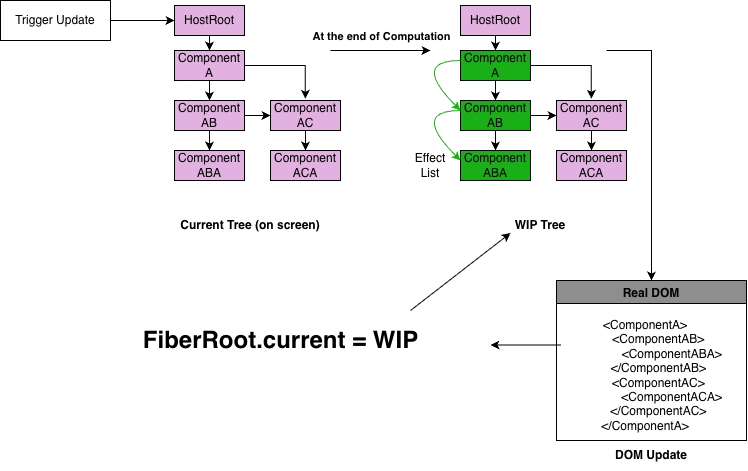
With Fiber, the reconciliation work is decomposed into smaller units of work. Each unit can be processed with attentiveness to higher-priority tasks. The scheduler can pause work when it detects user input, allow the browser to handle events, or let other critical tasks run, and then resume the remaining work later. This interruption capability is pivotal for maintaining interactive performance on time-sensitive tasks.
Several key concepts underpin Fiber:
- Work Units: The rendering work is divided into small chunks that can be executed incrementally. Each unit performs a portion of the diffing and patching steps, enabling better responsiveness.
- Scheduling and Priority: Updates are assigned priorities. User-initiated events like keystrokes or scrolls receive higher priority, while less critical updates can be deprioritized or deferred.
- Pausing and Resuming: The engine can yield control back to the browser mid-render, postponing non-critical work to preserve frame budgets and ensure smooth interactions.
- Reconciliation as a Flexible Process: The reconciler no longer assumes a single, uninterrupted pass. It can adjust in-flight work based on changing priorities and available time.
- Error Handling and Boundaries: Fiber’s architecture supports more granular error boundaries and improved error handling in asynchronous rendering scenarios.
The practical impact of these design choices is observed in several dimensions:
1) Responsiveness: By prioritizing user input and deferring less important work, React 16 reduces input latency and prevents jank during long renders. Users experience snappier interfaces, especially in data-heavy pages or complex component trees.
2) Scheduling Flexibility: The new model allows React to align rendering work with the browser’s availability, co-existing with other tasks and browser events. This alignment helps maintain stable frame rates, contributing to smoother scrolling and animation.
3) Incremental Rendering: Large component trees no longer force a single, long render. Instead, their rendering can be split into manageable chunks that stretch over multiple frames, reducing peak CPU usage and improving perceived performance.
4) Compatibility and Migration: Transitioning to Fiber required careful consideration for existing components and lifecycle semantics. While the end goals favored more predictable and responsive behavior, developers needed to adapt patterns to accommodate potential asynchronous rendering scenarios and new lifecycle opportunities.
5) Ecosystem and Tooling: Fiber’s introduction stimulated advancements in tooling, such as profiling capabilities that help developers measure where time is spent during rendering. It also set the stage for future enhancements in suspense, concurrent features, and more refined priority handling.

*圖片來源:Unsplash*
From a developer perspective, Fiber does not only promise faster, more responsive UIs; it also unlocks new capabilities for asynchronous rendering. This lays the groundwork for more sophisticated patterns, such as incremental loading, better suspense boundaries, and future optimizations that can further harness idle time and browser resources without compromising interactivity.
Perspectives and Impact
The advent of Fiber marks a turning point in how React balances performance with user-centric responsiveness. By decoupling the diffing phase from the actual DOM updates and enabling preemption, Fiber directly addresses one of the primary pain points in earlier React versions: the risk of blocking long render operations that degrade interactive performance.
A critical takeaway is that React 16 prioritizes user experience without sacrificing correctness. The ability to pause and resume work means React can ensure smooth input handling even in the face of large UI trees. This is particularly important for modern web applications, which often render dynamic and data-rich interfaces. As a result, developers can build more ambitious features and more complex interfaces without escalating concerns about UI stutter or input lag.
The implications extend beyond immediate performance gains. Fiber’s architecture invites a broader shift toward asynchronous rendering and non-blocking updates. It creates a framework where future capabilities—such as more granular concurrency, improved suspense mechanics, and even more adaptive scheduling—can be pursued with a solid foundation. This approach aligns with evolving web performance standards and the demand for responsive, interactive experiences across a wide spectrum of devices and network conditions.
Looking ahead, Fiber’s design anticipates further optimizations to reduce latency and improve throughput. As the ecosystem experiments with new patterns and as tooling matures, developers can expect more transparent performance profiling, better debugging experiences for asynchronous rendering, and easier adoption of advanced rendering strategies. The result is not merely a faster React, but a more capable one—one that can better adapt to the diverse and demanding workloads of modern web applications.
However, these advancements come with considerations. The introduction of asynchronous rendering requires developers to reconsider certain assumptions about component lifecycles and side effects. While React provides safeguards and abstractions to manage asynchronous work, practical usage may demand rethinking how and when effects run, how components mount, and how updates interact with user-driven events. With proper understanding and discipline, teams can harness Fiber to deliver smoother, more reliable interfaces.
In sum, Fiber represents a thoughtful re-architecture that preserves React’s core guarantees—predictable UI updates, composability, and a robust developer experience—while expanding the horizon of what’s possible in interactive web applications. The shift toward pausable, prioritized, and interruptible rendering embodies a forward-looking approach to performance that remains relevant as applications continue to grow in complexity and scale.
Key Takeaways
Main Points:
– Fiber is a complete rewrite of React’s reconciliation engine, enabling pausable, resumable, and prioritized rendering.
– The separation of diffing and patching allows better control over when and how work is performed.
– Priority-driven scheduling improves responsiveness to user input and interactive tasks.
Areas of Concern:
– Migration and lifecycle changes may require adjustments to rendering patterns.
– Asynchronous rendering introduces complexities in debugging and effect timing.
– Tooling and profiling must evolve to fully leverage Fiber’s capabilities.
Summary and Recommendations
The transition from the original Stack-based engine to Fiber marked a foundational improvement in React’s capacity to deliver responsive user interfaces. By enabling work to be paused, resumed, and prioritized, Fiber minimizes input lag during heavy renders and accommodates a broader range of workloads and devices. This architectural change unlocks opportunities for incremental rendering, improved suspense behavior, and future concurrency enhancements, all while preserving React’s core guarantees of predictable updates and composability.
For teams building modern applications, the practical takeaway is to design with priority-aware updates in mind. Leverage high-priority updates for user-driven interactions, profile rendering workloads to identify bottlenecks, and adopt patterns that align with asynchronous rendering where appropriate. While the transition to Fiber may require revisiting certain lifecycle patterns and effect timing, the payoff is a more resilient and responsive UI capable of delivering smooth experiences even under heavy rendering pressure.
As the ecosystem continues to evolve, Fiber’s principles will underpin further innovations in React’s concurrency model and performance tooling. Developers who embrace these changes can expect to build increasingly sophisticated interfaces without sacrificing responsiveness, ensuring applications feel fast and fluid across diverse scenarios and devices.
References
- Original: https://dev.to/nehamalviaaa/part-2-the-fiber-revolution-react-16-3g54
- Additional references:
- https://reactjs.org/docs/fiber-overview.html
- https://reactjs.org/docs/concurrent-mode-intro.html
- https://developer.chrome.com/blog/timing-responsiveness-priority-scheduling/

*圖片來源:Unsplash*