TLDR
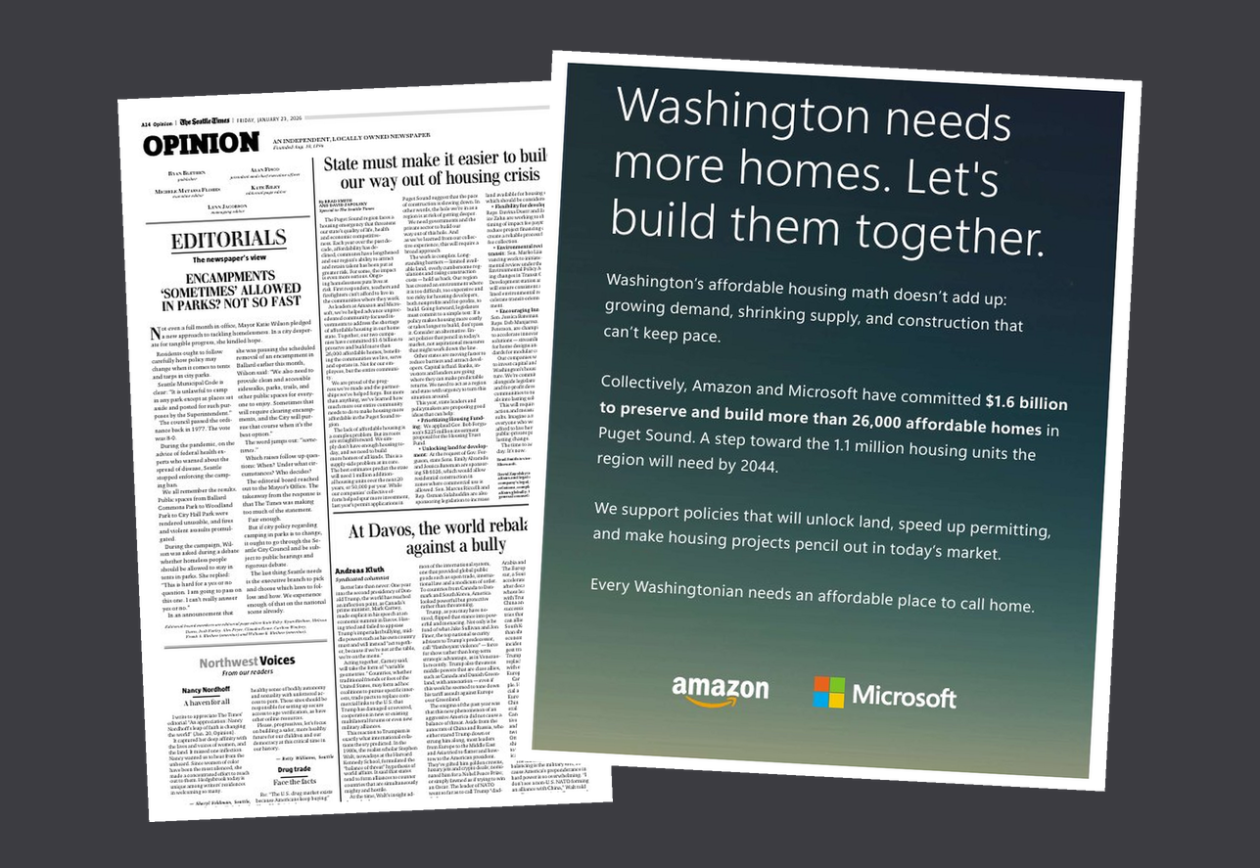
• Core Points: Rivalry in cloud services aside, Microsoft and Amazon align on addressing Washington state’s housing crisis through a coordinated policy push, including a joint op-ed and a full-page advertisement in The Seattle Times.
• Main Content: The collaboration signals a shared interest in housing affordability and supply as a policy priority, leveraging corporate voices to influence state policy discussions.
• Key Insights: Large tech employers recognize housing constraints as a friction point for talent retention and regional growth; the approach blends advocacy with public messaging to influence lawmakers.
• Considerations: The partnership raises questions about the role of private sector influence in housing policy and potential impacts on low-income communities and renters.
• Recommended Actions: Monitor policy proposals and funding debates in Washington; evaluate transparency of corporate advocacy and potential inclusionary housing measures or incentives.
Content Overview
Microsoft and Amazon, long-standing rivals in the cloud computing landscape, have teamed up on a policy front to address a shared challenge: Washington state’s housing affordability and supply crisis. The collaboration centers on a public-relations push that includes a joint op-ed authored by senior leaders from both companies and a full-page advertisement published in The Seattle Times. The effort underscores a growing trend where large technology employers use their influence to shape policy discussions around urban housing, zoning, and infrastructure to ensure the continued ability to attract and retain a skilled workforce.
The housing situation in Washington has become a focal point for employers who rely on a highly educated and mobile workforce. The Seattle metro area, along with broader Puget Sound regions, has experienced rapid population growth, rising rents, and a tight housing market in recent years. While tech giants have contributed to economic growth and job creation, the resulting demand for housing has outpaced supply, contributing to affordability challenges for many residents. The joint op-ed and advertising campaign signals that Microsoft and Amazon are seeking to elevate housing policymakers’ attention to concrete steps that can expand affordable housing, streamline zoning processes, and incentivize development in high-demand neighborhoods.
The two companies are known for competing vigorously in cloud services, with Amazon Web Services (AWS) and Microsoft Azure often positioned as direct rivals for enterprise clients seeking scalable infrastructure. Beyond competition, both firms have substantial real estate footprints in Washington state and rely on a steady influx of skilled workers, many of whom require affordable living options to remain in the region. The public-facing collaboration suggests a recognition that housing policy is an area where common ground can be found in pursuit of regional economic resilience and long-term talent pipelines.
The op-ed and ad present a measured, policy-oriented stance rather than a call for sweeping regulatory overhaul. While the specifics of proposed measures are not exhaustively detailed in public summaries, the messaging emphasizes a combination of supply expansion, faster permitting, rezoning where appropriate, and investments in transit-oriented development. The objective is to create a more predictable and scalable path to housing development that accommodates workers across income levels without compromising the region’s quality of life.
Commentators and observers note that the involvement of two corporate titans in housing policy discourse is part of a broader pattern, where large employers advocate for regulatory clarity, streamlined processes, and incentives that support housing construction near employment hubs. By collaborating on a high-visibility platform, Microsoft and Amazon aim to signal bipartisan or cross-partisan support for pragmatic policy changes, while also highlighting the potential economic benefits of a more robust housing ecosystem for business continuity and regional growth.
This development occurs in the context of ongoing political debates within Washington about housing policy funding, zoning reform, environmental considerations, and the balance between market-driven development and community protections. The joint effort illustrates how corporate advocacy can translate into public messaging that reaches a broad audience, including lawmakers, local communities, and potential employees who weigh relocation decisions against housing costs.
Overall, Microsoft and Amazon’s joint engagement on housing policy in Washington represents a pragmatic approach to a persistent urban issue. By aligning their voices and presenting a unified stance on practical policy levers, they are attempting to influence the policy conversation in a way that benefits not only their corporate interests but also the broader regional housing ecosystem. The long-term impact of this collaboration will likely depend on the specifics of enacted legislation, the allocation of public resources, and how well policymakers balance housing supply expansion with protections for vulnerable residents.
In-Depth Analysis
The collaboration between Microsoft and Amazon on housing policy marks a notable intersection of corporate strategy and public policy. While competition remains fierce in their primary business lines—cloud computing platforms AWS and Azure—the shared concern over Washington’s housing market reflects a recognition that talent attraction and retention are inseparable from the affordability and availability of housing.
Washington State has long been a hub for technology employment, driven by a cluster of software, hardware, and services companies concentrated in the Seattle metropolitan area and surrounding communities. The region’s growth has brought significant economic benefits, including high wages, accelerated innovation, and a thriving startup ecosystem. However, the rapid population increase has stressed housing supply, exacerbated affordability challenges, and created a dynamic where workers face long commutes, rising rents, and the risk of displacement.
For Microsoft and Amazon, the public stance on housing policy serves multiple strategic purposes. First, it signals a shared commitment to the regional ecosystem that supports their operations. A stable, affordable housing market reduces talent sourcing risk and helps ensure business continuity by widening the pool of potential employees, including first-time home buyers and essential workers who may otherwise be priced out of the area. Second, aligning on housing policy can help both companies bolster their corporate social responsibility profiles. By publicly supporting proactive policy changes, the tech giants can present themselves as constructive participants in urban development rather than distant corporate capital.
The op-ed and full-page advertisement appear to be carefully crafted communications designed to communicate broad policy principles rather than to advocate for highly specific measures. The messaging emphasizes the need for predictable planning processes, targeted investments in affordable housing, and smart growth strategies that pair housing development with transportation and infrastructure improvements. The emphasis on transit-oriented development aligns with broader regional goals to reduce vehicle reliance, ease congestion, and lower greenhouse gas emissions while still accommodating a growing workforce.
A critical dimension of this collaboration is transparency. Corporate involvement in public policy can be beneficial if it brings expert perspectives and practical considerations to the table. However, it also raises concerns about the potential for disproportionate influence by wealthy corporate entities over public policy, especially in issues that affect renters and lower-income residents. The balance between fostering business-friendly policy and protecting vulnerable communities requires careful legislative design, robust public engagement, and ongoing oversight to ensure equitable outcomes.
Policy mechanisms that are likely to be part of Washington’s housing policy discussions include:
- Expanding the supply of housing near employment centers through zoning reforms that allow higher-density development and reduce unnecessary restrictions.
- Streamlining permitting processes to reduce the time and cost required to bring housing projects to market.
- Providing targeted subsidies, tax incentives, or low-interest financing for affordable housing projects, particularly those that incorporate mixed-income housing and community amenities.
- Implementing or enhancing inclusionary housing policies that require a share of new developments to be affordable for low- to moderate-income residents.
- Coordinating housing policy with transportation investments to ensure that new housing developments are supported by reliable transit options and multimodal infrastructure.
- Protecting tenants’ rights and implementing renter-focused policies to balance market dynamics with housing stability.
Given the scale of Microsoft and Amazon’s operations and their geographic footprints, their joint stance may carry weight with policymakers who seek to balance economic growth with housing supply constraints. The Seattle-Tacoma corridor, in particular, stands to benefit from policy changes that reduce barriers to housing construction while ensuring that growth remains sustainable and inclusive. Yet the outcome will depend on the specifics of legislative proposals, the fiscal framework, and how well the policies integrate with environmental, labor, and community considerations.

*圖片來源:Unsplash*
Media strategy also plays a role in how effective this collaboration will be. A joint op-ed and full-page advertisement can create a strong signaling effect, reinforcing a united front and distributing talking points that emphasize shared goals. The choice of The Seattle Times—a major regional newspaper with broad readership—ensures that the message reaches policymakers, business leaders, civic organizations, and residents who are directly affected by housing dynamics. In addition to traditional media, the companies may amplify their message through digital channels, stakeholder meetings, and partnerships with local housing advocates to broaden reach and demonstrate constructive engagement.
It is important to consider how these efforts intersect with broader national and regional debates about housing policy. Across the United States, policy discussions frequently revolve around the tension between market-driven development and the need for affordable housing for middle- and lower-income residents. Washington’s political environment, which includes a mix of state-level policy initiatives and local government actions, provides a complex landscape for implementing changes. The involvement of two high-profile corporate players can help spotlight the issue but also invites scrutiny regarding whether corporate endorsement truly translates into meaningful policy enactment or is primarily a branding exercise.
Looking ahead, the long-term impact of Microsoft and Amazon’s housing policy collaboration will hinge on several factors:
- Legislation: Whether state lawmakers adopt specific zoning reforms, permitting reforms, and funding mechanisms that address the supply-demand imbalance.
- Implementation: The efficiency and transparency with which housing programs are administered, including oversight to prevent misuse of incentives or misallocation of public funds.
- Equity: The extent to which proposed policies address the needs of renters, low-income households, and marginalized communities, ensuring that benefits are equitably distributed.
- Economic outcomes: The potential for housing policy to influence regional competitiveness, labor markets, and overall economic resilience in the face of growth pressures.
- Community impact: How developments interact with existing neighborhoods, school capacity, infrastructure, and environmental considerations.
While this public alignment signals a pragmatic approach to a persistent challenge, it is not a substitute for comprehensive policy reform. Washington state will need to translate the high-level policy goals into concrete legislative text, backed by data, cost analyses, and stakeholder input. The responsibility also lies with local governments to implement reforms in ways that respect community input, preserve affordability over time, and integrate with transit and environmental objectives.
Ultimately, Microsoft and Amazon’s joint housing policy push underscores a broader trend: large employers increasingly recognize that housing affordability is not just a social issue but a practical business concern that can influence talent attraction, retention, and long-term competitiveness. By bringing their voices to the policy conversation in Washington, they contribute to a discourse that seeks to balance innovation-driven growth with inclusive, sustainable community development.
Perspectives and Impact
- Policymaker Lens: Lawmakers may view corporate advocacy as a constructive input into complex policy debates. The op-ed and advertisement can help frame housing policy in terms of pragmatic reforms that address supply constraints and support transit-oriented development. However, policymakers will require robust data, impact analyses, and transparent funding plans to translate intentions into actionable legislation.
- Community and Civil Society: Community groups and housing advocates might welcome the focus on increasing supply and reducing permitting friction. Conversely, there could be concerns about the extent to which private sector preferences shape policy, potentially favoring middle- and upper-income renters if incentives do not sufficiently protect lower-income residents.
- Economic Implications: A more accessible housing market could improve labor market mobility and reduce turnover costs for tech firms. It may also influence wage dynamics, cost of living discussions, and regional competitiveness. The key will be ensuring that housing gains are inclusive and sustainable over time.
- Corporate Strategy: For Microsoft and Amazon, the collaboration signals a holistic approach to regional development. It demonstrates a willingness to engage in public policy discussions beyond traditional lobbying and philanthropy, potentially strengthening corporate legitimacy and community relations.
Future implications extend beyond Washington. If successful, the joint venture could serve as a blueprint for other technology hubs facing housing affordability challenges. It may encourage similar cross-company collaborations or spur coalitions with local governments, urban planners, and housing advocates to devise scalable, data-driven policy solutions that enable growth without compromising community stability.
Key Takeaways
Main Points:
– Microsoft and Amazon, despite cloud-computing competition, jointly advocate for housing policy reforms in Washington state.
– The collaboration centers on a joint op-ed and full-page ad published in The Seattle Times to influence policymakers and public opinion.
– The policy emphasis appears to be on housing supply expansion, streamlined permitting, and transit-oriented development.
Areas of Concern:
– Potential unequal influence of wealthy corporations on housing policy and the risk of overshadowing the needs of renters and low-income households.
– The effectiveness of high-visibility messaging in driving substantive legislative changes without detailed policy proposals and funding commitments.
– The necessity of ensuring that proposed measures deliver long-term affordability and protection for vulnerable residents.
Summary and Recommendations
Microsoft and Amazon’s joint housing policy push in Washington represents a strategic alignment on a critical regional issue that affects both business operations and community wellbeing. By leveraging a shared public voice, the companies signal a commitment to enabling a sustainable, growth-friendly environment that can attract and retain talent. Their approach—public op-ed collaboration and a prominent advertisement—aims to elevate the housing debate, prompting policymakers to consider concrete, scalable measures that expand supply, shorten development timelines, and improve integration with transportation infrastructure.
For policymakers, the development signals a need to scrutinize proposed reforms through a rigorous lens of efficiency, equity, and fiscal sustainability. Detailed policy proposals, impact analyses, costings, and transparent funding mechanisms will be essential to turn aspirational goals into practical outcomes. For the broader community, the collaboration raises important questions about governance, inclusion, and the role of private sector influence in public policy.
In terms of practical steps, stakeholders should pursue:
– Clear, quantifiable housing targets tied to time-bound milestones (e.g., permits issued, units delivered, or transit-oriented developments completed).
– Streamlined permitting processes with accountability measures to reduce delays without compromising environmental and community protections.
– Inclusionary housing policies or equivalent incentives that ensure affordability across income levels, paired with strong renter protections.
– Coordinated planning that aligns housing expansion with transportation investments, utilities capacity, and school system planning.
– Transparent oversight of public funding and private-sector contributions to housing initiatives.
If Washington successfully translates this collaborative messaging into concrete, well-designed policy measures, the region could experience meaningful improvements in housing affordability and supply, with positive spillovers for economic resilience and quality of life. The joint effort also contributes to a broader dialogue about how private sector leadership can complement public policy in addressing complex urban challenges.
References
- Original: www.geekwire.com
- Additional context: Washington state housing policy discussions and regional economic reports (public policy analyses, municipal planning documents, housing data from state and local agencies)
- Related sources: Regional urban planning studies on zoning reform, transit-oriented development, and affordable housing incentives.

*圖片來源:Unsplash*