TLDR
• Core Points: A CL1 system, built on living human neurons organized with 59 electrodes, marks a commercial step beyond 2022 Pong demonstrations.
• Main Content: Engineered hardware uses a planar array of metal and glass to host neural tissue, enabling gameplay like Doom.
• Key Insights: This represents a fusion of biology and computing, raising questions about scalability, ethics, and future AI hardware paradigms.
• Considerations: Cost, reliability, and practical applications remain major hurdles; long-term data handling and neuron health are essential concerns.
• Recommended Actions: Monitor regulatory and ethical guidelines, pursue broader demonstrations, and encourage independent replication for transparency.
Content Overview
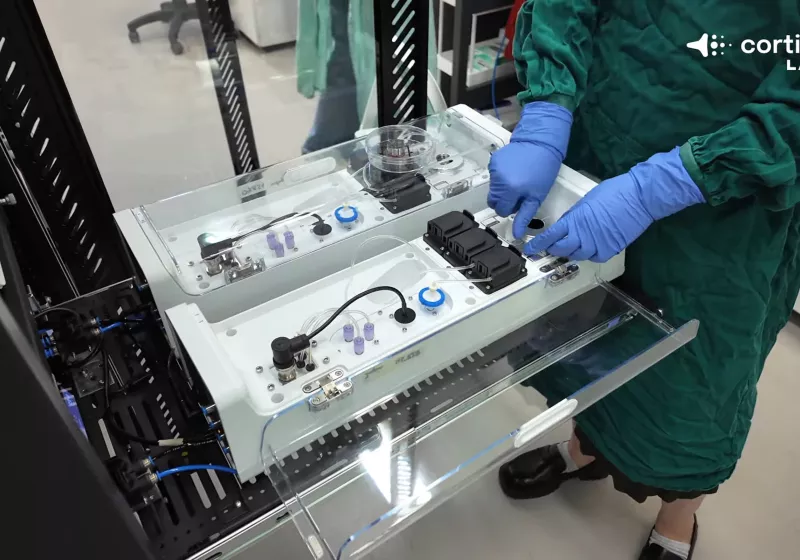
The CL1 project emerges as the commercial successor to a celebrated 2022 demonstration where researchers taught a cluster of around 800,000 living human neurons to play Pong. That earlier achievement captured wide attention by showing that biological neural networks could learn and perform tasks typically reserved for silicon-based AI. The CL1 aims to translate the same premise into a tangible hardware product designed for consumer and industrial evaluation. It features a planar array composed of metal and glass, upon which living neurons are cultured and interfaced with electronic components.
The core of the CL1 is its 59-electrode setup, arranged to establish an interface between the cultured neurons and external computing systems. This configuration is designed to facilitate input, processing, and output signals in a way that mirrors natural neural communication, but within a controlled engineered environment. The manufacturers position the CL1 as a first commercial iteration that can be deployed, evaluated, and iterated upon, providing a bridge between lab-scale demonstrations and more broadly accessible technology.
While the precise aims and proposed applications of the CL1 are still developing, the project highlights a broader trend in which living neural tissue is being used to explore computation, learning, and interaction. The idea is not to replace silicon processors wholesale but to explore hybrid architectures where biological and electronic systems can complement one another, potentially offering new ways to process information, learn from data, or interface with human operators.
Doom, as a test case, has become a recognizable benchmark due to its fast-paced action, spatial navigation requirements, and real-time decision making. Demonstrating Doom on a living-neuron-based computer underscores the practical challenge of translating gameplay tasks into a neural computation context. It also serves as a provocative demonstration of the capability of biohybrid systems to handle complex, interactive software environments.
The CL1 project rests at the intersection of neuroscience, bioengineering, and computer hardware design. Supporters argue that biohybrid systems could offer unique advantages in pattern recognition, adaptive control, and energy efficiency under certain conditions. Critics, however, caution about the stability of living tissue, ethical considerations, long-term viability, and the scalability of such systems to more demanding workloads or mass production.
In the broader landscape of computing and AI research, the CL1 adds to a growing spectrum of approaches exploring non-traditional substrates for computation. While silicon-based processors, neuromorphic chips, and quantum devices each promise specific strengths, biology-based computation invites questions about learning mechanisms, durability, and how such systems could be manufactured at scale. The ongoing dialogue touches on regulatory frameworks, safety protocols, and the criteria by which researchers and companies assess the practicality and value of biohybrid devices.
In-Depth Analysis
The emergence of a commercial system built around living human neurons marks a notable milestone in the domain of biohybrid computing. The device, referred to as the CL1, is designed to bring the concept of neuron-based computation from laboratory curiosity to a tangible product that can be tested, validated, and iterated in real-world settings. The technology builds on the fundamental idea demonstrated in 2022: that neural tissue, when organized and interfaced with appropriately designed hardware, can engage in computational tasks. The move to a 59-electrode planar platform represents a deliberate design choice to balance manageability, signal fidelity, and the capacity to form meaningful neural circuits within a compact footprint.
From a hardware perspective, the CL1 uses a planar array constructed from metal and glass to host the neural culture. The electrodes function as interfaces, enabling bidirectional communication between the living neurons and external electronics. Such interfaces typically rely on techniques to record electrical activity from neurons and to deliver precise stimuli that can influence neural firing patterns. The challenge in this space lies not only in capturing meaningful signals from living tissue but in maintaining tissue health and viability over time, ensuring stable signal quality, and preventing degradation that could affect performance.
The claim that the CL1 can run Doom serves multiple purposes. On one level, it provides a recognizable, high-pressure test scenario that stresses real-time processing, rapid decision making, and dynamic interaction with a simulated environment. On another level, it serves as a persuasive demonstration of the computing potential of biohybrid hardware: if a living-neuron network can handle gameplay dynamics, it may also perform complex tasks requiring adaptive control and pattern recognition. Yet translating the demands of a fast-paced first-person shooter into a neurobiological computation pipeline raises important questions about latency, reliability, and consistency across sessions.
One of the central considerations for this technology is scalability. A system built around living tissue raises questions about how to scale up from a small, controlled array to larger, more capable computational substrates. Biological systems are inherently variable; neurons can change their behavior in response to environmental factors, health status, and aging. This variability could complicate efforts to deliver predictable performance or to reproduce results across devices or over time. Consequently, commercialization hinges on robust standardization, rigorous quality control, and clear protocols for tissue preparation, maintenance, and replacement if necessary.
Ethical and regulatory dimensions are equally significant. The use of living human neurons in consumer- or enterprise-facing hardware invites scrutiny regarding donor consent, tissue sourcing, privacy considerations related to neural data, and potential welfare concerns. Researchers and developers must navigate frameworks that govern biomedical research, experimental devices, and neuromorphic technologies. Transparent reporting, independent verification, and adherence to established ethical guidelines will be crucial to maintaining public trust as this field progresses.
Battery life, energy efficiency, and thermal management are practical constraints that bear on any hardware device, and biohybrid systems have unique considerations. The metabolic activity of living tissue can influence power requirements and heat generation, potentially impacting device longevity and stability. Ensuring that the system can operate reliably in varying environmental conditions — such as altered temperatures or humidity — is essential for real-world use, whether in laboratory settings, research environments, or exploratory demonstrations.
In terms of potential applications, biohybrid computing could complement traditional AI hardware in scenarios where adaptive learning, real-time feedback, or sensory processing plays a critical role. For example, living neural networks might offer distinct advantages in pattern recognition tasks or dynamic control loops where conventional digital algorithms struggle with adaptation. However, these opportunities must be weighed against the current limitations in durability, reproducibility, and cost. The CL1, with a price point of $35,000, positions itself as an experimental, exploratory platform rather than a mass-market product. The cost may be a barrier for widespread adoption, but it could be justified for research institutions, specialized labs, or early adopters interested in examining the performance characteristics and potential of biohybrid hardware.
The broader scientific and engineering communities will be watching how the CL1 performs across different benchmarks, workloads, and operating conditions. Independent replication and peer-reviewed validation will be essential to establish credibility and to clarify the scope of capabilities. If the technology demonstrates reproducible advantages in specific tasks or domains, it could stimulate parallel research into more robust interfacing strategies, tissue preservation methods, and scalable manufacturing approaches that reduce costs and improve consistency.
At the same time, the field must address questions about long-term tissue viability. Maintaining living neurons outside the body requires carefully controlled environments that preserve cellular health, prevent contamination, and manage metabolic waste. The engineering challenge is not only to coax neurons to perform tasks but to do so in a manner that preserves their biological integrity over meaningful timeframes. Advances in biocompatible materials, microfluidics, and intracellular stimulation techniques will likely play a central role in sustaining such systems.
The Doom-capable demonstration also invites speculative discussions about the future of computation. If biohybrid systems become more capable and reliable, they could inspire hybrid architectures that combine the adaptability of biological networks with the precision and scalability of silicon-based processors. Such hybrids might leverage neurological-inspired learning rules and real-time environmental interaction to enhance performance in domains like robotics, autonomous systems, and adaptive control. However, the path from a single demonstration to a general-purpose platform is long and uncertain, with substantial hurdles to overcome in stability, manufacturability, and ethical governance.

*圖片來源:Unsplash*
Finally, the commercial narrative around the CL1 underscores the tension between ambitious scientific innovation and the pragmatic realities of bringing new hardware to market. The $35,000 price tag reflects the early-stage nature of the product, the costs associated with sourcing biological materials and maintaining sterile, controlled environments, and the specialized expertise required to operate and interpret the system. For stakeholders, the key questions are whether the technology can scale, whether its benefits justify the investment, and how it compares to alternative computing approaches in terms of performance, cost, and risk.
Perspectives and Impact
The CL1 program sits within a broader ecosystem of research and development aimed at expanding the substrate for computation. Proponents argue that biohybrid devices could unlock novel computational paradigms, particularly in areas where learning dynamics and adaptive behavior are crucial. Unlike traditional silicon chips that rely on fixed architectures, living neural networks can exhibit plasticity, potentially enabling on-device adaptation and learning in situ. If these capabilities can be harnessed reliably, biohybrid systems might offer energy efficiency advantages in specific tasks or operate with forms of computation that are more naturally aligned with human cognitive processes.
Ethical considerations stand as a central pillar of ongoing discourse. The use of living human neurons, even in anonymized and controlled contexts, demands careful attention to consent, donor rights, and the potential implications for privacy and human notional boundaries. Public policy will increasingly need to address questions about ownership of biohybrid devices, access to their intellectual property, responsibility for failures or unintended outcomes, and the potential for dual-use applications that raise safety concerns.
From a research perspective, independent replication and rigorous evaluation will shape the trajectory of this field. An open science approach, with clear reporting of experimental conditions, neuronal culture methods, electrode configurations, and performance benchmarks, will help establish credibility and facilitate cross-lab comparisons. The development of standardized benchmarks for biohybrid computation could accelerate progress and enable researchers to measure gains against established baselines.
The potential impact on education and training is another dimension to consider. If biohybrid computing devices become more common, they may become teaching tools that help students and professionals understand neural dynamics and neuromorphic principles in a hands-on context. This could inspire new lines of inquiry in neuroscience, bioengineering, and computer science, fostering interdisciplinary collaboration and new curricula that bridge the gap between wet-lab experiments and hardware design.
Industrial implications also deserve attention. For organizations that rely on real-time decision making, such as robotics and automation, biohybrid components could offer new ways to integrate learning from experience with robust control systems. However, industry adoption will hinge on achieving reliable performance, predictable maintenance, and clear cost-benefit advantages over conventional hardware. The balance of risk and reward will determine whether companies invest in biohybrid platforms as complementary tools or pursue parallel research programs to explore similar capabilities using purely silicon-based approaches.
The governance landscape will adapt as technologies like the CL1 evolve. Regulatory bodies may introduce requirements related to safety, data handling, and ethical standards for devices that incorporate living tissue. International collaboration and harmonization of guidelines could help streamline research while protecting public interests. Ongoing dialogue among scientists, policymakers, and ethicists will be essential to navigate the uncertainties and opportunities presented by biohybrid computation.
Looking ahead, the field may progress through incremental improvements in tissue viability, electrode design, signal processing, and software interfaces. Each advancement could unlock higher levels of performance or expand the range of feasible applications. At the same time, researchers must remain vigilant about the limitations and non-linear dynamics inherent in living systems, which can complicate predictability and control. A cautious, iterative approach—coupled with transparent reporting and independent verification—will be critical to ensuring that the technology develops in a responsible and beneficial direction.
In sum, the CL1 represents a provocative step in the evolution of computing, illustrating how living neural tissue can be integrated into engineered hardware to perform tasks that were previously the domain of purely digital systems. While it is too early to judge the long-term viability or broad utility of such devices, the project contributes valuable data and insights to a debate that intersects neuroscience, engineering, ethics, and public policy. As this line of inquiry progresses, stakeholders will need to address fundamental questions about scalability, safety, and societal impact alongside the pursuit of technical breakthroughs.
Key Takeaways
Main Points:
– The CL1 is a commercial successor to earlier demonstrations showing living neurons performing computational tasks.
– It uses a 59-electrode planar array with living human neurons cultured on a metal-glass substrate.
– The system can run complex software like Doom, illustrating real-time interactive capabilities.
Areas of Concern:
– Long-term viability and stability of living tissue in a consumer/enterprise device.
– Ethical, legal, and privacy considerations surrounding the use of human neurons in hardware.
– Scalability, manufacturing consistency, and cost barriers to broader adoption.
Summary and Recommendations
The CL1 project showcases a bold experiment at the intersection of biology and computing. By embedding living neurons within a planar, electrode-connected hardware platform and demonstrating real-time gameplay such as Doom, researchers are pushing the boundaries of what is possible with biohybrid systems. The price point and early-stage nature of the device position it as a research-oriented platform rather than a mass-market solution. This underscores a broader, longer-term question: can living neural networks offer a viable computational substrate that complements or competes with silicon-based hardware?
For now, the most prudent approach is to treat the CL1 as a foundational exploration with potential pathway toward new classes of computation. While the technology is intriguing, its practical impact will depend on several critical factors: sustained tissue viability, reproducibility across devices, rigorous ethical and regulatory compliance, and demonstrable advantages in specific applications that justify its costs. Independent verification and transparent reporting will be essential to validate claims and enable meaningful comparisons with alternative approaches in neuromorphic and conventional computing.
If the field advances, we may see more sophisticated biohybrid systems that address current limitations—through improved materials science, advanced microfluidics, and refined interfacing techniques that better harmonize biological and electronic signals. The ethical governance surrounding such technologies will also need to mature, ensuring responsible development and clear boundaries for applications. As researchers, engineers, policymakers, and the public engage with these questions, the trajectory of biohybrid computing will become clearer: a niche but potentially impactful avenue that could reshape how we think about computation, learning, and the boundaries between life and machines.
References
- Original: https://www.techspot.com/news/111506-35000-computer-made-living-human-neurons-can-run.html
- Additional references to contextualize discussing topics (to be added by user as needed):
- Review articles on biohybrid computing and neuron-electronic interfaces.
- Ethical guidelines for research involving living neural tissue in devices.
- Reports on neuromorphic computing and non-traditional substrates for computation.

*圖片來源:Unsplash*