TLDR
• Core Points: Anbernic launches RG G01, a standalone gamepad with a 2.5-inch display and built-in heart rate sensor, designed to streamline customization rather than enable secondary-screen gameplay.
• Main Content: The device departs from Nintendo’s dual-screen approach, focusing on intuitive customization and fitness-oriented features within a retro gaming chassis.
• Key Insights: The inclusion of a heart rate sensor signals a shift toward health-tracking integration in handheld gaming, raising questions about practicality and user demand.
• Considerations: Market reception, battery life, software ecosystem, and the alignment of health features with gaming experiences require evaluation.
• Recommended Actions: Prospective buyers should weigh the novelty against practical needs, compare with existing handhelds, and monitor software support and price.
Content Overview
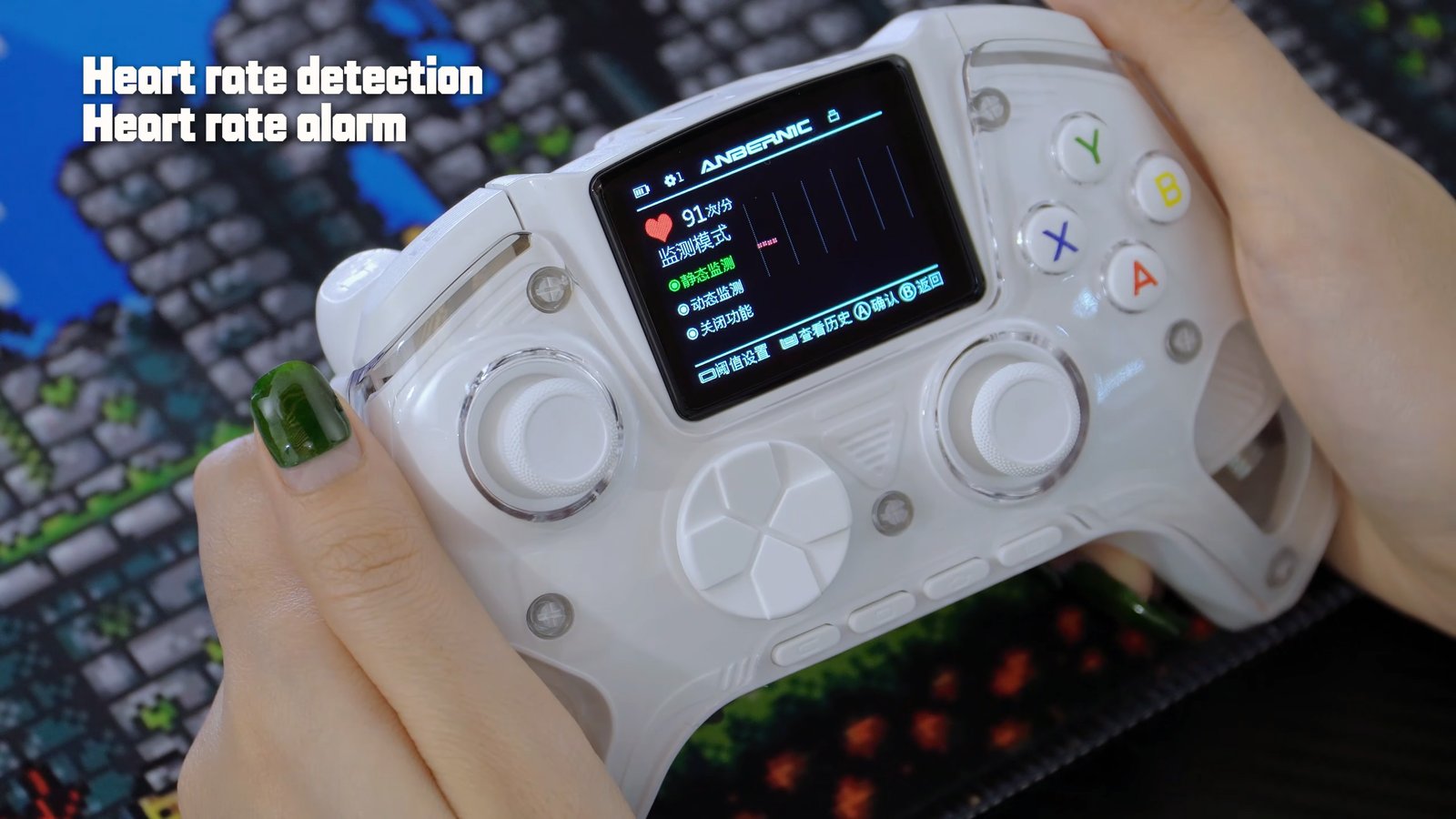
Anbernic, a name long associated with retro handheld gaming, has unveiled the RG G01, a new controller-style device that integrates a screen into its form. Unlike Nintendo’s Wii U controller, which used a built-in second display to augment gameplay, Anbernic’s RG G01 does not advertise second-screen functionality for games. Instead, the 2.5-inch HD display is positioned to streamline in-device customization—an area the company frames as a core advantage. The RG G01 also features an unusual pairing for a gaming peripheral: a heart rate sensor embedded within the controller. The combination of a small form-factor screen and biometric data collection aims to offer a more intuitive customization workflow and a distinctive value proposition for players who want to monitor physiology while gaming. In this article, we explore what the RG G01 brings to the table, how it fits into Anbernic’s broader ecosystem, and what it could mean for players who value both retro aesthetics and modern sensor-enabled features.
In-Depth Analysis
Anbernic’s RG G01 represents a deliberate pivot from pure retro nostalgia toward a more feature-rich, if unconventional, controller design. The 2.5-inch HD display, a defining hardware feature, is integrated into a compact form factor that resembles a traditional gamepad more than a handheld console. The display’s primary purpose, according to Anbernic, is to simplify customization workflows. This could involve on-device menus for mapping controls, tweaking performance profiles, selecting display modes, or adjusting lighting and aesthetic options that would otherwise require software tools or companion apps.
This emphasis on ease of customization aligns with a broader industry trend: manufacturers increasingly seek to reduce friction between hardware and the user’s preferred playstyle. By placing essential configuration options in reach of the thumbs, the RG G01 could appeal to users who value quick, on-the-fly adjustments without pulling out a smartphone or PC. It also hints at a potential future where more settings—such as key remaps, macro assignments, and profile switching—are accessible directly through the device’s display, potentially enabling rapid transition between games or genres.
The heart rate sensor introduces a biometric layer that is less common in retro or handheld gaming devices. Biometric data can be used for a variety of purposes, ranging from wellness-oriented features (e.g., activity monitoring, stress or exertion gauging) to potential game-integrated experiences (e.g., adaptive difficulty or real-time feedback tied to your physiological state). However, the practical integration of heart rate data into gameplay or user experience will hinge on the accompanying software ecosystem. Without meaningful software hooks—such as title-specific support, robust health data visualization, or in-game mechanics that respond to heart rate—the sensor risks feeling like a novelty rather than a core feature.
From a hardware perspective, the RG G01’s design choices appear to balance familiarity with novelty. The form factor is approachable for fans of traditional controllers, as are the button layouts and triggers. The added display and heart rate sensor do introduce additional considerations, notably power consumption and battery life. A screen and a sensor both draw power, potentially shortening life between charges in typical gaming sessions. Anbernic will need to provide transparent specifications regarding battery capacity, uptime under typical usage, and charging options to reassure prospective buyers.
Software compatibility and ecosystem support are equally important. If the RG G01 is intended as a standalone controller that can pair with multiple devices, the ease of pairing, latency, and cross-platform compatibility will heavily influence its appeal. Moreover, how the device handles firmware updates, access to a growing library of customization options, and whether the display can function as more than a secondary menu—such as a dynamic HUD or game-state indicator—will shape long-term value.
The RG G01’s reception will likely vary by audience segment. Retro gaming purists may appreciate the nod to classic aesthetics combined with modern conveniences, while power users who rely on extensive customization and robust software ecosystems might demand deeper, more flexible features. The heart rate sensor could attract fitness-minded gamers or those curious about quantifying their gaming sessions, but it may alienate users who see it as extraneous or unnecessary.
In terms of positioning, Anbernic faces a delicate balance between leveraging nostalgia and delivering practical features that resonate with current users. The RG G01’s novelty could generate early buzz, but sustained interest will depend on real-world utility, ease of use, and how compelling the health-tracking angle proves to be in actual gameplay contexts.
Market dynamics also play a role. Consumer interest in biometrics has grown in broader tech ecosystems, yet the gaming space has yet to fully mainstream this concept in affordable, handheld devices. If Anbernic can craft a coherent narrative and deliver dependable software support that translates biometric data into tangible benefits or engaging experiences, the RG G01 could carve a distinct niche. Conversely, if the display’s purpose remains limited to cosmetics or basic menu navigation, the device risks being perceived as an experimental detour rather than a solid product offering.
Finally, the RG G01 must compete within a crowded segment of handheld and controller-based devices. There are many retro-inspired consoles and third-party controllers that offer strong build quality, a diverse game library, and reliable ecosystems. The RG G01’s differentiators—the integrated display and heart rate sensor—need to translate into clear, practical advantages that justify its price and potential trade-offs in portability and battery life. As with many such devices, early impressions, hands-on testing, and long-term usability will be the true tests of whether the RG G01 becomes a sustainable addition to Anbernic’s lineup.

*圖片來源:Unsplash*
Perspectives and Impact
If Anbernic’s RG G01 gains traction, it could signal a broader industry interest in blending biometric data with handheld gaming. Developers might explore biometrics as triggers for adaptive difficulty, hazard warnings, or mood-based lighting and soundscapes that respond to a player’s physiological state. The prospect of real-time heart rate feedback influencing game pacing or mode selection could open up new creative avenues for game designers and hardware makers alike. However, this potential hinges on a robust software framework and developer tools that enable seamless data integration without compromising user privacy and battery endurance.
From a consumer perspective, the RG G01 could appeal to collectors and enthusiasts who prize distinctive hardware that stands out from conventional controllers. The combination of a compact screen for on-device configuration, a familiar ergonomic footprint, and an unconventional health-tracking feature offers a multi-faceted value proposition. Yet the value proposition must be more than novelty. Consumers will be looking for convincing demonstrations of how the display and biometric features translate into meaningful improvements to the gaming experience, whether through convenience, performance tuning, or novel gameplay mechanics.
In the broader market context, Anbernic’s strategy illustrates how hardware makers continually experiment with form factors and sensor integrations to differentiate products in a competitive field. The success of the RG G01 could influence future product iterations not only for Anbernic but for other companies contemplating similar feature sets. If the device proves popular, it could spur more peripherals or hybrid devices that blend immediate in-device controls with biometric data capture, potentially creating a new subcategory within handheld gaming devices.
On the software side, the importance of a strong companion app and ongoing firmware support cannot be overstated. A dedicated ecosystem that allows users to customize controls, monitor heart rate metrics, and access updates will be critical to sustaining interest. Privacy considerations will also come into play, as health data handling will require clear policies, secure storage, and user consent mechanisms. The degree to which Anbernic can communicate its commitment to user privacy and data security will influence consumer trust and adoption.
Ultimately, the RG G01 highlights a broader conversation about the role of health and biometric data in casual gaming. While not all players will want or need a heart rate sensor in their handheld, there is a segment of users curious about quantifying their gaming experience or using a device as a personal wellness companion. The challenge for Anbernic and similar manufacturers will be to translate this curiosity into tangible, long-lasting value that enhances play rather than distracts from it.
Key Takeaways
Main Points:
– Anbernic introduces the RG G01, a gamepad with a built-in 2.5-inch HD screen and a heart rate sensor.
– The display is positioned to facilitate on-device customization rather than enable second-screen gameplay.
– The heart rate sensor brings biometric data into the handheld gaming space, with uncertain practical utility.
Areas of Concern:
– Battery life and power management with a screen and sensor active.
– How software will leverage heart rate data for meaningful gameplay or personalization.
– Market reception and whether the feature set justifies potential price and bulk.
Summary and Recommendations
The RG G01 marks an intriguing if unconventional entry in Anbernic’s catalog, combining a compact, controller-like form with a small display and biometric sensing. Its core promise lies in simplifying customization through an on-device screen while offering a heart rate sensor that could, in theory, enable novel interactions or wellness-oriented features. However, the device’s success will depend heavily on software support, the robustness of the biometric integration, and the extent to which users perceive real value from these features.
For consumers, the RG G01 is worth a careful evaluation. Prospective buyers should consider how much they value quick, on-device customization versus relying on companion apps or desktop software. They should also assess whether a heart rate sensor adds practical gaming value or is primarily a novelty. Battery life remains a key practical concern, given the dual power demands of a display and biometric sensor.
From a broader industry perspective, the RG G01 exemplifies ongoing experimentation at the intersection of classic gaming and modern sensor tech. If Anbernic can deliver a compelling software ecosystem that meaningfully leverages heart rate data—while maintaining portability and user-friendly operation—the RG G01 could influence future hardware designs and encourage a healthier, more data-informed approach to gaming experiences. Otherwise, it may serve as a curiosity-driven footnote in the evolution of handheld gaming devices.
Overall, the RG G01 is a product of curiosity as much as utility. It invites debate about what players want from a modern retro gaming device: is nostalgia enhanced by a screen for quick settings, or should a handheld prioritize battery life, expansive game libraries, and polished software? Only through hands-on testing, long-term usage, and market feedback will practitioners and enthusiasts determine whether Anbernic’s latest venture will be remembered as a clever experiment or a meaningful step forward in portable gaming.
References
- Original: https://www.engadget.com/gaming/retro-handheld-maker-anbernic-has-a-new-gamepad-with-a-screen-and-heart-rate-sensor-201651899.html?src=rss
- Additional sources to consult for context on biometric integration in gaming and handheld customization trends:
- [Reference 1] Industry trend reports on biometric data in consumer electronics and gaming peripherals
- [Reference 2] An overview of handheld gaming device ecosystems and accessory ecosystems
- [Reference 3] General coverage of Anbernic’s product lineup and design philosophy

*圖片來源:Unsplash*