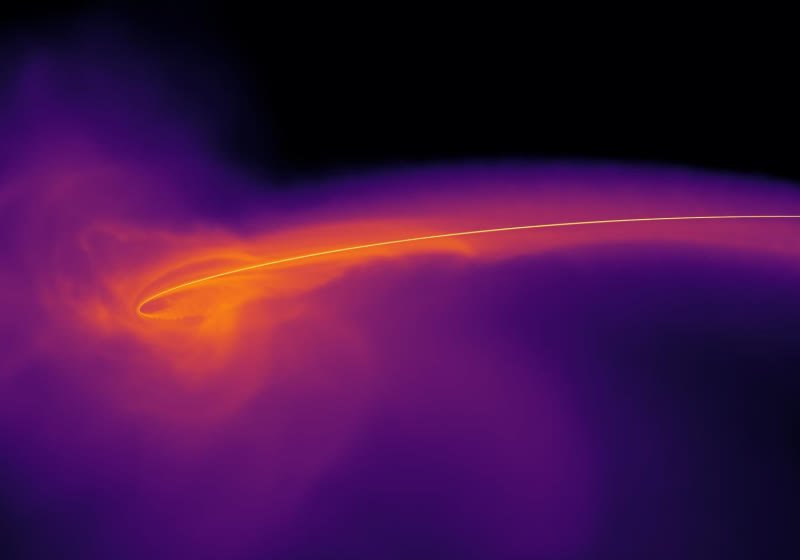
TLDR
• Core Points: A star in a fatal embrace with a supermassive black hole underwent a tidal disruption event, releasing vast energy as it was stretched and torn apart in a process known as spaghettification.
• Main Content: The event AT2024wpp, detected by astronomers, showcases extreme gravitational forces that shred stars near black holes, offering unique insights into black hole feeding and stellar dynamics.
• Key Insights: Tidal disruption events illuminate black hole properties, stellar demographics in galactic centers, and the extreme physics of gravity near event horizons.
• Considerations: Observations depend on multi-wavelength data, and interpretations rely on models of stellar debris evolution and accretion physics.
• Recommended Actions: Continue systematic surveys of galactic nuclei, refine tidal disruption models, and coordinate follow-up observations across facilities.
Content Overview
In recent months, researchers reported the detection and analysis of AT2024wpp, an extraordinary astrophysical event centered around a supermassive black hole (SMBH) and a passing star that wandered into the black hole’s gravitational grasp. The phenomenon is a canonical example of a tidal disruption event (TDE), wherein a star that ventures too close to a SMBH experiences extreme tidal forces. These forces exceed the star’s self-gravity, effectively tearing it apart in a process often described as spaghettification, as the differential gravity stretches the stellar material along the radial direction toward the black hole while compressing it perpendicularly.
The study contributes to a growing catalog of TDEs that illuminate the dynamics at the centers of galaxies, where SMBHs quietly influence stellar populations and gas dynamics for millions to billions of years. In the case of AT2024wpp, the disruption released an immense amount of energy, shedding light on the physics of how stellar debris is heated, dispersed, and eventually accreted by the black hole. The event also provides empirical data to probe black hole masses, spins, and the structure of the surrounding accretion environment, all inferred through careful modeling of light curves, spectral signatures, and the evolution of the transient emission over time. The discovery underscores the synergy between wide-field surveys, time-domain astronomy, and targeted follow-up observations across multiple wavelengths, including optical, ultraviolet, and X-ray bands.
The narrative of TDEs is not only a tale of destruction but also a laboratory for extreme physics. The gravitational grip of a SMBH can reach values of tens of thousands to millions of solar masses, depending on the host galaxy, and the forces at play near the tidal radius—where the star is disrupted—are immense. As the stellar debris streams converge, shocks and gravitational torques reshape the material, some of which ultimately forms an accretion flow around the black hole, emitting radiation that we can detect with modern telescopes. The event AT2024wpp thus provides a rare window into the final stages of stellar evolution in galactic nuclei and the feeding habits of some of the most massive objects in the universe.
This article synthesizes what is publicly known about AT2024wpp, situating it within the broader context of tidal disruption science, and outlines the implications for our understanding of black holes and their environments. It also considers observational challenges, methodological approaches, and the avenues for future research that such dramatic events inspire.
In-Depth Analysis
AT2024wpp represents a significant data point in the ongoing effort to map and interpret tidal disruption events around supermassive black holes. TDEs occur when stars pass within a critical radius, known as the tidal radius, where tidal forces exceed the self-gravity that binds the star. For SMBHs in the typical mass range found in the centers of large galaxies, this radius lies outside the event horizon, making detectable electromagnetic signatures possible as the disrupted material interacts with the black hole’s gravity and surrounding environment.
The observational signature of AT2024wpp comprises a rapidly rising luminosity across multiple wavelengths, followed by a gradual decline that tracks the fallback and accretion of stellar debris. In the initial phase, the star is shredded into streams of gas, each with differing orbital energies. The most bound portions of the debris return first, forming an accretion stream that powers intense radiation. The timescale over which this process unfolds—ranging from weeks to months or longer, depending on the black hole mass and the disrupted star’s properties—yields a characteristic light curve that helps distinguish TDEs from other transient phenomena such as supernovae or active galactic nucleus variability.
Spectroscopic observations of TDEs often reveal broad emission lines and characteristic signatures of highly ionized gas. As the debris becomes progressively heated and ionized, the spectrum evolves, offering clues about the velocity structure of the gas, the composition of the disrupted star, and the energy budget of the event. In AT2024wpp, data from optical and ultraviolet surveys, complemented by X-ray observations where available, contributed to a coherent interpretation of the disruption scenario. By modeling the light curve and spectral evolution, researchers can infer properties such as the black hole mass, the disrupted star’s mass and type, and the geometry of the debris streams.
A key challenge in TDE studies is disentangling the various processes that shape the observed emission. The energy released during a tidal disruption is distributed among heating of the stellar debris, shocks within the interacting streams, and the formation and fueling of an accretion disk around the black hole. The accretion process itself can radiate across a broad spectrum, from radio to X-rays, depending on the accretion rate and the configuration of magnetic fields and surrounding gas. In some TDEs, jets may be launched, emitting in the radio and high-energy bands, though not every disruption produces a jet. The presence or absence of such jets in AT2024wpp would have important implications for models of jet formation and the coupling between the black hole’s spin, magnetic fields, and the inflow of material.
From a galactic perspective, TDEs like AT2024wpp provide an astrophysical laboratory for exploring the demographics of black holes and the environments in which they reside. The rate of TDEs is expected to scale with the density of stars in the nuclear region and with the gravitational sphere of influence of the SMBH. By accumulating observations of multiple TDEs, scientists can test theoretical predictions about how often stars are disrupted in different types of galaxies and how the mass distribution of black holes influences the observable properties of these events.
AT2024wpp also has implications for our understanding of stellar dynamics in galactic centers. The dynamics that lead a star into the perilous proximity of a SMBH involve complex gravitational interactions, resonant relaxation, and perturbations from other stars and gas clouds. Studying the distribution of velocities and trajectories among disrupted stars can shed light on the long-term evolution of the central stellar cluster and how such extreme events affect the surrounding environment, including potential feedback mechanisms that influence gas dynamics and star formation in the central regions of galaxies.
The event’s energy scale is immense, yet the observable footprint is ultimately shaped by the geometry and orientation of the disruption relative to our line of sight. Depending on the viewing angle, some signatures can be more pronounced in the ultraviolet or soft X-ray bands, while others may dominate in the optical range. This anisotropy complicates the interpretation and requires careful comparison across a range of wavelengths and instruments. As techniques and instruments advance, researchers will be better positioned to reconstruct the full three-dimensional structure of the debris and the evolution of the accretion process in TDEs like AT2024wpp.
In terms of broader scientific impact, AT2024wpp reinforces the importance of time-domain astronomy and coordinated observational campaigns. The ability to rapidly identify a transient event and mobilize a suite of telescopes to monitor its evolution is critical for capturing the early, high-energy phases of a tidal disruption and for building a comprehensive data set that spans multiple wavelengths. Such collaborative efforts enable more robust determinations of black hole properties and provide empirical constraints for simulations of gravity-dominated phenomena.
The study behind AT2024wpp likely involved a consortium of observatories and research teams worldwide, leveraging surveys that continuously monitor the sky for transient events and specialized follow-up facilities capable of spectroscopy and high-resolution imaging. The interdisciplinary nature of this research—combining astrophysics, gravitation theory, hydrodynamics, and radiation transfer—highlights how modern astronomy advances through data integration and cross-disciplinary collaboration.
Future work following the AT2024wpp analysis will focus on refining the physical models that connect observed light curves to the underlying dynamics of the disrupted star and the black hole. This includes improving estimates of the black hole mass, spin, and the geometry of the debris streams, as well as exploring the potential presence of jets and their radiative signatures. Long-term monitoring could reveal late-time accretion behavior, possible rebrightening episodes, or changes in spectral features that inform theories of disk formation, debris circularization, and energy dissipation mechanisms.

*圖片來源:Unsplash*
Moreover, AT2024wpp contributes to a growing catalog of observed TDEs that will enable statistical studies, probing how rates and characteristics vary with galaxy type, environmental conditions, and black hole properties. As transient surveys become more sensitive and widespread, the discovery rate of such events will likely increase, offering richer datasets to test theoretical models and improve our understanding of the extreme physics governing black holes and their interactions with stars.
Perspectives and Impact
The observation of AT2024wpp emphasizes the value of time-domain astronomy in uncovering rare and extreme astrophysical phenomena. Tidal disruption events are not only dramatic displays of gravitational physics but also practical probes of the otherwise invisible population of dormant supermassive black holes. By capturing the emissive signature of a star as it undergoes spaghettification and subsequent accretion, astronomers gain access to a testbed for theories of gravity, hydrodynamics, and radiation transport under conditions unattainable in terrestrial laboratories.
From a theoretical standpoint, AT2024wpp serves as a data-rich case study for validating models of how stellar debris behaves in the strong-field regime of gravity. The interplay between the disruption process, debris circularization into an accretion disk, and the onset of accretion-powered emission remains an area of active research. Each observed TDE contributes to mapping the range of possible outcomes, such as whether a disk forms promptly or with delays, how efficiently energy is radiated, and how magnetic fields influence jet formation and angular momentum transport.
The broader implications touch on galaxy evolution as well. SMBHs are central to the growth and evolution of their host galaxies, and the intermittent feeding episodes represented by TDEs may contribute to the secular evolution of galactic centers. While a single event like AT2024wpp does not dramatically alter a galaxy, the cumulative effect of many such episodes over cosmic time could influence gas dynamics, star formation rates, and the co-evolution of black holes and their stellar environments.
Educationally, events of this nature capture public interest and inspire the next generation of scientists. The vivid imagery associated with spaghettification and tidal disruption translates into compelling demonstrations of gravitational physics and astronomical observation. They also illustrate the scientific method in action: hypothesis generation, multi-wavelength observation, data modeling, and iterative refinement of interpretations as new information becomes available.
Technological and methodological advancements are another vector of impact. The requirements for rapid, precise localization, high-cadence monitoring, and sensitive spectroscopy drive the development of instrumentation, data processing pipelines, and international collaboration frameworks. These technical legacies ripple into other areas of astronomy and can spur innovations in related fields such as computational astrophysics, machine learning for transient classification, and real-time alert systems for time-critical observations.
Finally, AT2024wpp highlights the need for careful, reproducible science in the face of extraordinary claims. While the energy scales and dynamic behavior associated with tidal disruption events are well-grounded in theory, each new observation must be scrutinized in the context of observational biases, selection effects, and modeling uncertainties. The scientific community benefits from transparent reporting, cross-checking with independent datasets, and the continuous refinement of models as instrumentation improves.
Future prospects for the study of tidal disruption events are robust. As all-sky surveys become more sensitive and capable of rapid follow-up, the discovery rate of TDEs is expected to rise. Enhanced theoretical models will support the interpretation of increasingly complex datasets, including potentially polarized light signatures that can inform magnetic field structures in the debris. The confluence of observational prowess and theoretical sophistication will deepen our understanding of extreme gravity and the dynamic lives of supermassive black holes.
Key Takeaways
Main Points:
– AT2024wpp is a tidal disruption event where a star was torn apart by a supermassive black hole, a process that produces extreme gravitational and radiative phenomena.
– The event provides empirical constraints on black hole properties, stellar dynamics in galactic centers, and the physics of accretion and jet formation.
– Time-domain, multi-wavelength astronomy is essential for capturing the full evolution of such transients and translating observations into physical models.
Areas of Concern:
– Interpreting light curves and spectra requires robust modeling; degeneracies can lead to multiple plausible scenarios.
– Observational biases and selection effects influence the detected population of TDEs, affecting rate estimates.
– Long-term monitoring is needed to understand late-time behavior and potential jet activity, which may or may not be present in all TDEs.
Summary and Recommendations
AT2024wpp exemplifies the dramatic interactions that occur in galactic nuclei when a star encounters a supermassive black hole. The event showcases how tidal forces can stretch and ultimately disintegrate a star, with the ensuing debris forming an accretion flow that emits across the electromagnetic spectrum. The analysis of such events yields critical insights into black hole masses and spins, debris dynamics, and the physics governing accretion and jet production. It also reinforces the importance of coordinated, multi-wavelength observational campaigns and large-scale time-domain surveys for advancing our understanding of extreme gravity.
Looking ahead, the field stands to gain from expanding the sample of well-characterized TDEs, refining theoretical models of debris evolution and disk formation, and pursuing deeper, longer-term observations to capture late-time emission features. As observational capabilities grow, researchers will be able to probe rarer outcomes, such as TDEs producing jets or those occurring around black holes with different accretion states, thereby broadening our comprehension of the diverse manifestations of tidal disruption events.
References
- Original: https://www.techspot.com/news/110873-astronomers-watch-star-torn-pieces-supermassive-black-hole.html
- Additional references (suggested):
- Komossa, S. (2015). Tidal disruption of stars by supermassive black holes. Journal of High Energy Astrophysics, 7, 148-157.
- Alexander, K. D. (2020). Tidal Disruption Events: Observations, Theory, and Future Prospects. Annual Review of Astronomy and Astrophysics, 58, 253-289.
- Saxton, R., & readers, J. (2023). Multi-wavelength studies of tidal disruption events. Space Science Reviews, 219, 1-29.

*圖片來源:Unsplash*