TLDR
• Core Points: Enterprises invest heavily in AI, but most pilots fail due to a lack of context and integrated understanding within automation strategies. Agentic AI offers a solution by framing workflows as dynamic, context-aware agents that reason, plan, and act across systems.
• Main Content: The article examines the misalignment between automation investments and realized value, arguing that traditional automation focuses on isolated tasks rather than holistic, context-rich processes.
• Key Insights: Context, continuity, and governance are the pillars missing from many automation initiatives; agentic approaches can orchestrate complex workflows while maintaining explainability and control.
• Considerations: Implementing agentic AI requires clear governance, data accessibility, security, and change management to avoid new bottlenecks.
• Recommended Actions: Bind automation to business outcomes, pilot context-aware agents, and establish measurable metrics for value realization and risk management.
Product Review Table (Optional)
N/A
Content Overview
Enterprises are increasing their investments in automation and AI with the expectation of achieving tangible efficiencies, faster decision-making, and enhanced customer experiences. Global indicators show substantial spending, with AI-related investments reaching hundreds of billions in a single year. Yet the anticipated value rarely materializes. Independent research highlights a persistent gap: a large majority of generative AI pilots fail to deliver promised outcomes, and a vast share of organizations report they have not progressed to AI maturity despite ongoing expenditures.
The central issue is not the technology itself but how it is deployed within organizational ecosystems. Many automation initiatives are designed to handle discrete, isolated tasks—such as filling forms, routing tickets, or triggering single-step actions. While these micro-automations can improve individual processes, they often operate in silos, lacking the broader context required to optimize end-to-end workflows. The result is fragmented automation that creates more seams than speed, leading to limited ROI and, in some cases, increased operational risk.
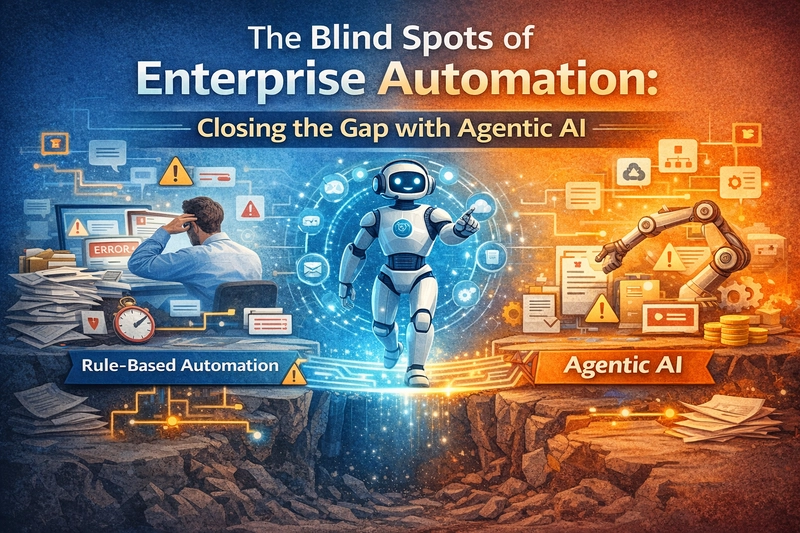
This piece argues for a shift from task-centric automation to context-rich, agentic automation. Agentic AI envisions automation agents that can perceive their environment, reason about goals, plan sequences of actions, and adapt as conditions change. Rather than merely executing predefined steps, these agents interpret data from multiple sources, negotiate with other systems, and optimize outcomes across a network of processes. The approach promises deeper integration, better alignment with business objectives, and improved resilience in the face of complexity.
The article also places emphasis on governance, transparency, and human-in-the-loop oversight. As automation becomes more capable, organizations must ensure that agents operate within clear boundaries, with auditable decisions and robust security controls. The goal is to unlock meaningful value while maintaining trust, accountability, and control over automated processes.
In sum, the current automation landscape is characterized by high investment and uneven results. To realize the promise of enterprise automation, organizations should elevate context, coordination, and governance—principles that agentic AI is positioned to deliver. By doing so, automation can move beyond isolated tasks toward integrated, intelligent, and adaptable workflows that align with strategic business outcomes.
In-Depth Analysis
The adoption curve for enterprise automation has been steep, propelled by the lure of increased efficiency and rapid scalability. Many organizations embarked on automation programs with the expectation of dramatic improvements in speed, accuracy, and cost containment. However, empirical findings suggest that the majority of AI pilots fail to deliver sustained value. MIT and other research institutions have reported high failure rates for generative AI pilots, with a significant portion not reaching the claimed maturity stage. The disconnect between investment and outcome points to deeper systemic issues within how automation is designed, deployed, and governed.
One fundamental problem is the tendency to treat automation as a set of isolated tasks rather than as components of a broader value chain. When automation is tethered to discrete activities—like data entry, routing, or simple notifications—it tends to create automated bottlenecks or gaps at the handoff points between systems. In complex enterprises, many processes span multiple departments, data sources, and legacy systems. Without a holistic perspective, automation efforts often re-create inefficiencies, transfer bottlenecks, or produce data silos that hinder visibility and decision-making.
Context is the missing ingredient. Context includes the understanding of business goals, historical behavior, organizational constraints, data quality, regulatory requirements, and the interdependencies among processes. When automation lacks this context, it can make suboptimal decisions, misinterpret data, or fail to adapt to changing circumstances. For example, an automated ticket-routing rule might push issues to the wrong team if it does not consider workload, priority shifts, or upcoming product changes. Similarly, a form-filling automation may overlook exceptions that require human judgment, leading to rework and delays.
Agentic AI offers a different paradigm. Rather than executing a fixed sequence of steps, agentic automation builds “agents” that can perceive, reason, plan, and act. These agents operate with a sense of purpose—defined business goals—and can autonomously coordinate actions across multiple systems. They can access diverse data streams, interpret ambiguous inputs, negotiate with other services, and adjust strategies in real time. This capability enables more cohesive workflows where decisions are informed by a broader context rather than by a single source of truth or a single task, producing outcomes that are more aligned with strategic objectives.
However, the shift to agentic automation is not merely about deploying more sophisticated software. It requires a thoughtful approach to data architecture, governance, and change management. Organizations must ensure accessible and trustworthy data pipelines, with standardized metadata, lineage, and quality controls. Security and privacy considerations become even more critical as agents operate across networks and potentially sensitive datasets. Governance frameworks must define the permissible scope of agent actions, escalation protocols, and auditability to satisfy regulatory and internal compliance demands.
A practical way to realize agentic automation is through phased experimentation. Start with a small, constrained domain where success criteria are well-understood and measurable. Examples include end-to-end order processing, customer support escalation, or IT incident management. In these pilots, agents are given explicit goals, success metrics, and a boundary of operation. As outcomes demonstrate reliability, the scope can expand to more complex workflows, with additional safeguards, monitoring, and governance layers.
Another important dimension is human collaboration. Agentic automation should augment human workers rather than replace them. Human-in-the-loop mechanisms enable experts to supervise agent decisions, provide corrections, and refine agent reasoning. This collaborative dynamic accelerates learning and helps ensure that automation supports meaningful work rather than substituting routine tasks without regard to broader impact.
Measuring value is essential. Traditional metrics such as cycle time or cost per ticket remain relevant, but there is a need for more nuanced indicators that capture context-aware performance. Metrics might include the rate of correct prioritization, average decision latency under varying conditions, rate of successful escalation when human judgment is required, and the agent’s ability to recover from failures without human intervention. Tracking these indicators over time helps determine whether agentic automation is delivering durable improvements and where further refinement is needed.
The broader organizational impact extends beyond efficiency. Agentic automation can improve consistency in decision-making, enhance customer experiences by reducing friction and delay, and enable more rapid adaptation to market or product changes. It can also shift the skill requirements of the workforce, prioritizing capabilities in systems thinking, governance, and collaboration with intelligent agents. Companies that commit to upskilling and change management initiatives are more likely to realize long-term value from agentic approaches.

*圖片來源:Unsplash*
Despite the promise, several risks warrant attention. Over-reliance on autonomous agents without adequate oversight can lead to unforeseen consequences, including biased outcomes, data leakage, or inadvertent policy violations. The complexity of coordinating multiple agents and systems increases the potential surface for errors if not properly engineered. Therefore, robust testing, staged deployment, and continuous monitoring are indispensable. Clear accountability structures must be established so that when an agent missteps, there is an auditable path to resolution.
Technological maturity alone cannot guarantee success. The organizational readiness to adopt agentic automation—encompassing leadership alignment, process redesign, and investment in governance—often determines whether the technology yields sustainable value. A resilient automation strategy integrates agentic capabilities with existing processes, data governance, security, and performance management. It aligns automation initiatives with strategic priorities and ensures that the pursuit of automation does not compromise risk management or regulatory compliance.
In sum, the current landscape of enterprise automation reflects a tension between high ambitions and practical execution. The missing context—an understanding of goals, data, interdependencies, and governance—limits the impact of automation programs. Agentic AI, with its intent-driven, context-aware, and collaborative capabilities, offers a pathway to more coherent and scalable automation. Realizing this potential requires careful design, incremental experimentation, and a robust framework for governance and human collaboration. When implemented thoughtfully, agentic automation can convert automation from a collection of isolated improvements into a unified capability that consistently drives meaningful business outcomes.
Perspectives and Impact
Looking ahead, the adoption of agentic AI in enterprise automation could reshape how organizations approach process optimization. Rather than chasing marginal gains from ticking boxes on checklists, enterprises can pursue holistic transformations that consider end-to-end value streams. Agentic capabilities enable dynamic orchestration across systems, data sources, and teams, allowing organizations to respond more quickly to operational shifts, customer needs, and regulatory changes.
One potential impact is improved resilience. By coordinating actions across multiple components and enforcing guardrails, agents can compensate for individual system failures, rerouting tasks, or re-prioritizing workloads to maintain continuity. This resilience is especially valuable in complex environments where dependencies are intricate and variability is high.
Another implication is accelerated innovation. When automation is guided by context and governance, experimentation can proceed with lower risk. Teams can prototype new workflows, test hypotheses, and iterate rapidly, all while maintaining oversight and control. The ability to simulate scenarios and reason about outcomes before execution can significantly shorten development cycles and improve alignment with business strategy.
At the same time, the shift toward agentic automation raises considerations for the workforce. Roles may evolve from performing repetitive tasks to configuring, monitoring, and refining agent behavior. Organizations should anticipate changes in required skills, invest in training, and design new governance models that balance autonomy with accountability. The human-automation collaboration paradigm emphasizes augmenting human judgment with machine reasoning, rather than replacing it.
Regulatory and ethical dimensions also come into play. As agents operate across data ecosystems and possibly touch sensitive information, compliance with privacy, security, and industry-specific regulations becomes paramount. Transparent auditing, explainability of agent decisions, and rigorous access controls will be essential to maintaining trust and meeting regulatory standards.
The broader economic landscape may benefit from more efficient operations and improved customer experiences. For enterprises, the promise lies in translating substantial AI investments into durable competitive advantages—achieved not through isolated automation gains but through integrated, context-aware orchestration that supports strategic objectives.
In summary, agentic AI represents a maturation point for enterprise automation. By embedding context, reasoning, and collaboration into automated workflows, organizations can unlock more significant value, reduce risk, and foster a culture of responsible innovation. Realizing this potential will require a deliberate, governance-driven approach that aligns technology with business outcomes and workforce capabilities.
Key Takeaways
Main Points:
– Context is the critical missing ingredient in most automation initiatives.
– Agentic AI enables context-aware, goal-driven, and cross-system orchestration.
– Governance, data quality, and human collaboration are essential for trustworthy autonomy.
Areas of Concern:
– Risk of unchecked autonomous actions without proper oversight.
– Data governance and security challenges as agents access multiple systems.
– Potential workforce disruption and the need for new skills and workflows.
Summary and Recommendations
To bridge the gap between high automation investment and tangible value, organizations should pivot from task-centric automation to context-rich, agentic automation. This transition begins with a clear articulation of business goals, end-to-end value streams, and governance expectations. Start with small, well-scoped pilots that demonstrate context-aware decision-making and cross-system orchestration, with explicit success criteria and measurable impact. As confidence grows, expand the scope while maintaining strong monitoring, explainability, and security controls. Emphasize human-in-the-loop oversight to ensure accountability, and invest in data governance and workforce development to support new roles around agent design, monitoring, and governance. By prioritizing context, coordination, and governance, enterprises can transform automation from a series of isolated improvements into a coherent, scalable capability that consistently delivers strategic value.
References
- Original: https://dev.to/agixtech/enterprise-automation-is-missing-context-heres-how-agentic-ai-fixes-it-1na5
- Additional references to inform context and best practices in agentic automation:
- McKinsey & Company: The case for intelligent automation and the role of context in scaling automation programs
- Gartner: Market guide to intelligent automation and the governance of AI-enabled processes
- Harvard Business Review: How to design responsible and collaborative AI in the enterprise

*圖片來源:Unsplash*