TLDR
• Core Points: Synthesis of object-oriented and functional design to address the expression problem via an extensible visitor pattern, blending visitor with factory method concepts.
• Main Content: Examines how an extensible visitor pattern extends the classic visitor to improve reusability, flexibility, and type safety in C#.
• Key Insights: The approach aims to separate type definitions from operations, enabling new data types and operations without invasive changes.
• Considerations: Balance between extensibility and complexity; ensuring clean integration with SOLID principles and practical tooling.
• Recommended Actions: Investigate adopting extensible visitors in new C# projects requiring open-ended extensibility, while evaluating codegen and factory-like dispatch mechanisms.
Content Overview
The article investigates a scholarly contribution that attempts to tackle the expression problem in programming language design. The expression problem concerns how to define data structures (data types) and operations on them in a way that allows both to be extended independently. In object-oriented and functional paradigms, certain patterns help address this tension, but traditional solutions often force compromises: adding new data types may require changing existing operations, and adding new operations can necessitate touching every data type.
A particular research-oriented proposal, the extensible visitor pattern, presents a refined version of the classic visitor pattern. The core idea is to fuse the visitor pattern with elements reminiscent of the factory method pattern to enable safer, more scalable extension points. While the original paper does not explicitly foreground SOLID principles, the discussion suggests that the approach aims to improve modularity and reusability without sacrificing type safety or clarity in C# codebases.
This rewritten article summarizes the motivation, design considerations, and potential trade-offs of the extensible visitor pattern. It also situates the proposal within broader software engineering goals, including maintainability, testability, and long-term evolution of software systems. The aim is to provide a coherent narrative that helps practitioners understand what the pattern tries to achieve, how it contrasts with traditional patterns, and what implications it has for real-world development.
In-Depth Analysis
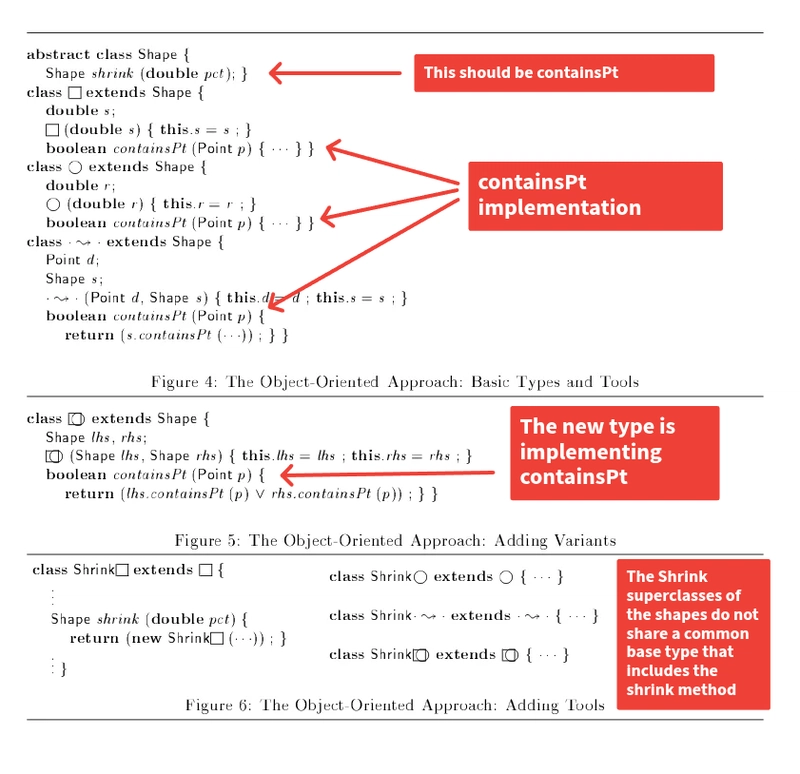
The expression problem arises when a language or design pattern seeks to allow both the data structures representing expressions (like arithmetic expressions, syntax trees, or domain-specific constructs) and the operations performed on them (such as interpretation, pretty-printing, optimization) to evolve independently. In a conventional visitor pattern, one typically defines a hierarchy of element types (the data structures) and a visitor interface with a visit method for each type. Each concrete data type implements an accept method that dispatches to the appropriate visitor method. While this organizes operations and adheres to single-responsibility principles, it often creates a rigid coupling: adding a new operation is straightforward (implement a new visitor), but adding a new data type requires modifying the visitor interface and all concrete visitors. Conversely, adding new data types is easy if the visitor interface is closed, but adding new operations becomes invasive.
The extensible visitor pattern proposes a hybrid approach that seeks to reconcile these tensions by introducing an extensible mechanism for dispatch and operation execution. At a high level, the pattern attempts to decouple type definitions from the operations acting on them while preserving type safety. The integration of factory-method-like behavior serves to support extensibility in a controlled manner. In practice, this might involve:
- A base hierarchy of expression types that define an extensible protocol for accepting visitors without forcing every operation to depend on a fixed set of concrete types.
- A registry or factory-like component that can construct or compose visitors for a broader set of types, enabling new operations to be added without touching all existing types.
- A dispatch strategy that can handle new combinations of data types and operations without requiring widespread changes.
From a software engineering perspective, this approach aligns with several goals emphasized in SOLID and related design principles:
- Open/Closed Principle: Systems should be open for extension but closed for modification. An extensible visitor pattern seeks to realize this by enabling new operations to be added with minimal changes to existing code.
- Single Responsibility Principle: Data structures and operations can be more cleanly separated, as the logic for visiting and handling type-specific behavior is delegated to visitors or visitor-like components.
- Dependency Inversion Principle: High-level modules (operations) should not depend on low-level details (concrete data types); instead, they depend on abstractions (visitor interfaces and factory components).
However, practical considerations temper the theoretical promise. Implementing an extensible visitor pattern in C# introduces complexity that must be carefully managed:
- Type Safety vs. Extensibility: Ensuring that new data types can be integrated without compromising type safety or forcing widespread changes across the codebase.
- Performance Overheads: Additional indirection and dynamic dispatch can incur runtime costs, which may be significant in performance-critical code paths.
- Tooling and Maintenance: More intricate patterns can complicate debugging, refactoring, and comprehension for developers unfamiliar with the approach.
- Compatibility with C# Features: Language constructs such as generics, pattern matching, and interfaces offer opportunities to implement extensible design with varying degrees of verbosity and complexity. The design should leverage these features without becoming unwieldy.
Design variants in the literature generally differ in how they structure the accept/visit mechanism and how they enable the addition of new operations and types. Some approaches emphasize double dispatch and visitor interfaces, while others explore registry-based or factory-assisted dispatch to handle extensibility more gracefully. The primary trade-off is the degree to which adding new types or new operations alters existing code and the amount of ceremony required to keep the system coherent and maintainable.
In practical terms, if a software team considers adopting an extensible visitor pattern, they should evaluate their project goals, team experience, and the likely evolution path of the domain model. Projects that require long-lived families of expressions with evolving operations—where the cost of modifying every visitor each time a new operation is introduced would be burdensome—may benefit from a carefully designed extensible visit mechanism. Conversely, projects with stable data types and a relatively small set of operations may find traditional visitor patterns sufficient and simpler to maintain.
It is essential to recognize that the literature on the expression problem and related design patterns often presents abstract models and theoretical trade-offs. Real-world adoption requires translating these abstractions into pragmatic code that respects the language idioms of the target platform. In C#, this means balancing the elegance of extensibility with the practicalities of readability, testability, and compatibility with existing codebases and tooling ecosystems.

*圖片來源:Unsplash*
Perspectives and Impact
The extensible visitor pattern represents a thoughtful attempt to harmonize two competing design imperatives: the desire to extend data types and the desire to extend operations without producing combinatorial explosion. If successfully implemented, such a pattern can offer several meaningful benefits:
- Enhanced Extensibility: New operations can be added without forcing changes across all expression types. This reduces the risk of Introducing bugs in existing code when extending behavior.
- Separation of Concerns: Data structures focus on representing data, while operation implementations encapsulate behavior, aligning with separation-of-concerns principles.
- Improved Maintainability: By centralizing the logic for operations, teams may achieve more maintainable code, especially in large systems with complex expression trees.
- Stronger Abstraction Boundaries: The use of factory-like constructs to manage dispatch can help decouple concrete types from the operations that act upon them, potentially improving testability and flexibility.
From a future-oriented perspective, the extensible visitor approach invites several lines of exploration:
- Tooling Support: Code generation, scaffolding, or meta-programming facilities could reduce boilerplate and error-prone parts of the implementation, making the pattern more approachable.
- Language Evolution: As languages like C# evolve—with better support for records, discriminated unions, and pattern matching—there are opportunities to implement extensible visitors in clearer and more idiomatic ways.
- Domain-Driven Design Synergy: In domain-driven scenarios where expressions or domain models evolve over time, an extensible visitor approach could align well with the need to evolve operations independently from domain concepts.
However, these opportunities come with caveats. The pattern’s complexity may raise the barrier to entry for teams, and there is a non-trivial maintenance cost if the extension surface area grows unchecked. Projects must weigh the long-term benefits of extensibility against the immediate costs of design, implementation, and ongoing care.
In terms of impact, the extensible visitor pattern contributes to the broader discourse on how to manage evolution in software systems. It adds to the toolkit available to developers grappling with the tension between closed-world data type hierarchies and open-world operational requirements. For practitioners, the key takeaway is not to adopt the pattern wholesale but to consider its principles as a spectrum of techniques. Teams can mix and match ideas—such as using factory-like dispatch for extensibility, while preserving straightforward visitor interfaces for core operations—according to their specific domain needs and organizational capacities.
Looking ahead, further empirical studies and practical case studies would help illuminate when and where the extensible visitor pattern delivers the most value. Comparative analyses with alternative approaches—such as the use of algebraic data types, sum types, or extensible sum types implemented via code generation—could provide clearer guidance on trade-offs. As language ecosystems continue to evolve, so too will the patterns that developers use to model data and behavior in scalable, maintainable ways.
Key Takeaways
Main Points:
– The extensible visitor pattern seeks to address the expression problem by combining visitor and factory-like mechanisms to enable extendable operations and data types.
– It emphasizes decoupling data structures from the operations applied to them, promoting modularity and potential adherence to SOLID principles.
– Practical adoption requires a careful balance between extensibility benefits and added complexity, performance, and maintenance costs.
Areas of Concern:
– Increased pattern complexity and potential readability challenges for teams unfamiliar with the approach.
– Potential performance overhead due to dynamic dispatch and indirection.
– The need for solid tooling, documentation, and clear guidelines to manage growth of operations and types.
Summary and Recommendations
The notion of an extensible visitor pattern in C# presents a thoughtful response to the longstanding expression problem by proposing a design that blends the strengths of the visitor pattern with factory-style extensibility. The central goal is to allow both the set of data types and the set of operations to grow without entailing widespread changes across the codebase. This approach aligns with core software engineering principles such as Open/Closed, Separation of Concerns, and Dependency Inversion, while recognizing the practical realities of implementing such patterns in a modern language like C#.
For teams evaluating this pattern, a prudent strategy includes:
- Conducting a careful needs assessment to determine whether ongoing evolution of domain models and operations justifies the added complexity.
- Prototyping with a small, representative subsystem to gauge the developer experience, maintenance costs, and performance implications.
- Leveraging language features (such as generics, pattern matching, and records) to implement extensibility in a clean and idiomatic manner.
- Integrating supportive tooling, such as code generators or scaffolding, to reduce boilerplate and encourage consistent usage.
- Establishing clear guidelines for when to introduce new extension points versus when to consolidate operations within existing visitors.
Ultimately, the extensible visitor pattern offers a conceptual pathway toward more flexible and maintainable architectures in scenarios where systems must evolve to accommodate new data types and new operations independently. Its success in practice will depend on thoughtful design choices, disciplined implementation, and ongoing evaluation against real-world requirements.
References
- Original: dev.to
- Additional references to be added (2-3) based on article content:
- [Insert relevant reference 1]
- [Insert relevant reference 2]
- [Insert relevant reference 3]

*圖片來源:Unsplash*