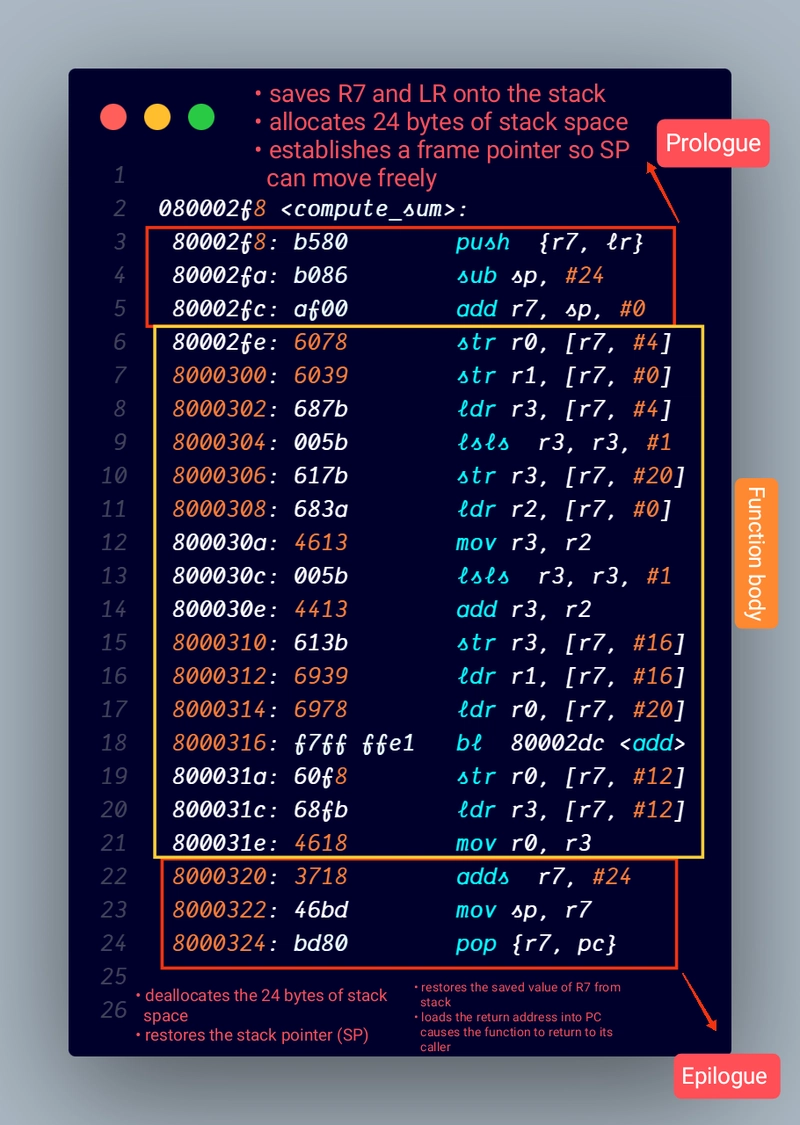
TLDR
• Core Points: Function prologues/epilogues preserve CPU state, manage the stack, and ensure safe, correct function calls on ARM, as inserted automatically by compilers.
• Main Content: This article explains why prologues/epilogues exist, how ARM compilers implement them, and their impact on performance and correctness.
• Key Insights: Stack frame setup, register preservation, calling conventions, and secure exit paths are central to robust ARM code.
• Considerations: Optimization, attribute-driven variations, and ABI specifics influence prologue/epilogue design.
• Recommended Actions: Review compiler options, understand ABI requirements, and profile function call overhead in performance-critical code.
Content Overview
In high-level languages like C, developers rarely think about the precise sequences executed when a function begins or ends. Yet, at the assembly level, these moments are governed by function prologues and epilogues—short blocks of instructions responsible for preserving the CPU state, organizing the stack, and ensuring a consistent calling convention. On ARM architectures, compilers automatically generate these sequences to guarantee correctness across function calls, interrupt handling, and nested invocations. This article delves into what prologues and epilogues do on ARM, why they are required, and how they influence performance and reliability in compiled code.
The concept of a function prologue is to save the necessary registers and establish a stack frame before any function body executes. Epilogues, conversely, restore the saved state and dismantle the stack frame as the function returns control to its caller. The exact instructions used can depend on the ARM architecture (ARMv7, ARMv8-A, and their AArch64/ARM64 variants), the calling convention in use (i.e., the Application Binary Interface or ABI), and compiler optimizations. While the C language abstractly describes function calls, the compiler translates that model into concrete machine operations. Prologues and epilogues are central to that translation, ensuring that callee-saved registers are preserved, local variables are allocated on the stack, and the program can resume correctly after a function returns.
In practice, understanding ARM prologues and epilogues requires attention to several core topics: stack frame layout, register preservation rules (which registers must be saved and where), how local variables are addressed on the stack, and how the return address is managed. ARM ABIs specify which registers are callee-saved or caller-saved, how arguments are passed (via registers or the stack), and how the stack pointer must be aligned. The compiler, guided by the ABI, emits a prologue at the start of a function to save the necessary registers, adjust the stack pointer to allocate space for locals and spill areas, and set up any frame pointers if needed. At function exit, the epilogue restores the registers, cleans up the stack, and returns control, often via a branch-and-link or return instruction that uses the saved return address.
This treatment is not merely academic. The way a prologue saves registers can affect the pressure on the function’s performance, the ease of inlining, and the predictability of timing in real-time or performance-critical code. In turn, epilogues influence tail-call optimization opportunities and how exceptions or asynchronous events interact with ongoing function calls. Developers who work close to the hardware, such as those writing kernels, embedded systems, or performance-sensitive libraries, benefit from an understanding of these mechanisms to optimize conventions, align stacks, and minimize unnecessary work during function entry and exit.
In-Depth Analysis
A function call in the ARM world triggers a well-defined sequence of events that begins with the function prologue and ends with the epilogue. The exact content of these sequences is determined by several variables: the ARM architecture variant (32-bit ARM versus 64-bit ARM64), the compiler, the optimization level, and the ABI governing the calling conventions.
1) The Role of the ABI and Calling Conventions
An ABI defines how functions receive arguments, how return values are conveyed, how the call stack is managed, and which registers must be preserved across calls. In ARM, common ABIs include the AAPCS (Arm Architecture Procedure Call Standard) for 32-bit ARM and the AAPCS64 for 64-bit ARM. These standards specify which registers are caller-saved and which are callee-saved, how many argument registers are available, and alignment requirements for the stack.
The prologue begins the process of respecting these conventions. If a function uses any callee-saved registers (for example, r4–r11 on many ARM configurations), it must save them at the start and restore them before returning. The compiler achieves this by pushing those registers onto the stack and adjusting the stack pointer accordingly. The prologue also allocates space for local variables and, if necessary, creates a frame pointer to enable easier access to locals and spilled values.
2) Stack Frame Layout and Frame Pointer
A stack frame is a contiguous region on the stack that holds local variables, spilled registers, saved input parameters, and the return address. Depending on optimization settings and the presence of frame-pointer elimination, a frame pointer (commonly r29 or x29 in ARM64) may be used to reference local variables reliably. When a frame pointer is omitted, the compiler relies on a combination of the stack pointer and fixed offsets to access locals.
The prologue typically performs these steps:
– Save callee-saved registers that the function will use.
– Subtract a value from the stack pointer to create stack space for the frame.
– Optionally save the previous frame pointer and establish a new frame pointer.
– Save additional context if the function might be interrupted or if stack unwinding is required for exceptions.
3) Register Preservation and Spill/Reload
During a function’s execution, it may need to use registers that must be preserved across calls. To honor the ABI and maintain correctness, the prologue saves the required callee-saved registers onto the stack. During the function’s execution, the compiler may spill registers to the stack to free up temporary registers for local computations. The epilogue then reloads these values from the stack before returning to the caller.
4) Handling Return Addresses and Link Registers
ARM uses a link register (LR) to hold the return address for subroutine calls. In the prologue, the return address is typically preserved, either by saving LR onto the stack or by ensuring that a function that makes a non-tail call can restore LR before returning. In ARM64, the return is performed with a dedicated return instruction (RET) that uses the x30 register as the link register, or via a sequence that restores the proper return address before branching.
5) Tail-Call Optimization and Epilogue Variants
Tail-call optimization (TCO) can influence the epilogue. If a function ends with a tail call to another function, the compiler may implement a tail call by reusing the current stack frame and avoiding the prologue/epilogue overhead for the callee. In such cases, the prologue may not fully allocate a new frame, and the epilogue may skip some restoration steps, since control does not return to the current function in the usual way. TCO availability depends on the optimization level and the exact code sequence generated by the compiler.
6) Stack Alignment and Safety Concerns
The ARM architecture imposes stack alignment requirements, typically 16-byte alignment for performance and to satisfy certain SIMD and calling conventions. The prologue ensures that, after its execution, the stack pointer is aligned as required. Misalignment can lead to performance penalties or runtime exceptions on some platforms.

*圖片來源:Unsplash*
7) Exception Handling, Interrupts, and Unwind Information
In languages like C++, exception handling imposes additional constraints on prologues and epilogues. The compiler may emit additional spill/reload code and unwind metadata to support stack unwinding during exceptions. This extra context ensures that the runtime can accurately unwind the call stack to locate catch blocks or perform stack traces for debugging.
8) Impact of Optimization Levels
Higher optimization levels can alter how aggressively the compiler minimizes spill code and whether it uses a frame pointer. With frame-pointer elimination, the prologue/epilogue sequences can be slimmer, reducing overhead and enabling more efficient inlining. However, losing the frame pointer can complicate debugging and limit certain forms of stack unwinding. The balance between performance and debuggability is a central trade-off driven by compiler options and ABI constraints.
9) Practical Considerations for Developers
– Performance monitoring: Function entry/exit overhead can accumulate in tight loops or frequently called hot paths. Analyzing assembly output and profiling can reveal opportunities to reduce prologue/epilogue pressure.
– Inlining decisions: Inlining a function reduces call overhead but can lead to larger code size and altered prologue/epilogue sequences in the inlined context.
– Security and reliability: Preserving the correct state of callee-saved registers is essential for program correctness, especially when integrating with libraries or system calls.
– Cross-platform considerations: ARM32 and ARM64 ABIs differ in register usage and calling conventions. Code compiled for multiple ARM targets may exhibit different prologue/epilogue patterns.
10) Summary of Practical Effects
– Prologues guarantee that a function begins with a clean and predictable state, with essential registers saved and a frame established to host locals and spill storage.
– Epilogues ensure the original state is restored and the method of returning to the caller is correct, preserving program correctness across function boundaries.
– The exact instructions and sequences are highly dependent on architecture variant, ABI, and compiler optimization level, making it important for developers to understand the specific toolchain behavior for their target platform.
Perspectives and Impact
Understanding function prologues and epilogues on ARM provides more than a theoretical glimpse into compiler internals. It informs practical decisions in systems programming, embedded development, and high-performance computing:
- Toolchain transparency and control: Modern compilers allow customization through attributes and pragmas to influence register preservation, frame pointer usage, and tail-call optimization. Developers can tailor prologue/epilogue behavior to match performance or debugging requirements, particularly in low-level libraries or real-time systems.
- Performance engineering: In performance-sensitive code paths, the overhead of the prologue/epilogue becomes non-trivial when functions are small and called millions of times per second. Understanding which registers are saved and how much stack space is allocated can guide micro-optimizations, such as limiting register usage within critical functions or reorganizing code to reduce spill operations.
- Debugging and maintenance: Frame pointers facilitate debugging, stack traces, and post-mortem analysis. However, removing frame pointers can complicate these tasks. Developers must weigh debugging convenience against potential performance gains when tuning compiler settings.
- Cross-architecture considerations: As software increasingly targets multiple architectures, developers should be mindful of differing prologue/epilogue patterns between ARM variants and other architectures. Writing portable code or providing architecture-specific optimizations requires awareness of ABI conventions and how compilers implement function entry and exit.
- Future directions: Advances in compiler technology continue to refine prologue/epilogue generation, with better optimization of register usage, more aggressive frame-pointer elimination, and improved support for safe tail calls. The ongoing evolution of ARM architectures and ABIs will shape how these sequences are produced in future toolchains.
These perspectives highlight the broader implications of prologue and epilogue design beyond mere assembly trivia. They connect compiler behavior to system reliability, performance, and the practical realities of software development on ARM platforms.
Key Takeaways
Main Points:
– Function prologues save callee-saved registers, allocate stack space, and set up a frame; epilogues restore state and return control.
– ARM ABIs dictate which registers must be preserved, argument passing, and stack alignment, guiding prologue/epilogue generation.
– Tail-call optimization and frame-pointer elimination influence the structure and overhead of these sequences.
– Performance, debugging, and portability considerations drive how developers interact with or influence prologue/epilogue behavior.
Areas of Concern:
– Misunderstanding ABI requirements can lead to subtle bugs or crashes due to improper register preservation.
– Frame-pointer elimination can hinder debugging or stack unwinding in some environments.
– Optimizations may complicate inlining decisions and affect predictable timing in real-time systems.
Summary and Recommendations
Function prologues and epilogues are fundamental elements of how compiled ARM code preserves program correctness across function calls. They implement the ABI-defined rules for register preservation, stack management, and return handling, ensuring that every function adheres to a consistent calling convention. While their exact instructions depend on architecture variant, compiler, and optimization settings, their purpose remains constant: to establish and restore a safe, predictable execution environment for functions.
For developers working with ARM-based systems, a practical approach includes:
– Familiarizing yourself with the relevant ABI (e.g., AAPCS or AAPCS64) and its rules for callee-saved registers and stack alignment.
– Using compiler options to balance performance and debuggability, such as enabling or disabling frame-pointer elimination judiciously.
– Profiling hot paths to determine whether prologue/epilogue overhead is a meaningful contributor to total execution time.
– Keeping an eye on tail-call opportunities, which can reduce the cost of function returns in certain patterns.
– Ensuring that code relying on precise stack layouts or exceptions remains compatible with the chosen optimization level and debugging tools.
By understanding the mechanics of prologues and epilogues, developers can write more reliable, portable, and efficient ARM code, and make informed decisions about optimizations and toolchain configurations.
References
- Original: dev.to
- Arm Architecture Reference Manual (for ABIs and calling conventions)
- GCC or Clang Programmer’s Guide on Function Prologues/Epilogues and Frame Pointer Elimination
- ARM64 ABI Documentation for AAPCS64 and related conventions

*圖片來源:Unsplash*