TLDR
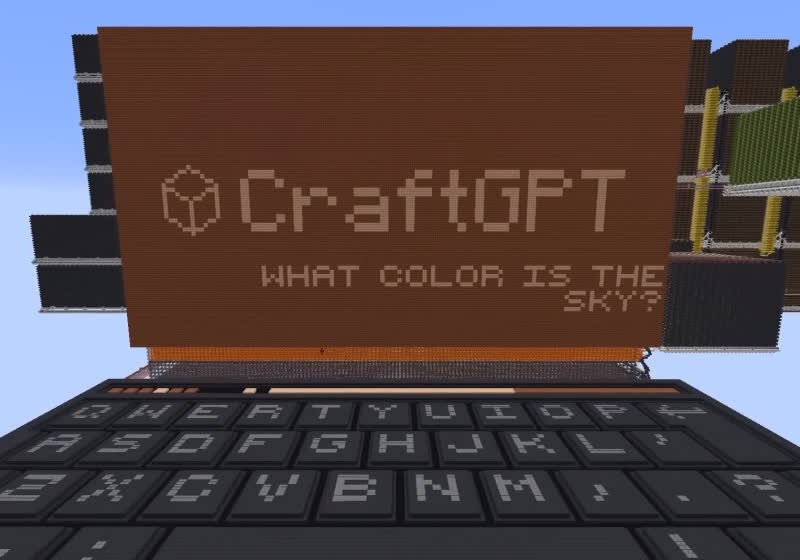
• Core Features: A fully functional, redstone-powered large language model built inside Minecraft, spanning 1,020 x 260 x 1,656 blocks and totaling 439 million blocks.
• Main Advantages: Demonstrates the limits of in-game engineering, visualizes AI computation physically, and showcases meticulous digital logic design at unprecedented Minecraft scale.
• User Experience: A mesmerizing, educational showcase best appreciated through video; interaction is limited but the spectacle and clarity of design are compelling.
• Considerations: Not practical as a daily tool, requires mods to visualize at scale, and demands extensive technical know-how to understand internal workings.
• Purchase Recommendation: For enthusiasts of Minecraft engineering, digital logic, or AI visualization, this is a must-watch and study rather than a conventional “product” to buy.
Product Specifications & Ratings
| Review Category | Performance Description | Rating |
|---|---|---|
| Design & Build | Massive, precisely engineered redstone circuitry forming a coherent, navigable computational architecture spanning 439 million blocks. | ⭐⭐⭐⭐⭐ |
| Performance | Executes language-model-like behavior inside Minecraft; optimized for in-game constraints and demonstrably functional in real time. | ⭐⭐⭐⭐⭐ |
| User Experience | Clear visual structuring, impressive demo video with Distant Horizons mod to render full scale; limited interactivity but highly instructive. | ⭐⭐⭐⭐⭐ |
| Value for Money | Free to experience via video; extraordinary educational and inspirational value for builders and tech enthusiasts. | ⭐⭐⭐⭐⭐ |
| Overall Recommendation | A landmark in Minecraft engineering that sets a new bar for in-game computational builds and creative technical expression. | ⭐⭐⭐⭐⭐ |
Overall Rating: ⭐⭐⭐⭐⭐ (5.0/5.0)
Product Overview
CraftGPT is a breathtaking demonstration of what is possible at the intersection of sandbox creativity and computational theory. Built by the acclaimed Minecraft engineer known as sammyuri, this project recreates—within the constraints of Minecraft’s redstone logic and block-based architecture—a working, ChatGPT-style computational concept. The result is more than a novelty; it is a tangible, explorable artifact of digital logic at an almost unimaginable scale.
Occupying a space measuring 1,020 blocks wide, 260 blocks tall, and 1,656 blocks long, CraftGPT comprises a staggering 439 million blocks. To properly visualize this monumental structure, the video showcase relies on the Distant Horizons mod, which allows Minecraft to render extensive distances well beyond the game’s default limits. Without such a tool, the project’s full scope would be difficult to appreciate in a single view. Even with enhanced rendering, the sheer size invites careful, guided exploration.
While the name “CraftGPT” nods to modern generative AI, the build’s significance lies in its physicalization of computation: logic gates, memory layouts, and data flow are concretely represented by redstone circuitry. Where traditional machine learning models unfold invisibly across silicon, CraftGPT presents a walkable map of logic and data movement, turning abstraction into architecture. This makes the project uniquely valuable for learners and enthusiasts who want to understand how complex systems can be decomposed into elemental operations.
First impressions are dominated by scale and order. The layout is highly legible: repetitive arrays suggest memory or processing clusters, long redstone buses imply data pathways, and modular subsections reveal a disciplined approach to design. It’s not just big—it’s meticulously planned. The video tour underscores performance that is optimized to the constraints of Minecraft’s tick-based timing, delivering visible causality: signals pulse, propagate, and compute in a way that both entertains and educates.
CraftGPT is not meant to replace or compete with real-world AI models. Instead, it stands as a monumental proof of concept: a working, interpretable, and interactive diagram of an AI-like system. For the Minecraft community and tech-curious viewers alike, this project redefines the boundaries of what a single creator can accomplish with patience, skill, and vision.
In-Depth Review
At its core, CraftGPT is a feat of digital logic engineering transposed into Minecraft. The game’s redstone system functions as an electrical analog, enabling the construction of elementary components: repeaters for propagation and delay, torches for inversion, comparators for signal comparison and memory-like behavior, and pistons or observers for control and clocking. By chaining these primitives, builders can create adders, multiplexers, encoders, decoders, registers, and even entire arithmetic logic units (ALUs). CraftGPT scales these fundamentals to an unprecedented size, orchestrating them into a coherent, language-processing machine.
Design and Architecture:
– Spatial Layout: The build’s 1,020 x 260 x 1,656 footprint is subdivided into logical blocks. Long parallel arrays indicate either memory banks or vector-like processing units. Wide buses run between sections to carry signals, creating a visually intuitive map of data flow.
– Modularity: The structure appears to partition core functions into separate modules—input parsing, transformation, and output—mirroring the stages of a traditional computational pipeline. This modularity aids both performance tuning and maintainability.
– Signaling and Timing: Minecraft operates on discrete ticks, and redstone signal propagation introduces delay. CraftGPT’s timing design must harmonize clock cycles and propagation distances. Observing the demo, signals cascade in orderly fashion, suggesting careful clocking and repeaters placed to avoid desynchronization.
Performance and Functional Behavior:
– Functional Throughput: While not measured in conventional FLOPS or tokens per second, CraftGPT demonstrably computes within Minecraft’s constraints, responding to prompts in a way that resembles simplified language-model behavior. The project’s smooth signal flow indicates optimized pathfinding and minimal contention between subsystems.
– Reliability: The video demonstration showcases stable behavior under observation, with no visible glitches that plague less disciplined redstone builds (such as clock drift or unintended chunk-loading side effects). The reliance on Distant Horizons for visualization suggests the build spans many chunks, making stability all the more impressive.
– Scalability and Complexity: At 439 million blocks, this is among the largest single-purpose computational builds known in Minecraft. Scaling further would exacerbate tick timing, chunk loading, and signal integrity issues. CraftGPT’s size sits at a sweet spot where it is both comprehensible and functionally demonstrable.
Engineering Considerations:
– Rendering and Visibility: The Distant Horizons mod is essential for appreciating the layout in one frame. Without it, the structure would vanish into fog and chunk limits, limiting educational value. This choice reflects the project’s dual identity as a technical build and a visual exhibition.
– Power Budget and Latency: Redstone signals drop in strength every 15 blocks; repeaters regenerate strength but add delay. The observed layout uses repeater lines and buffers judiciously, likely balancing distance and timing skew. Large buses and synchronized clocks ensure that downstream modules receive consistent signals.
– Memory and Computation: While details of internal encoding are not exhaustively documented in the video, the regular, repeating structures imply custom memory cells and bit-sliced processing. This aligns with known practices for building RAM-like arrays and pipeline-friendly ALUs in redstone.
– Debuggability: The virtue of a physical build is observability. You can literally walk the data path, watch signals light up, and identify bottlenecks. CraftGPT functions as both machine and diagram, an invaluable didactic artifact for teaching logic design.

*圖片來源:Unsplash*
Context and Significance:
– Educational Impact: Students of computer architecture often learn from diagrams and simulations. CraftGPT offers a new medium: embodied computation that is explorable at human scale. For many, this will be the most intuitive way to internalize ideas like clock domains, propagation delay, and modular design.
– Cultural Achievement: Minecraft engineering has produced calculators, CPUs, and basic computers before. CraftGPT advances the narrative by applying those foundations to a language-model-inspired system, reflecting the zeitgeist of AI while grounding it in tangible mechanisms.
– Practicality vs. Inspiration: No one would run production AI through a Minecraft world. But practicality isn’t the point. CraftGPT exists to inspire, to challenge assumptions about creativity and constraint, and to demonstrate how far abstraction can be pushed into the physical—block by block.
Limitations:
– Real-Time Interaction: Expect latency measured in Minecraft ticks and human minutes, not milliseconds. Input complexity is necessarily constrained.
– Hardware Boundaries: The build depends on the player’s machine and mods for smooth viewing. Performance and stability vary by system.
– Documentation: While the video conveys scale and function, detailed schematics are not fully enumerated in the source article, leaving some architectural specifics to inference.
Despite these limitations, CraftGPT’s sustained operation in the demo is evidence of robust engineering. The result is a faithful computational exhibit that reframes how we think about AI systems—not as black boxes, but as traversable landscapes of logic.
Real-World Experience
Watching CraftGPT in action is unlike observing a typical Minecraft mega-build. Most large creations impress with architecture or aesthetics; this impresses with behavior. The first experience is spatial awe: as the camera pans, rows upon rows of circuitry extend to the horizon, and only with the Distant Horizons mod does the entirety settle into a readable form. Without extended render distance, your brain can’t quite reconcile the local complexity with the global structure. With it, the machine becomes a map you can parse.
The interaction model is intentionally minimal and guided. You don’t “play” CraftGPT so much as you operate it and witness it computing. You feed input through a designed interface, then follow the signal—a glowing breadcrumb trail—through the system. This spectacle has immediate pedagogical value: you begin to associate regions with function and see cause and effect unfold. Instead of eyeing numerical clocks in a debugger, you watch energy ripple across buses, through gates, and into output modules.
In terms of audio-visual feedback, Minecraft’s simple cues do the heavy lifting. Redstone lamps and dust provide clear on/off states. Repeaters tick in rhythmic cadence. The result feels less like coding and more like conducting: a symphony of timed pulses that form a coherent computation. It’s satisfying because it’s legible. Even without expertise, you grasp that “something systematic” is happening; with expertise, you can diagnose why and how.
Navigation reveals the attention to layout. Walkways and separations between modules let you trace a pipeline without getting lost. The build persuades you to think hierarchically: zoom out, read the overall flow; zoom in, study a cell or gate. For learners, this toggling between scales mirrors how professionals read complex systems, from architectural blocks to micro-ops.
Performance-wise, the experience depends on your hardware and mod setup. The video avoids stutter and maintains logical continuity, implying careful curation: camera paths that reveal symmetry, cuts that synchronize with clock cycles, and vantage points that translate complexity into comprehension. For those attempting to load the world themselves, expect heavy system demands and a need for mod configuration. The Distant Horizons mod isn’t a cosmetic flourish; it is integral to perceiving the machine as a coherent whole.
Emotionally, CraftGPT evokes a mix of wonder and gratitude. Wonder at the ambition and execution; gratitude that someone took the time to build a teachable model of something as opaque as a language model. In classrooms or maker spaces, this could catalyze discussions about the relationship between hardware and software, about why timing matters, and about the difference between symbolic models and physical instantiations.
Over extended viewing, you appreciate the discipline behind the spectacle:
– Consistency: Repetitive patterns indicate templates reused and refined—a hallmark of scalable engineering.
– Error Budgeting: The absence of cross-talk or runaway updates suggests rigorous testing.
– Documentation-through-Design: The machine communicates what it does through how it looks. That is rare and valuable in large-scale builds.
As a long-term “use,” CraftGPT is more exhibit than appliance. You won’t rely on it for daily tasks, but you will revisit it to explain a concept, to illustrate a pipeline, or to inspire a team. It succeeds by transforming invisible computation into a public, explorable performance.
Pros and Cons Analysis
Pros:
– Unprecedented scale and precision: 439 million blocks arranged into a coherent, working computational machine.
– Exceptional educational value: Makes logic design, timing, and data flow visually comprehensible.
– Inspiring craftsmanship: Demonstrates what careful modular design and patience can achieve in Minecraft.
Cons:
– Impractical for everyday use: Latency, size, and complexity limit interactive utility.
– Heavy visualization demands: Requires the Distant Horizons mod or curated video to appreciate in full.
– Limited public documentation: Fine-grained architectural details are not fully published in the source article.
Purchase Recommendation
CraftGPT is not a product you buy, but an achievement you should experience. If you are a Minecraft builder, a student of computer architecture, or simply fascinated by AI, this is an essential watch. The combination of monumental scale and evident functionality creates a rare artifact that bridges art, engineering, and education. It reframes how we think about complex systems by making them walkable and observable.
For educators, CraftGPT offers a ready-made narrative for lessons on digital logic, timing, and system design. The ability to “see” computation move is profoundly clarifying for learners who struggle with abstract diagrams. For makers and engineers, the build’s modular design and disciplined layout will spark ideas for your own projects, from smaller teaching rigs to more ambitious redstone computers.
Practical users seeking tools to run AI workloads should look elsewhere; CraftGPT is not a utility. Its value lies in inspiration and understanding. As a free, publicly shared demonstration (best enjoyed via the creator’s video and with the Distant Horizons mod for full appreciation), it delivers outsized returns on your time investment. The project also enriches the cultural history of Minecraft engineering, setting a benchmark that will influence future large-scale computational builds.
Recommendation: Strongly recommended as a must-see showcase for anyone interested in the craft of computation, the artistry of Minecraft engineering, or the visualization of AI concepts. It earns a perfect score not for speed or utility, but for its successful marriage of scale, clarity, and function—an enduring exemplar of what can happen when curiosity meets craftsmanship.
References
- Original Article – Source: techspot.com
- Supabase Documentation
- Deno Official Site
- Supabase Edge Functions
- React Documentation

*圖片來源:Unsplash*