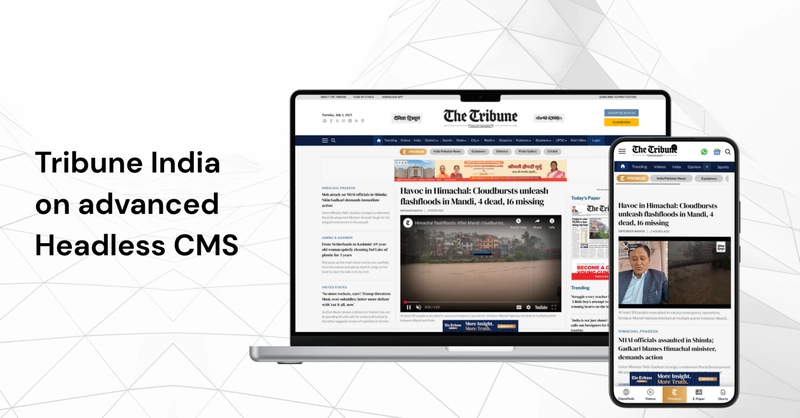
TLDR
• Core Points: Tribune migrated from a legacy monolithic CMS to a headless CMS to support mobile-first, real-time news delivery, faster feature rollouts, and streamlined editorial workflows.
• Main Content: A structured digital transformation addressing architecture, workflows, and audience expectations to keep pace with modern publishing demands.
• Key Insights: Decoupled content management enables scalable, faster development and better cross-channel delivery without sacrificing editorial control.
• Considerations: Data migration, integration with existing tools, and governance to ensure consistency and security across services.
• Recommended Actions: Plan a phased migration with clear governance, adopt API-first publishing, and invest in responsive delivery pipelines and analytics.
Content Overview
The Tribune, a prominent English-language newspaper in India, recognized a strategic need to evolve its digital publishing model. As readership shifted toward mobile devices and real-time news consumption, the limitations of the traditional, monolithic CMS became increasingly evident. The legacy system constrained feature development, created tightly coupled components that hindered innovation, and fragmented editorial workflows, making rapid iteration and cross-platform delivery difficult.
This article outlines how The Tribune undertook a comprehensive digital transformation by adopting a headless CMS. The change aimed to empower agile, mobile-first publishing while preserving editorial quality, ensuring reliable delivery across devices, and enabling faster, more flexible feature rollouts. The transition involved rethinking content modeling, decoupling content creation from presentation, and integrating with modern delivery pipelines and analytics to support data-driven decision making. The Tribune’s journey illustrates how a well-planned headless approach can address evolving audience expectations, streamline operations, and future-proof a news organization in a fast-moving digital landscape.
In-Depth Analysis
The decision to move away from a legacy monolithic CMS was driven by several concrete pain points. The old system tightly coupled content, presentation, and workflow logic, making even small feature additions time-consuming and resource-intensive. This rigidity impeded rapid response to emerging news cycles and user demands, particularly on mobile platforms where latency and performance directly affect readership. Editorial workflows were fragmented, with content creation, approval, and publication processes scattered across disparate tools and interfaces. This fragmentation increased the risk of inconsistencies and delays, undermining the newsroom’s ability to publish breaking news swiftly and accurately.
A core objective of The Tribune’s transformation was to implement a headless CMS that decouples content management from presentation. In a headless architecture, content is stored and managed in a backend content repository, while a set of APIs delivers this content to any frontend or channel. This separation provides several strategic advantages:
- Platform agnosticism: Content can be consumed by websites, mobile apps, social media integrations, email newsletters, and emerging formats without reworking the core content store.
- Faster development cycles: Frontend teams can work independently from backend systems, enabling faster feature development and experimentation.
- Consistent delivery: A unified content model reduces duplication and inconsistencies across channels.
- Real-time updates: APIs enable near-instantaneous content delivery, essential for breaking news and live events.
- Scalability: As audience demand grows, the system can scale more predictably, supporting additional channels and higher traffic.
Implementing a headless CMS required careful planning around content modeling and governance. The Tribune needed to define a flexible yet robust content schema capable of representing articles, multimedia assets, author metadata, classifications, and related stories. Content modeling also had to accommodate multilingual support, tagging, provenance, and editorial workflows that preserve the human oversight and editorial standards readers expect from a trusted newspaper.
Migration strategy was a critical success factor. Rather than a big-bang replacement, a phased approach was favored to minimize risk and preserve continuity. Key steps typically included:
- Inventory and mapping: Catalog existing content types, metadata, and assets. Establish how each element would map to the new content model.
- API-first delivery: Build or adopt API layers that expose content in a predictable, versioned manner. Ensure performance characteristics meet newsroom needs and reader expectations.
- Frontend modernization: Develop or adapt frontends (web, mobile apps, apps for connected devices) to consume the decoupled content via APIs. Invest in responsive and adaptive design to accommodate diverse screen sizes and bandwidth conditions.
- Editorial workflow integration: Rebuild editorial processes within the headless environment, including roles, approvals, versioning, and publishing controls. Maintain clear separation between content creation and presentation logic.
- Asset management: Centralize media handling—images, video, audio—alongside metadata to streamline production workflows and rights management.
- Quality assurance and governance: Implement validation, review, and compliance checks to maintain editorial standards and data integrity as content moves through the system.
The transition delivered several tangible benefits. First, feature rollouts accelerated significantly. With frontend and backend decoupled, developers could deploy new presentation layers or interactive features without waiting for back-end changes. This agility is especially valuable for real-time news features, interactive graphics, and personalized reader experiences. Second, editorial workflows became more streamlined and collaborative. A unified content model, coupled with robust permissions and version control, reduced the risk of inconsistencies and enabled faster approvals and publication cycles. Third, multi-channel distribution became easier and more reliable. Content could be published once and surfaced across multiple platforms, ensuring consistency and reducing duplication of effort.
From a technical perspective, the headless approach required solid API design and performance optimization. RESTful or GraphQL APIs, along with appropriate caching strategies and edge delivery networks, ensured low latency for readers around the world. Content editors benefited from modern authoring interfaces and real-time previews, while developers gained the flexibility to use modern frameworks and tooling for frontend experiences. Security considerations were also central, with measures to protect sensitive editorial workflows, enforce access controls, and audit changes across the publishing pipeline.
The Tribune’s experience also highlighted the importance of data governance and analytics. With content flowing through modular services, the organization had greater visibility into how stories perform, reader engagement patterns, and attribution for editorial effort. Analytics-informed decisions could drive editorial priorities, distribution strategies, and investments in technology and training.
Context is important when evaluating this transition. India’s digital news market is highly competitive, with readers demanding speed, accuracy, and a seamless cross-device experience. Publishers must manage the tension between rapid publication and maintaining rigorous editorial standards. A headless CMS supports this balance by enabling rapid iteration and precise content control, while the underlying governance framework protects brand integrity and ensures compliance with journalistic ethics.
The transformation also required attention to change management. Moving to a headless architecture affects publishers, editors, designers, and IT teams. Successful adoption depends on clear communication about goals, training for staff to use new tools, and ongoing support to address challenges as workflows are redesigned. By fostering cross-functional collaboration and establishing best practices, The Tribune could align diverse teams around a common architecture and a shared vision for digital publishing.
While the benefits were compelling, several considerations shaped the project’s execution. Data migration posed a risk of data loss or inconsistency if not carefully planned and validated. Integration with existing production systems—advertising, subscription management, analytics, and authentication—needed meticulous mapping and testing. Ensuring accessibility and inclusivity across new frontends remained a priority, as did maintaining a consistent editorial voice and brand style in a more modular delivery environment. Finally, ongoing governance was essential to prevent fragmentation as new services and teams join the publishing ecosystem.

*圖片來源:Unsplash*
Looking ahead, The Tribune’s headless CMS strategy positions it to adapt to future publishing trends. As news ecosystems continue to evolve with AI-assisted writing, personalization, and immersive experiences, a decoupled architecture provides the flexibility to experiment and scale responsibly. The newsroom can pursue initiatives such as modular interactive features, personalized reader journeys, and cross-platform monetization strategies without being constrained by a monolithic backend. This agility also supports global expansion, where multiple international editions could share common content models while maintaining region-specific nuances and regulatory compliance.
In summary, The Tribune’s modernization of its digital publishing stack illustrates a thoughtful, staged, and outcome-focused shift from a legacy monolithic CMS to a headless architecture. The approach aligns technology with newsroom goals: faster feature delivery, more efficient workflows, and stronger cross-channel content delivery, all while preserving editorial integrity and trust. The transformation demonstrates how a traditional news outlet can adapt to the digital era by embracing decoupled architectures and modern content orchestration.
Perspectives and Impact
The move to a headless CMS is about more than just technology; it reflects a broader strategy to future-proof a news organization in a rapidly changing media landscape. By decoupling content creation from presentation, The Tribune positioned itself to respond to reader demands with greater speed and accuracy. Editors can focus on storytelling and fact-checking, while developers concentrate on building engaging, performant delivery experiences. This separation of concerns is particularly valuable in an era where readers access news through smartphones, tablets, wearables, and a growing ecosystem of connected devices.
The headless approach also encourages experimentation. Teams can test new front-end frameworks, interactive formats, and personalized experiences without destabilizing back-end content management. This flexibility supports innovation on a modular basis, enabling the newsroom to iterate based on reader feedback and performance analytics. The ability to push updates quickly across channels enhances the timely delivery of breaking news and feature-rich stories alike, satisfying an audience that expects immediacy and depth.
From a business perspective, a robust headless CMS can contribute to cost efficiencies over time. While upfront migration requires investment, ongoing development and maintenance can become more predictable when front-end and back-end services are decoupled. Shared APIs and centralized content governance reduce duplication, improve accuracy, and simplify licensing and rights management for multimedia assets. This efficiency is particularly beneficial for a publication with a broad portfolio of content types and distribution channels.
Yet, the transition is not without potential challenges. Sustaining content quality at scale requires strong editorial governance and clear processes for content creation, review, and publishing. Operational discipline is necessary to manage a distributed team of editors, developers, and designers who contribute to multiple channels. Data security and privacy considerations become increasingly important as content flows through various services, third-party integrations, and analytics pipelines. Ongoing performance monitoring and incident response planning are essential to maintain the reliability expected by readers and advertisers.
Future implications for The Tribune include deeper integration with AI-assisted workflows for drafting, editing, and curation, given the API-driven nature of headless systems. Personalization strategies could tailor content recommendations and delivery formats to individual readers while respecting editorial standards and privacy considerations. Additional channels—such as voice assistants, connected devices, and emerging media formats—could be supported more easily as part of an evolving, modular publishing platform.
Overall, the transition to a headless CMS reflects a disciplined, strategic investment in a scalable, future-ready publishing architecture. It demonstrates how a traditional newspaper can maintain its trusted brand while embracing modern digital capabilities to meet the demands of a mobile-first, real-time news audience.
Key Takeaways
Main Points:
– The Tribune shifted from a legacy monolithic CMS to a headless architecture to support mobile-first, real-time publishing.
– Decoupling content management from presentation enables faster feature development and consistent cross-channel delivery.
– A phased migration with strong governance, content modeling, and API-first delivery reduces risk and preserves editorial standards.
Areas of Concern:
– Data migration risks and ensuring data integrity during the transition.
– Integrations with existing systems (advertising, subscriptions, analytics) requiring careful mapping.
– Maintaining editorial voice and brand consistency in a modular delivery environment.
Summary and Recommendations
The Tribune’s digital transformation, anchored by a headless CMS, represents a principled approach to modernizing news publishing. By decoupling content from presentation, the organization achieved faster feature rollouts, streamlined editorial workflows, and reliable cross-channel delivery—while preserving the integrity and trust readers expect. The staged migration, coupled with robust governance and a clear content model, minimized risk and enabled the newsroom to adapt to a rapidly changing media landscape.
For other publishers considering a similar path, the following recommendations emerge:
– Adopt an API-first mindset: Design stable, versioned APIs for content delivery and ensure front-end teams can work autonomously.
– Plan phased migrations: Break the project into manageable steps with continuous validation to preserve continuity and reduce disruption.
– Invest in governance: Establish clear editorial standards, metadata schemas, and workflows to maintain consistency across channels.
– Prioritize performance and security: Implement caching, edge delivery, and secure authentication to meet reader expectations and protect content.
– Align with business goals: Integrate analytics and monetization considerations early to maximize the value of the new architecture.
The Tribune’s experience offers a pragmatic blueprint for news organizations seeking to balance rapid innovation with editorial rigor. A headless CMS, when implemented thoughtfully, can empower a newsroom to deliver fast, engaging, and trusted journalism across an increasingly diverse digital landscape.
References
- Original: https://dev.to/poojamehta88/how-the-tribune-modernized-its-digital-publishing-with-a-headless-cms-51hi
- Additional references:
- “Headless CMS for Newsrooms: A Practical Guide” (Industry whitepaper)
- “API-Driven Content Delivery: Strategies for Modern Publishers” (Tech publisher article)

*圖片來源:Unsplash*