TLDR
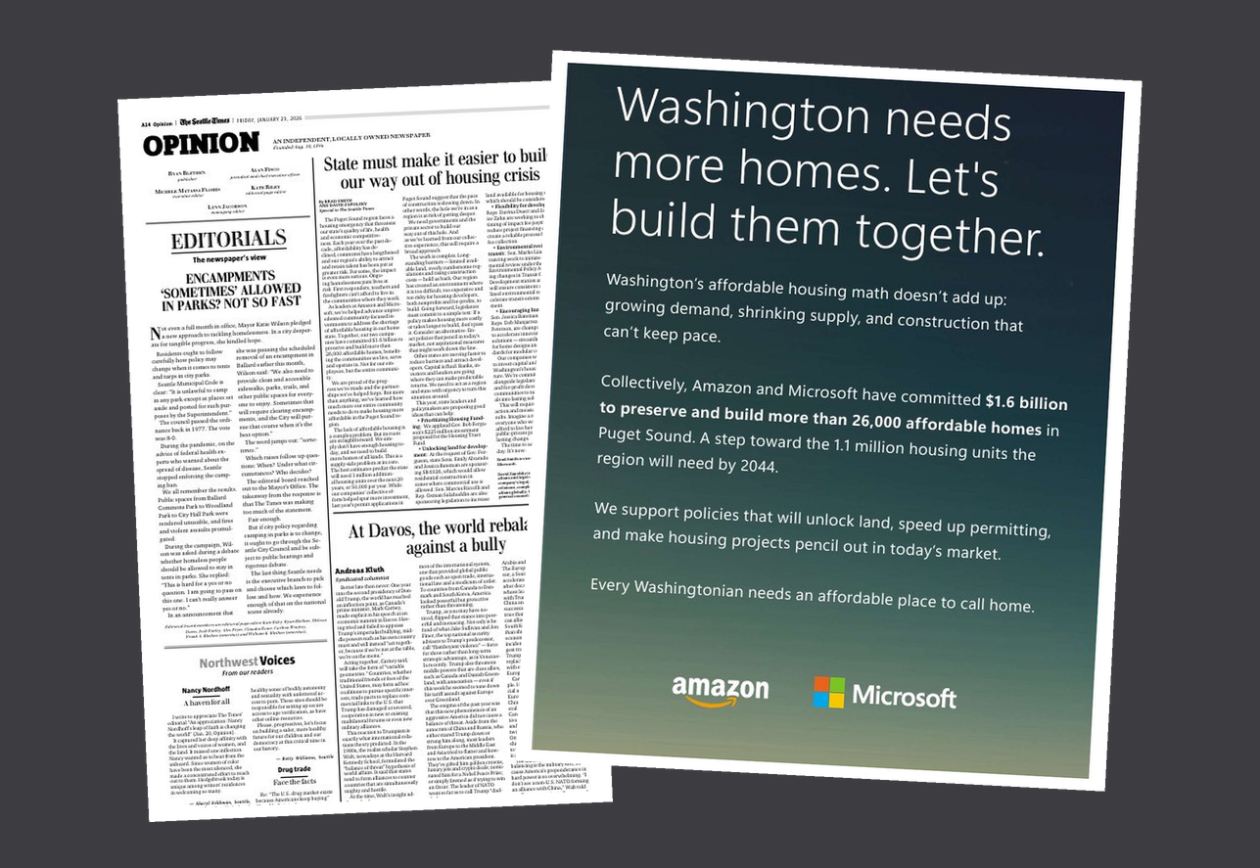
• Core Points: Microsoft and Amazon, rivals in cloud services, align on housing policy through a joint op-ed and full-page Seattle Times ad advocating policy changes.
• Main Content: The companies urge policymakers to accelerate supply, ease permitting, and expand affordable housing to address Seattle-area housing challenges.
• Key Insights: Large employers can influence state policy by presenting a unified stance on urban housing, highlighting roles for zoning reform and infrastructure funding.
• Considerations: Corporate advocacy raises questions about corporate political spending, regional impact, and implementation timelines for proposed policies.
• Recommended Actions: Policymakers should engage with tech employers to co-create practical housing solutions, while companies monitor local regulatory outcomes and adjust advocacy as needed.
Content Overview
Microsoft and Amazon, two of the largest employers in the Seattle metropolitan region, are commonly viewed as fierce competitors in the cloud computing arena. However, when it comes to the region’s housing crisis, they have found common ground. The push reflects a growing trend among major employers to advocate for public policies that can facilitate job growth and sustain employee recruitment and retention in expensive urban areas. The collaborative effort includes a joint op-ed published in The Seattle Times and a full-page advertisement, signaling a unified voice in favor of housing policy reforms.
The housing situation in the Puget Sound region has long been a point of concern for residents, local businesses, and policymakers. Rapid job growth, limited housing supply, and rising costs have created affordability challenges that affect workers across sectors, from tech to service industries. In this context, Microsoft and Amazon argue that policy adjustments—especially around housing supply, zoning, permitting, and transit-oriented development—are essential to ensure that the region remains competitive and livable for its workforce.
The op-ed and advertisement outline a broad set of policy proposals, emphasizing the importance of accelerating housing production while preserving community character and infrastructure. The companies stress that addressing the housing shortage is not only a social objective but also a business imperative, as talent recruitment and retention increasingly depend on affordable, accessible housing options for employees.
In-Depth Analysis
The collaboration between Microsoft and Amazon on housing policy signals a strategic use of influence by corporate giants to shape local and regional policy. While both companies are prominent players in the cloud services market, their joint stance on housing demonstrates how large employers can converge on public policy issues that affect labor markets and regional competitiveness.
Key elements of the proposed policy changes include:
– Expedited permitting and streamlined regulatory processes for housing projects, particularly in areas experiencing high demand and constrained supply.
– Zoning reforms to enable higher-density development, mixed-use projects, and transit-oriented development near major employment hubs.
– Increased investment in infrastructure, including transportation networks and utilities, to support newly added housing stock and reduce commute times.
– Support for affordable housing initiatives, possibly through public-private partnerships, incentives for developers to include affordable units, and targeted subsidies for low- to moderate-income households.
– Strategic consideration of environmental impacts, consistency with regional growth plans, and adherence to long-term sustainability goals.
The joint effort underscores several dynamics shaping regional policy discussions:
– The role of major employers as policy advocates: Large companies can influence public discourse by leveraging their visibility and resources to push for reforms that directly impact their ability to attract and retain talent.
– The balance between market-driven growth and community concerns: Policymakers must weigh the need for more housing against potential neighborhood impacts, such as density, traffic, and school capacity, while maintaining neighborhood character.
– The importance of coordination with local jurisdictions: Housing policy success often hinges on alignment across city, county, and state levels, as well as coordination with transit authorities and housing finance agencies.
Experts note that the Seattle region’s housing imperative is complex, intersecting land use, labor markets, and infrastructure planning. Policymakers may consider adopting a phased approach to reforms, initiating pilot programs in select districts to test streamlined permitting, density allowances, and affordable housing incentives before scaling region-wide. Stakeholders may also explore how climate resilience and environmental stewardship can be integrated into housing policy to ensure sustainable growth.
The public nature of the Microsoft-Amazon collaboration reflects a broader trend in which tech leaders are increasingly vocal about policy areas impacting their operations. While this can accelerate reforms, it also raises considerations about the appropriate scope of corporate political involvement, transparency, and potential partisan perceptions. Transparent reporting on lobbying activities and the concrete policy mechanisms being proposed can help maintain public trust while enabling constructive policy debate.
In terms of economic impact, addressing housing affordability could enhance the region’s competitiveness by attracting a diverse workforce and reducing turnover associated with high living costs. Conversely, rapid policy changes must be designed to avoid unintended consequences, such as escalating construction costs, gentrification pressures, or displacement of long-standing communities. A careful balance of market incentives, regulatory efficiency, and community protections will be crucial to achieving durable outcomes.
The Seattle Times op-ed and full-page ad serve as a test case for how private sector leadership can influence public policy discourse. If successful, similar coalitions may emerge in other regions facing housing shortages, particularly near major tech corridors. However, the long-term effectiveness of such advocacy will depend on ongoing collaboration among policymakers, developers, community organizations, and residents to implement practical, equitable housing solutions that align with broader urban planning goals.
Perspectives and Impact
- Short-Term Implications: The immediate effect of Microsoft and Amazon’s advocacy is to elevate housing policy as a strategic priority among state and local leaders. By framing housing as a business imperative, the companies aim to catalyze faster consideration of zoning reform, permitting improvements, and infrastructure investments. In the near term, policymakers may respond with hearings, pilot programs, or targeted incentives designed to demonstrate the feasibility and impact of proposed reforms.

*圖片來源:Unsplash*
Medium-Term Opportunities: If policy changes move forward, the region could see an increase in housing supply, particularly near employment centers and transit corridors. Expanded housing options may help stabilize or reduce some of the upward pressure on rental and ownership costs. Public-private partnerships could emerge to finance affordable units, with developers drawing on incentives and streamlined processes to accelerate project timelines.
Long-Term Considerations: Sustained housing policy reform requires ongoing oversight to ensure equitable outcomes. Monitoring displacement risks, ensuring inclusivity in affordable housing, and maintaining affordable rents as the market evolves will be essential. Long-term success will also depend on the integration of housing policy with transportation planning, education, and healthcare access to support resilient communities.
Implications for Corporate Strategy: Corporate advocacy on housing could become a standard component of regional talent strategy for large employers. Companies may engage in multi-stakeholder coalitions, participate in policy co-design, and align lobbying with philanthropic and workforce development initiatives. Transparent governance and measurable policy outcomes will be critical to maintaining corporate credibility.
National and Global Context: The Seattle example may offer a blueprint for other tech hubs facing similar tensions between rapid growth and housing affordability. As nations and cities grapple with urban density, climate risks, and infrastructure constraints, public-private collaborations around housing policy could become part of broader urban resilience strategies.
Community Response and Equity: Community groups, neighborhood associations, and housing advocates may welcome policy reforms that facilitate new housing supply but will likely emphasize protections for renters, tenants’ rights, and ways to combat displacement. Ensuring that lower-income residents benefit from new housing stock, rather than being pushed to marginal neighborhoods, will be a central concern for equitable policy design.
Transparency and Accountability: The collaboration raises questions about transparency in corporate political activity. Stakeholders may seek clarity on funding sources, messaging, and the specific policy outcomes sought. Clear reporting and accountability mechanisms can help sustain constructive dialogue and public confidence.
Key Takeaways
Main Points:
– Microsoft and Amazon unite on housing policy despite competitive tensions in cloud services.
– The joint effort emphasizes expedited permitting, zoning reform, and infrastructure investment to increase housing supply.
– Corporate advocacy models can influence regional policy debates but require careful attention to transparency and implementation.
Areas of Concern:
– Potential perceptions of corporate overreach or partisan alignment in public policy.
– Risks of rapid policy changes, including unintended market or displacement effects.
– Ensuring equitable distribution of benefits from new housing and infrastructure investments.
Summary and Recommendations
Microsoft and Amazon’s joint call for housing policy reform in the Seattle region illustrates how major regional employers can leverage their influence to address systemic urban challenges. By advocating for streamlined permitting, smarter zoning, and targeted infrastructure and affordable housing investments, the two companies assert that housing policy is integral to regional economic vitality and talent retention. The collaboration signals a proactive stance that may intensify regional policy conversations, potentially accelerating reforms that align housing supply with job growth.
For policymakers, the key takeaway is to engage with these corporate stakeholders to translate broad policy concepts into concrete, testable programs. A measured approach—starting with pilots in high-demand corridors, coupling density incentives with community safeguards, and ensuring transparent monitoring of outcomes—can help balance growth with equity. Collaboration should involve a wide range of voices, including tenants, neighborhood associations, affordable housing groups, developers, and transit authorities, to craft solutions that are scalable and adaptable.
For the companies themselves, sustained advocacy should be accompanied by transparent reporting and ongoing evaluation of policy impacts. Aligning housing policy with broader commitments to workforce development, regional resilience, and climate-conscious planning can strengthen public trust and provide a framework for constructive collaboration with local governments. Monitoring implementation progress and embracing feedback from diverse stakeholders will be essential to achieving durable, equitable housing outcomes.
Ultimately, the Seattle case could serve as a model for other technology hubs facing similar housing pressures. If successful, it may demonstrate how competitive dynamics in one domain can give way to policy collaboration that benefits the broader community, ensuring that economic growth remains sustainable and inclusive.
References
- Original: https://www.geekwire.com/2026/microsoft-and-amazon-together-on-housing-tech-giants-find-common-ground-in-push-for-policy-changes/
- Additional context on housing policy, zoning reform, and public-private partnerships in urban development
- Commentary on corporate political advocacy and transparency in policy engagement

*圖片來源:Unsplash*