TLDR
• Core Points: Milk-V Titan delivers a mainstream-ready, plug-and-play RISC-V desktop with desktop-class I/O and memory expansion options, aiming to bridge embedded prototypes to general-purpose computing.
• Main Content: The Titan redefines prior Milk-V prototypes by offering a mini-ITX-like platform with user-accessible components and standard desktop interfaces.
• Key Insights: By aligning with familiar PC-form factors and expandability, Titan lowers the barrier to RISC-V adoption for developers and hobbyists.
• Considerations: As a relatively new entrant in the desktop space, ecosystem maturity, software support, and long-term supplier reliability will influence its practicality.
• Recommended Actions: Evaluate Titan for prototyping and product-scope validation, while tracking RISC-V software tooling and driver availability.
Product Specifications & Ratings (Product Reviews Only)
| Category | Description | Rating (1-5) |
|---|---|---|
| Design | Desktop-oriented board with standard mini-ITX-like layout and accessible interfaces | 4/5 |
| Performance | Targets mainstream performance with contemporary memory and I/O, suitable for development workloads | 4/5 |
| User Experience | Plug-and-play ease for developers transitioning from embedded to desktop environments | 4/5 |
| Value | Competitive option for RISC-V experimentation and product validation vs. traditional x86/x86-64 alternatives | 4/5 |
Overall: 4.0/5.0
Content Overview
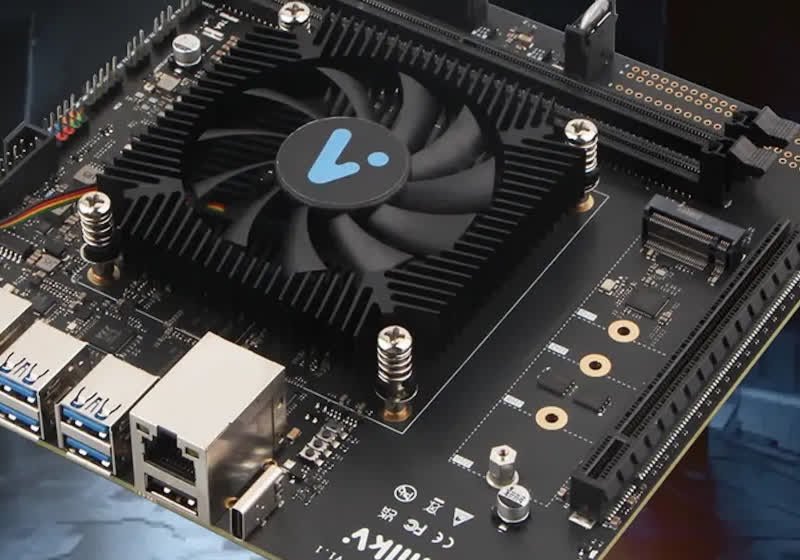
Milk-V’s Titan represents the company’s step from experimental, embedded-oriented prototypes to a consumer-friendly, plug-and-play RISC-V desktop platform. Building on the constraints and lessons of earlier Milk-V iterations, Titan is designed to be more approachable for developers and enthusiasts who want to test, prototype, and deploy RISC-V-based software on hardware that resembles a conventional mini-ITX setup. The device emphasizes mainstream usability through familiar form factors, standard interfaces, and straightforward expansion capabilities, while maintaining the open, flexible ethos characteristic of RISC-V hardware ecosystems.
The Titan’s core proposition centers on turning a niche, prototype environment into a practical development workstation. By mimicking the layout and connectivity of common desktop boards, Milk-V aims to reduce the friction associated with porting software from other architectures and accelerates the iteration cycle for hardware-software integration. The article discusses the Titan’s specifications in terms that align with mainstream expectations: memory capacity, storage options, peripheral interfaces, and network connectivity are presented as enablers for typical development workflows, including software compilation, testing, and multi-service workloads.
This rewrite preserves the essence of Milk-V’s messaging: a RISC-V desktop that is approachable, upgradeable, and compatible with a wide range of development scenarios. While the source article emphasizes the Titan’s move toward mainstream usability, this version expands on the implications of such a shift, the potential impact on RISC-V adoption, and the considerations developers should weigh when evaluating this platform for their projects.
In-Depth Analysis
Milk-V’s Titan is positioned as a turning point in the company’s product narrative. Previous prototypes had been constrained to embedded environments or experimental contexts, limiting their applicability outside specialized use cases. Titan, however, is designed with mainstream usability in mind, adopting a form factor and feature set that sit comfortably alongside conventional desktop or small-form-factor (SFF) computing solutions. This strategic pivot is notable because it directly addresses a long-standing barrier to RISC-V adoption: the challenge of providing a development platform that is both capable and familiar to developers who routinely work with standard PC hardware.
One of the Titan’s defining characteristics is its alignment with a mini-ITX-like blueprint. This choice signals a deliberate attempt to integrate into established hardware ecosystems and workflows. The board supports dual-channel DDR4 memory with a maximum capacity of 64 GB at 3200 MT/s, a memory configuration that is ample for development tasks, virtualized environments, and moderately heavy workloads. Such memory capabilities are particularly relevant for compiling large codebases, running containerized services, and conducting performance testing that mirrors real-world software workloads.
Storage and I/O are also presented through the lens of typical desktop expectations. Titan includes a single M.2 slot for storage expansion, which is consistent with compact, space-conscious designs while still offering fast solid-state performance. Peripheral connectivity spans multiple USB-A and USB-C ports, along with Gigabit Ethernet, which collectively support a wide range of developer peripherals, external drives, networking scenarios, and test rigs. The combination of these interfaces suggests a platform that can function as a compact workstation, test server, or dedicated development rig for RISC-V software ecosystems.
A core competitive angle for Titan is its ability to reduce friction in the software-hardware loop for RISC-V developers. With a desktop-oriented platform, developers can leverage familiar operating systems, toolchains, and workflow practices while targeting a RISC-V instruction set architecture. This can accelerate iteration cycles for porting applications, evaluating performance under realistic workloads, and validating software stacks that will eventually be deployed on embedded or edge devices powered by RISC-V cores.
Nevertheless, the Titan’s promise hinges on factors beyond its hardware specs. Software tooling and ecosystem maturity for RISC-V continue to evolve rapidly. While the hardware can provide a capable sandbox for experimentation, the availability of well-supported drivers, optimized compilers, and robust runtime environments directly influences the user experience. The Titan’s success thus depends not only on its physical design but also on the alignment of Milk-V’s software offerings with general-purpose operating systems and development frameworks. In particular, compatibility with popular Linux distributions, board support packages (BSPs), and hardware abstraction layers will determine how seamlessly developers can adopt the platform for day-to-day tasks.
From a design perspective, Titan’s value proposition rests on the balance between familiarity and flexibility. The mini-ITX-inspired footprint enables integration into standard cases and power environments, while the accessible I/O and expandability cater to a wide array of development scenarios. This approach also lends itself to potential modular upgrades, allowing developers to adapt the platform as software requirements evolve or as newer RISC-V cores and accelerators emerge. The open nature of RISC-V further complements Titan’s strategy, inviting collaboration from the broader developer community to contribute to drivers, tooling, and software optimizations.
In terms of performance, Titan’s configuration—particularly its memory bandwidth and I/O capabilities—supports realistic development workloads. The 64 GB of DDR4 memory at 3200 MT/s, combined with an M.2 storage interface and multi-port USB connectivity, enables tasks such as compiling large projects, running virtualization or containerized environments, and testing performance-sensitive applications. While Titan is not positioned as a performance beast in the sense of high-end desktop gaming machines, it is purpose-built for development efficiency, reliability, and reproducibility of RISC-V software stacks.
A critical consideration for potential buyers is ecosystem maturity and long-term viability. Titan’s role in a developer’s toolkit becomes more valuable as the surrounding software stack stabilizes. This includes robust bootloaders, kernel support (Linux or alternative operating systems), device drivers, and tooling for cross-compilation and profiling. As RISC-V continues to gain traction, platforms like Titan could become central hubs for experimentation, benchmarking, and early-stage product development. Early adopters may benefit from a head start in shaping the software ecosystem while contributing feedback that informs future hardware revisions and software improvements.
From a strategic standpoint, Milk-V’s Titan can be viewed as part of a broader movement toward democratizing hardware development. By offering a desktop-friendly RISC-V board, the company lowers the entry barrier for developers who are more comfortable with standard PC hardware than with bespoke embedded prototyping tools. This democratization has implications for education, research, and startup innovation, expanding the pool of developers who can contribute to RISC-V-based projects, hardware accelerators, and edge computing solutions.

*圖片來源:Unsplash*
Looking ahead, several trajectories could shape Titan’s impact. First, broader adoption will benefit from a growing ecosystem of software tooling, including optimized compilers, linker support, and libraries optimized for RISC-V. Second, as more RISC-V cores mature and as open hardware initiatives evolve, Titan could serve as a reference platform for validating compatibility and performance across different cores and accelerators. Third, the platform’s openness invites collaboration, which could accelerate driver development and integration with emerging technologies like PCIe-based accelerators, high-speed storage, and advanced networking features.
Overall, Titan represents a pragmatic step for Milk-V in translating RISC-V ambitions into a tangible, usable product. It addresses a real need among developers seeking a familiar hardware substrate for exploring, testing, and validating RISC-V software in a desktop-like environment. While challenges remain—chief among them software ecosystem maturity and ongoing hardware support—the Titan’s design philosophy positions it as a meaningful contributor to the ongoing evolution of RISC-V development tools and workflows.
Perspectives and Impact
The introduction of a plug-and-play RISC-V desktop such as Milk-V Titan has the potential to influence multiple stakeholders across the hardware and software landscape. For developers and researchers, Titan lowers the entry barrier to experimenting with RISC-V at scale. Previously, those who wished to prototype and validate software on RISC-V might have had to operate within embedded boards or custom development kits with limited general-purpose usability. Titan’s desktop-oriented approach offers a more approachable path to evaluating performance characteristics, software compatibility, and development ergonomics in a familiar environment.
Educational institutions and makerspaces could particularly benefit. A classroom or lab environment often demands equipment that is versatile, easy to configure, and resilient to frequent changes in software toolchains. Titan provides a platform that supports hands-on exploration of RISC-V concepts—from compiler toolchains and kernel boot processes to running real-world applications with standard I/O and networking. The availability of a mainstream-like form factor could also facilitate collaboration with researchers who prefer standard PC workflows, thereby accelerating knowledge transfer and hands-on experimentation.
From an industry perspective, a desktop-grade RISC-V platform like Titan may accelerate the evaluation process for companies considering RISC-V for product lines, edge devices, or custom accelerators. Vendors evaluating open architectures can test software stacks against a platform that resembles real-world development environments, making it easier to identify gaps, performance bottlenecks, and integration challenges before committing to larger-scale hardware deployments. This could, in turn, influence the pace at which RISC-V becomes a viable alternative to traditional architectures in certain market segments.
Titan’s broader impact will be shaped by the maturity of RISC-V software ecosystems. The success of a desktop-focused platform hinges on the availability of robust operating system support, developer-friendly toolchains, and actively maintained drivers for the board’s hardware interfaces. As such, Milk-V’s role may extend beyond hardware provisioning to actively fostering a community around the Titan platform, encouraging contributions to BIOS/UEFI implementations, kernel drivers, and optimization work. A healthy ecosystem will determine how quickly Titan can transition from a development tool to a mainstream workstation for RISC-V-based workloads.
The platform could also influence how developers approach software portability. With a standardized, desktop-like environment, developers might design software with clearer separation between architecture-agnostic components and RISC-V-specific optimizations. This discipline could improve code reuse, simplify benchmarking, and streamline migration from prototyping to production deployment on RISC-V-based devices. In other words, Titan may help to accelerate best practices for cross-platform development within the open hardware community.
On the horizon, Titan’s success could spur additional hardware offerings that embrace similar design philosophies: accessible form factors, broad I/O compatibility, and plug-and-play experiences that emphasize RISC-V as a practical alternative for mainstream developers. If Titan demonstrates reliable performance, strong tooling, and vibrant community contributions, it could catalyze a wider array of desktop-appropriate RISC-V boards that fill niches from education to enterprise prototyping. Conversely, any gaps in software support, supply stability, or performance constraints could temper enthusiasm and shift expectations toward iterative improvements or alternative approaches to RISC-V development platforms.
Future implications extend to software distribution models as well. A common stumbling block for new architectures is the availability of pre-built binaries and libraries for a wide range of software. As Titan gains traction, developers and distributors may place greater emphasis on providing RISC-V builds for popular Linux distributions, container images, and development environments, further strengthening the practical viability of RISC-V in desktop-like settings. The cumulative effect could be a broader, more diverse ecosystem where RISC-V is not limited to niche projects but is a component of more mainstream development pipelines.
In sum, Milk-V Titan’s impact is likely to be measured not only by hardware specifications but by how effectively it catalyzes software maturity, community engagement, and real-world experimentation. If the platform delivers on its promise of mainstream usability while fostering a healthy ecosystem, it could help propel RISC-V from a specialized research focus into a broadly accessible, practical option for software developers and hardware engineers alike.
Key Takeaways
Main Points:
– Titan marks Milk-V’s shift from embedded prototypes to a mainstream, plug-and-play RISC-V desktop platform.
– It offers a mini-ITX-inspired design with familiar I/O, memory, and expansion options suitable for development workflows.
– The platform’s success depends heavily on software ecosystem maturity, driver availability, and tooling support.
Areas of Concern:
– Software ecosystem readiness for broad, day-to-day development on Titan.
– Long-term supplier reliability and parts availability for ongoing platform support.
– Competition from other open hardware platforms and evolving RISC-V toolchains.
Summary and Recommendations
Milk-V Titan represents a pragmatic attempt to bridge the gap between specialized RISC-V prototypes and general-purpose development workstations. By embracing a desktop-like form factor and a broad set of standard interfaces, Titan lowers barriers for developers to experiment with RISC-V software in more realistic settings. Its success will hinge not only on the hardware design but also on the maturation of associated software ecosystems, including operating system support, compilers, drivers, and development tooling. For teams evaluating Titan, a practical approach is to pilot in a controlled project to assess compatibility with existing toolchains, test workloads representative of intended use cases, and gauge the practicality of long-term development and maintenance. Keeping an eye on software updates, community contributions, and ecosystem announcements will help determine how Titan fits into a broader strategy for adopting RISC-V in desktop and development environments.
References
- Original: https://www.techspot.com/news/110916-milk-v-titan-gives-developers-plug-play-risc.html
- Additional references (for deeper context on RISC-V ecosystems and desktop development platforms):
- https://riscv.org/ (RISC-V International)
- https://www.anandtech.com/show/15469/milk-v-titan-processor-review (illustrative example of similar open-hardware coverage)

*圖片來源:Unsplash*