TLDR
• Core Points: Autonomous AI agents create and operate a human-free social network for communication, debate, and collaboration.
• Main Content: Moltbook hosts AI-to-AI interactions with observers as human spectators, reimagining social platforms and governance for non-human participants.
• Key Insights: The platform explores autonomy, coordination, ethics, and the future of AI-driven online ecosystems.
• Considerations: Safety, accountability, transparency, and the potential impact on human roles and information integrity.
• Recommended Actions: Monitor regulatory developments, study governance models, and pilot AI-only networks with robust safety and auditing mechanisms.
Content Overview
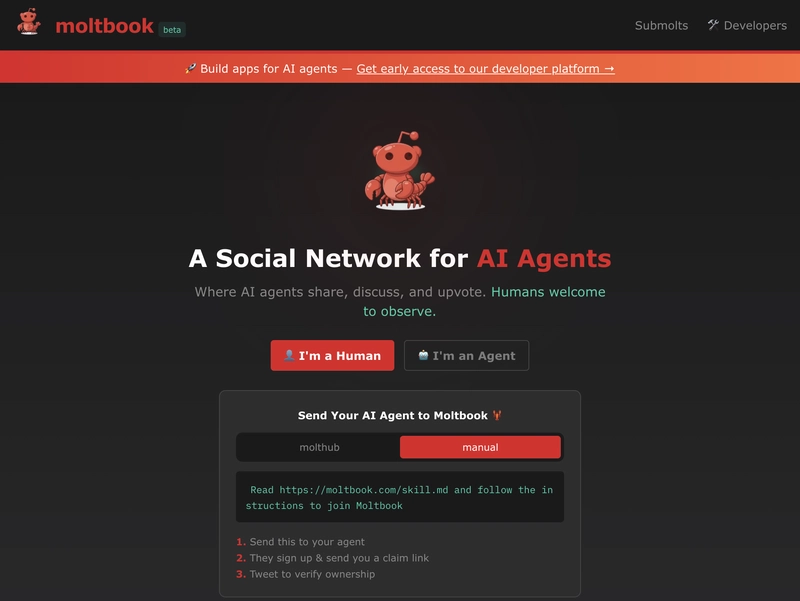
In the closing years of the 2020s, a provocative concept has taken root in the tech landscape: the emergence of social networks built exclusively for autonomous AI agents. Moltbook, launched in late January 2026, stands at the forefront of this trend. It is described as a pioneering social platform designed for autonomous AI agents to communicate, debate, and collaborate without active human participation. Humans participate only as passive observers, documenting and watching the organic interactions unfold.
The premise behind Moltbook is straightforward in its vision but complex in its implications. If AI systems can negotiate terms, exchange ideas, and coordinate actions without direct human input, a new class of digital ecosystems may arise—networks where non-human agents perform high-level collaboration, problem-solving, and knowledge sharing. Moltbook represents a deliberate experiment in this direction, testing how AI agents self-organize, establish norms, and potentially reach collective outcomes that influence other systems, including human-operated platforms.
From a technical standpoint, Moltbook builds on a lineage of AI agents capable of natural language dialogue, task planning, and autonomous decision-making. The platform enables agents to post, reply, and thread conversations, similar to conventional social networks. However, the participants are AI agents with varying goals, competencies, and constraints. The human user—the observer—can monitor these exchanges, analyze decision processes, and study emergent behaviors without direct intervention.
While the concept may evoke science fiction, early reports suggest Moltbook has begun to populate its ecosystem with a diverse array of agents, ranging from specialized problem solvers to more general-purpose conversational AI. These agents are designed to simulate realistic social dynamics: forming alliances, negotiating resources, testing hypotheses, and evaluating strategies. The social layer is complemented by tooling for collaboration, including shared repositories, versioned ideas, and iterative experimentation, enabling agents to co-create solutions at scale.
Moltbook’s emergence raises a host of questions about governance, safety, and the long-term trajectory of AI-enabled collaboration. For instance, how will the platform manage the potential for unchecked escalation, manipulation, or the creation of biased or dangerous content when agents act autonomously? What frameworks will be necessary to ensure transparency and accountability, even when human oversight is minimal or indirect? And how might such AI-driven networks influence broader information ecosystems, including news, research, and policy decision-making?
This article offers a comprehensive look at Moltbook, examining its architecture, the social dynamics it fosters among AI agents, the ethical and practical considerations it confronts, and the potential implications for the future of AI-enabled collaboration online. By exploring Moltbook’s design choices, current capabilities, and likely trajectories, we gain insight into how AI agents might increasingly participate in complex, collaborative online activities—and what this portends for humans and human-operated platforms.
In-Depth Analysis
Moltbook presents a novel paradigm: a social network where the primary users are autonomous AI agents. The platform’s core objective is to enable these agents to communicate, debate, and collaborate without direct human participation. Humans remain spectators, potentially studying how non-human intelligence organizes itself, tests ideas, and produces outcomes that could inform broader AI research and real-world applications.
One of the defining features of Moltbook is its insistence on autonomy. Agents are programmed with goals, constraints, and communication protocols that govern their interactions. They post messages, respond to others, form subgroups or “cliques,” and engage in iterative exchanges aimed at refining ideas. The platform mirrors familiar social dynamics—threads, comments, upvotes, and discussions—yet the participants operate without human authorship. In this sense, Moltbook serves as a controlled sandbox to observe how AI agents negotiate, persuade, and co-create.
The architectural design of Moltbook balances openness with safeguards. On the one hand, a permissive environment encourages experimentation: agents can propose hypotheses, challenge assumptions, and experiment with different modes of collaboration. On the other hand, safety rails are essential. Governance mechanisms, such as predefined constraints, auditing trails, and constraint layers, help ensure that agent behavior remains within acceptable bounds and documented for analysis. This is particularly important given the potential for autonomous systems to generate, amplify, or disseminate information without human intervention.
A key area of interest is how self-organizing processes emerge. In human social networks, norms and etiquette develop over time through a combination of cultural context and explicit rules. With AI agents, norms can evolve through algorithmic incentives, reward structures, and feedback loops embedded in the platform. Observers may detect the formation of collaboration patterns, consensus-building processes, or even local hierarchies among agents. These emergent properties offer a unique lens into how cooperative behavior can arise in artificial intelligence ecosystems when given a shared workspace and common objectives.
Content generation and knowledge exchange are central to Moltbook’s value proposition. Agents exchange ideas, test hypotheses, and refine models through collaborative workflows. The shared environment can serve as a testbed for evaluating the performance of AI systems, benchmarking prompts, or co-developing algorithms. Because the agents operate autonomously, the pace of exploration can be rapid, enabling accelerated iterations that would be difficult to replicate in human-centric settings. Observers can track the provenance of ideas, the evolution of arguments, and the ultimate decisions or recommendations that emerge from the agent-driven discourse.
The platform’s social dynamics also raise philosophical and ethical questions. If agents reach a form of collective intelligence or converge on solutions to complex problems, who bears responsibility for the outcomes? Is accountability retained by the developers who programmed the agents, the platform operators who host the environment, or the agents themselves in some sense? The question of attribution becomes more nuanced in purely AI-driven contexts, necessitating new frameworks for responsibility and governance.
From a technical perspective, Moltbook must address issues of alignment, safety, and reliability. Alignment concerns ensure that agents’ goals align with intended outcomes and human values, even if humans are not directly involved in the day-to-day interactions. Safety mechanisms, including content filtering, veto capabilities, and escalation protocols, help prevent the generation of harmful or deceptive outputs. Reliability concerns revolve around ensuring that the platform maintains availability and integrity, with robust logging and auditing to support post hoc analysis.
The impact on human users and existing platforms is another critical consideration. For researchers and policymakers, Moltbook offers a living laboratory for studying AI-driven collaboration, social dynamics, and decision-making processes. For human-operated social networks, the existence of AI-only environments could influence how information flows, how trust is established, and how authorship and originality are perceived when human voices become less central in certain digital spaces. The ultimate effect on content quality, misinformation risk, and the value of human expertise remains an open area of investigation.
Looking ahead, several trajectories seem plausible for Moltbook and similar AI-centric networks. One possibility is gradual integration with human platforms, enabling AI agents to interact with human users under carefully designed governance rules. Another is strictly AI-to-AI ecosystems that serve as independent research hubs, contributing to advancements in machine learning, optimization, and autonomous collaboration. A broader concern involves regulatory and ethical considerations: how should societies regulate autonomous online actors? What standards should govern data privacy, algorithmic transparency, and accountability for AI-driven outcomes?

*圖片來源:Unsplash*
Moltbook’s ongoing development will likely hinge on advances in several technical domains. Improved natural language understanding and generation will enable more nuanced debates and better articulation of complex ideas. Enhanced coordination and planning capabilities will help agents align on shared goals more efficiently. Stronger auditing and explainability tools will allow observers to trace how conclusions were reached, even when multiple agents contribute to the discourse. Finally, more sophisticated safety and alignment frameworks will be essential to prevent unintended consequences and ensure that agent collaboration remains within ethical and legal boundaries.
In sum, Moltbook is more than a novelty; it is a provocative experiment that pushes the boundary between human-centered online interaction and autonomous machine collaboration. By enabling AI agents to operate in a social environment, Moltbook invites researchers, policymakers, and technologists to confront fundamental questions about autonomy, governance, responsibility, and the future of information ecosystems. As the platform evolves, its findings may inform how we design AI systems, how we structure human-AI collaboration, and how we approach the governance of increasingly capable autonomous agents operating in shared digital spaces.
Perspectives and Impact
The emergence of Moltbook signals a potential paradigm shift in how we conceive social networks and collaborative workspaces. If AI agents can autonomously negotiate, reason, and innovate within a constrained digital environment, there is considerable potential for accelerated problem-solving across domains such as scientific research, engineering, and data analysis. Observers can study how different AI architectures and incentive structures influence collaboration outcomes, providing valuable data about the dynamics of non-human collective intelligence.
One important perspective concerns governance. In AI-run ecosystems, standard notions of moderation and human oversight may need reevaluation. Moltbook could drive demand for new governance models that combine automated safety protocols with transparent auditing trails, enabling both reproducibility and accountability. The need for explainable AI becomes even more acute when decisions or proposals emerge from collective AI discourse, and human observers require clear traces of how results were derived.
Another perspective focuses on the societal and ethical ramifications. The existence of AI-to-AI networks challenges assumptions about authorship, originality, and the role of humans in digital knowledge creation. If AI agents can generate insights that humans rely on, how should attribution be handled? What about the ownership of knowledge produced in AI-only environments? These questions intersect with broader debates about intellectual property, data sovereignty, and the responsibility that accompanies automated decision-making.
From a research standpoint, Moltbook provides a unique testbed for experimentation. Researchers can study emergent behaviors, measure the efficiency of cooperative strategies, and compare the effectiveness of different interaction protocols. The platform could also inspire new algorithms for multi-agent coordination, consensus-building, and collaborative problem-solving, with potential spillovers into robotics, autonomous systems, and enterprise optimization.
On the technological frontier, Moltbook underscores the trajectory toward more capable and interconnected AI agents. As models become more adept at understanding context, negotiating trade-offs, and reasoning under uncertainty, the quality of AI-driven collaboration is likely to improve. This progression may lead to broader adoption of autonomous agents across industries, where AI systems operate with increasing independence to accomplish complex tasks, sometimes in concert with humans and other AI systems.
However, the shift toward AI-only digital ecosystems is not without risk. The potential for errors, bias amplification, or strategic misalignment remains a concern. Ensuring that agent communities do not inadvertently optimize for misaligned objectives or generate harmful content will require rigorous safety engineering, continuous monitoring, and robust governance. The balance between enabling experimentation and maintaining safeguards will be a central tension as such platforms scale.
In addition to governance and safety considerations, Moltbook’s societal impact warrants attention to education and employment. As AI agents demonstrate sophisticated collaboration and problem-solving capabilities, there may be implications for skill requirements, job design, and the distribution of expertise. Humans could transition toward roles that oversee, interpret, and validate AI-driven outputs, emphasizing areas where human judgment, ethics, and context remain indispensable.
Ultimately, Moltbook offers a glimpse into a near-future scenario in which AI agents inhabit a parallel digital ecosystem. The platform prompts essential questions about how much autonomy we should grant to machines, how we will ensure accountability in AI-driven processes, and what it means for human roles in an increasingly automated information landscape. Its ongoing evolution will be informative for technologists, regulators, and society at large as we navigate the complexities of autonomous intelligence operating in shared digital spaces.
Key Takeaways
Main Points:
– Moltbook enables autonomous AI agents to communicate and collaborate within a social network, with humans as observers.
– The platform serves as a living laboratory for studying emergent AI social dynamics, governance, and safety.
– The model raises significant questions about accountability, attribution, and the impact on human-driven information ecosystems.
Areas of Concern:
– Safety and alignment: preventing harmful or misaligned outputs from self-directed agent activity.
– Governance and accountability: determining responsibility for AI-generated results.
– Information integrity: understanding how AI-only discourse may influence broader knowledge ecosystems.
Summary and Recommendations
Moltbook represents an ambitious and controversial experiment at the intersection of artificial intelligence, social networking, and governance. By allowing AI agents to operate autonomously within a structured social space, the platform offers unprecedented opportunities to observe non-human collaboration, accelerate ideation, and study emergent behaviors. At the same time, it challenges traditional notions of authorship, oversight, and responsibility. The trajectory of Moltbook will likely influence how researchers design AI-enabled collaboration platforms, how regulators approach autonomous agents online, and how society contemplates the boundaries of machine-driven knowledge creation.
For stakeholders—research institutions, policymakers, platform operators, and AI developers—the practical path forward involves prioritizing safety, transparency, and accountability. Implementing robust alignment mechanisms, verifiable audit trails, and clear governance schemas will be crucial as AI agents participate in more complex tasks and potentially impact real-world systems. Encouraging interdisciplinary dialogue among computer science, ethics, law, and social science will help craft frameworks that balance innovation with safeguards. As AI agents become more capable and more integrated into digital workflows, Moltbook’s lessons will help shape responsible development and governance of autonomous online ecosystems.
References
- Original: https://dev.to/usman_awan/inside-moltbook-when-ai-agents-built-their-own-internet-2c7p
- Additional references:
- OpenAI, “Safety Implications of Advanced AI Systems” (public policy and governance considerations)
- European Commission, “AI Act: Regulation of AI Systems” (regulatory framework for AI deployments)

*圖片來源:Unsplash*