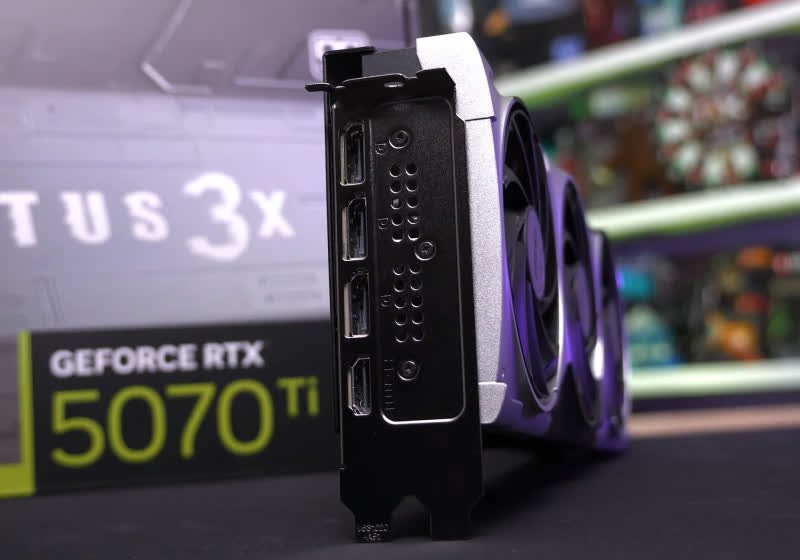
TLDR
• Core Points: Nvidia effectively ends production of the GeForce RTX 5070 Ti; Asus confirms supply shortage and end-of-life status. The industry-wide GPU market faces continued strain from supply constraints, pricing volatility, and shifting demand.
• Main Content: The RTX 5070 Ti is essentially discontinued; primary AIB partner Asus reports ongoing supply issues, signaling broader market weakness beyond a single SKU.
• Key Insights: End-of-life signals for mid-range GPUs reflect deeper supply chain challenges, competitive dynamics, and potential moves by Nvidia to reallocate wafers to higher-margin products.
• Considerations: Buyers may face limited availability, fluctuating prices, and delayed upgrades; retailers and partners must navigate stockouts and consumer expectations.
• Recommended Actions: Monitor official statements from Nvidia and major partners; consider alternative GPUs or generation gaps; plan for longer purchase cycles and potential pricing normalization over time.
Content Overview
The headline fact driving the current discussion in the GPU market is stark: Nvidia has effectively removed the GeForce RTX 5070 Ti from its active product lineup. This development is not a one-off supply hiccup but reflects a broader pattern in which mid-range GPUs face persistent shortages and, in some cases, deliberate end-of-life status by board partners. Asus, the largest Nvidia AIB partner, has publicly indicated that the RTX 5070 Ti is currently in a supply-constrained state and has been designated as End of Life (EOL). This categorization means the model is unlikely to receive further production runs or significant retail support in the near term, complicating purchase considerations for gamers and PC builders who had anticipated this SKU as a viable upgrade path.
The RTX 5070 Ti’s fate sits within a wider context of GPU scarcity that has characterized the market over the past year. While stock levels fluctuate for various SKUs, the mid-range tier—where the 5070 Ti sat—has been particularly affected by supply chain bottlenecks, wafer allocation decisions, and demand dynamics that favor higher-margin cards or refreshed generations. In practical terms, this translates to limited availability, inconsistent supply windows, and price volatility that can frustrate consumers seeking practical performance gains without breaking the bank.
To understand the broader implications, it’s helpful to recall how Nvidia and its ecosystem of partners manage product lifecycles. Nvidia’s core strategy includes periodic product refreshes with new architectures and memory configurations, interspersed with price adjustments and the reallocation of wafer production to high-demand or higher-margin SKUs. When a model is designated End of Life by partners like Asus, it signals that the supply chain has prioritized other products, and market demand for that specific SKU has diminished to the point where continued manufacturing is not economically justified. This is particularly relevant in an environment where component costs, fab capacity, and logistics costs continue to influence product viability for mid-range GPUs.
This situation raises questions beyond a single card. If the RTX 5070 Ti is effectively dead in the market, what does that mean for consumer choice, price trends, and the broader progression of the GPU market? The answer is multi-layered. First, it underscores how sensitive the segment is to supply allocation decisions and market demand signals. Second, it highlights potential shifts in how Nvidia and its partners price and position mid-range GPUs relative to their higher-end siblings and to next-generation machines. Finally, it emphasizes the impact on supply chains, retailers, and consumers who rely on predictable product availability for timely upgrades.
As the market continues to grapple with these dynamics, potential buyers must navigate a landscape where availability is uneven, and pricing can swing based on stock levels and channel strategy. The RTX 5070 Ti’s status as largely unavailable and effectively discontinued suggests that alternatives within Nvidia’s catalog—or potentially from competitors—will be the default paths for buyers seeking mid-range performance in this generation.
In-Depth Analysis
The RTX 5070 Ti’s exit from the product lineup is not simply a local decision by Asus or a few retailers; it reflects a coordinated approach across the ecosystem that prioritizes scarce wafer resources and long-term profitability over maintaining a broad mid-range portfolio. In practice, this means Nvidia and its AIB partners may reallocate production capacity toward GPUs that are more likely to sustain demand or yield higher margins, such as higher-tier RTX 50-series models or the upcoming generations. The end-of-life designation by Asus indicates that, from a supply perspective, the model is no longer a reliable option for channels, and retailers should shift focus to remaining inventory or future stock of successor products.
From a consumer perspective, this development reduces mid-range options for synthetic benchmarks, gaming at 1440p with higher frame-rate targets, and mainstream 4K ambitions. For many buyers, the RTX 5070 Ti represented a balanced choice between cost, performance, and feature set. Its removal leaves a gap in the lineup that will be filled, if at all, by either other Nvidia SKUs with different price-to-performance ratios or by competing platforms such as AMD’s mid-range offerings. The absence of a stable supply in this segment can also influence pricing strategies for the rest of the lineup. If demand for mid-range cards dries up due to inconsistent supply, prices on remaining SKUs could rise or fall more unpredictably, depending on stock turns and channel incentives.
The broader GPU market has faced a confluence of challenges: supply chain disruptions, high demand for chips used in AI workloads, and the reallocation of memory and processing resources toward models capable of delivering AI acceleration. While AI workloads have driven demand in certain segments, traditional gaming graphics require a steady cadence of product refreshes to keep prices aligned with performance improvements. The RTX 5070 Ti’s EOL status is a tangible signal that not all parts of the market will experience sustained support, especially those that sit in the middle of performance and price points.
Moreover, the GPU market is increasingly sensitive to how manufacturers communicate product lifecycles. End-of-Life designations can ripple through distribution channels, affect pricing power, and influence consumer confidence in the current generation’s value proposition. For enthusiasts who track the precise performance deltas between generations, an abrupt exit of a model can complicate decision-making, particularly for those who plan incremental upgrades or who rely on a specific balance of features, such as ray tracing capabilities and DLSS performance.
Looking ahead, there are a few plausible trajectories. First, Nvidia could consolidate its mid-range position around remaining SKUs in the 50-series or pivot toward a refreshed generation with a new branding and performance targets. Second, the market could see a continued emphasis on higher-end cards, at least in the near term, as supply constraints persist and as partners manage inventory. Third, competition from AMD remains a factor, particularly as the company continues to optimize its own mid-range stack for 1440p gaming and efficiency. In any case, the absence of a widely available RTX 5070 Ti creates an opportunity for alternative SKUs to claim the mid-range market segment, but only if supply meets demand and price points align with expected performance.
For retailers, the situation demands careful channel management. End-of-life announcements should be paired with clear communication about anticipated stock levels for successor products, estimated restock windows, and any promotion plans intended to clear existing inventories. Given the current climate, retailers that maintain a diverse slate of options across multiple brands may fare better in meeting consumer needs than those that heavily anchor on a single SKU. Moreover, the risk of price volatility calls for proactive pricing strategies, including transparent MSRPs, curbside promotions, and restocking alerts that help customers plan their purchases.
From a technological perspective, Nvidia’s ongoing focus on AI capabilities and ray-tracing optimization means that future mid-range products might prioritize features that deliver superior efficiency and AI acceleration at a given wattage. This could shape what consumers should expect from next-generation offerings: improved performance per watt, better DLSS integration, and more robust ray-tracing performance, all while staying mindful of price-to-performance expectations for mainstream users.

*圖片來源:Unsplash*
Perspectives and Impact
The RTX 5070 Ti’s decline is emblematic of a reshaped GPU ecosystem where supply dynamics, product lifecycles, and strategic resource allocation intersect. The immediate impact is visible in how channels report and stock mid-range GPUs. Asus’ confirmation of the model’s end-of-life status signals to retailers and consumers that this particular SKU is unlikely to see replenishment in the near term. This reduces the number of accessible options for consumers seeking mid-range performance, potentially widening the gap between high-end and lower-end cards and diminishing the middle ground that often serves as a bridge for gamers upgrading from entry-level GPUs.
Longer-term implications include how Nvidia and its partners calibrate pricing and product strategy across generations. If the market perceives mid-range GPUs as less available, there may be price pressure on remaining options, especially if demand remains steady for gaming performance at 1080p, 1440p, and entry-level 4K workloads. Alternatively, price stability could improve if supply normalizes and if Nvidia reallocates production toward new generations or higher-margin SKUs. In either scenario, consumer confidence depends on consistent messaging and transparent stock updates from manufacturers, AIB partners, and retailers.
From a broader industry perspective, the RTX 5070 Ti’s status highlights the ongoing tension between supply chain realities and consumer demand. The semiconductor market has endured inflationary pressures, logistics bottlenecks, and competing demand from data centers and AI accelerators. While gaming remains a significant driver of GPU sales, it represents only one facet of a much larger market. The repositioning of mid-range GPUs can influence how buyers allocate their budgets and how system integrators plan builds for gaming rigs, content creation PCs, and compact desktops where GPU capabilities are a key determinant of feasibility.
The discourse around mid-range GPUs is also evolving in light of new competition and potential price adjustments. If AMD continues to deliver compelling mid-range offerings or if Nvidia accelerates product refreshes with more affordable options, the market could see a normalization that benefits consumers. However, until supply stabilizes and new generations reach the market with clear performance and efficiency gains, buyers may experience frustration around availability and timing.
In terms of user experience, enthusiasts who rely on the RTX 50-series for ray-traced gaming and DLSS performance may need to adjust expectations. With fewer mid-range cards in circulation, some users might be forced to stretch budgets for higher-tier options or to settle for older generations that may not support the latest features as robustly. This shift could influence not only gaming performance but also power consumption, thermals, and overall system balance, particularly in builds designed for 1440p gaming or content creation workflows that rely on GPU acceleration.
Looking forward, the market could see a diversification of supply channels as manufacturers and retailers explore alternative sourcing strategies, including more aggressive promotions for stock across different regions. If the RTX 5070 Ti’s unavailability mirrors a broader trend, there may be an enduring bias toward higher-end GPUs or creative solutions like bundles that help move inventory. In any case, the situation emphasizes the need for buyers to stay informed about stock levels, expected restocks, and the broader strategic shifts within the GPU sector.
—
Key Takeaways
Main Points:
– The RTX 5070 Ti is effectively discontinued due to supply constraints and strategic product allocation.
– Asus publicly confirms the end-of-life status, signaling broader market implications beyond a single SKU.
– The mid-range GPU market is experiencing persistent volatility and supply challenges that affect pricing and availability.
Areas of Concern:
– Reduced mid-range options could widen price gaps and complicate upgrades for mainstream gamers.
– Consumers face uncertainty regarding restock timelines and alternative recommendations.
– Retailers must communicate clearly about stock, replacements, and expected availability.
—
Summary and Recommendations
The end-of-life status of the RTX 5070 Ti, as confirmed by Asus, marks a notable inflection point in the current GPU market. It underlines the fragility of mid-range availability in times of supply chain stress and highlights how manufacturers prioritize supply around higher-demand or higher-margin SKUs. For consumers, the immediate takeaway is a need for flexibility in upgrade plans. If you were considering an RTX 5070 Ti, you’ll likely need to explore alternative options within Nvidia’s catalog or consider AMD’s mid-range lineup or prior-generation cards that still meet your performance targets.
Retailers and partners can mitigate disruption by offering transparent information on remaining inventory, restock projections, and recommended alternatives. Buyers should keep an eye on official announcements from Nvidia and major partners and be prepared to adjust expectations regarding pricing and availability. As the market continues to navigate supply constraints, the mid-range space may experience ongoing volatility until conditions stabilize or new generations shift demand dynamics.
In the near term, potential buyers could:
– Compare remaining mid-range Nvidia SKUs with comparable AMD offerings to determine the best balance of price and performance.
– Track restock updates from manufacturers and retailers to time purchases effectively.
– Consider future-proofing investments by evaluating next-generation GPUs and anticipated feature sets, such as DLSS improvements and ray-tracing efficiency, across different price tiers.
Ultimately, the RTX 5070 Ti’s retirement from the market is less about a singular card and more about how the ecosystem adapts to scarce resources, shifting demand, and strategic prioritization. The GPU market’s health depends on transparent communication among manufacturers, partners, and retailers, as well as a clear signal to consumers about where the technology is headed and how to plan for upcoming generations.
References
- Original: https://www.techspot.com/news/110943-rtx-5070-ti-effectively-dead-gpu-market-worse.html
- Additional context and industry discussion: (to be added by editor)
- Market dynamics and GPU lifecycle analysis: (to be added by editor)

*圖片來源:Unsplash*