TLDR
• Core Points: Raspberry Pi launches AI HAT+ 2, a more capable accelerator add-on for single-board computers, delivering up to 40 TOPS and broader model support than its predecessor.
• Main Content: The AI HAT+ 2 extends neural network acceleration, enabling more capable edge AI workloads on Raspberry Pi boards with improved performance, efficiency, and compatibility.
• Key Insights: Enhanced TOPS throughput, expanded model types, and streamlined integration position the HAT+ 2 as a practical bridge between hobbyist projects and industrial edge AI tasks.
• Considerations: Power, cooling, and software optimization remain important for sustained high-performance inference on compact SBCs.
• Recommended Actions: Developers and enthusiasts should evaluate project latency, thermal constraints, and model requirements to determine if the HAT+ 2 meets their edge AI goals.
Content Overview
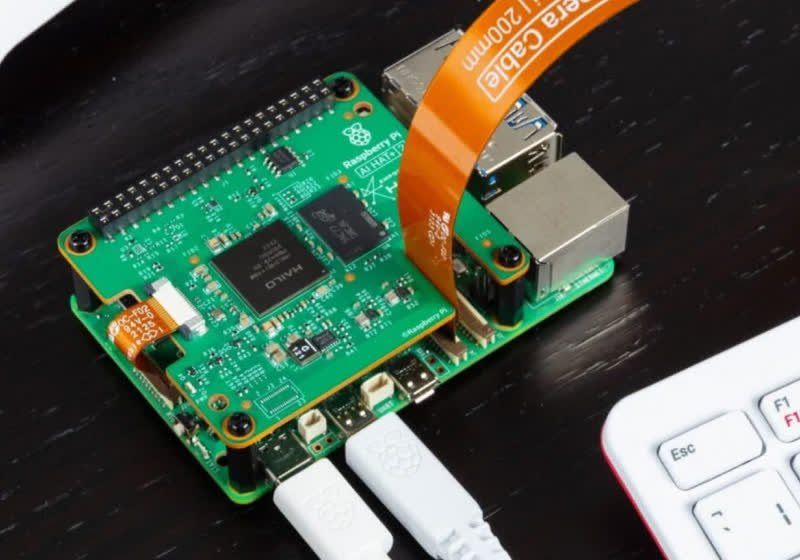
Raspberry Pi has expanded its AI-focused hardware line with the AI HAT+ 2, a new add-on board designed to supersede the original AI HAT+ released in 2024. While its predecessor could accelerate a subset of neural network models, the AI HAT+ 2 presents a notable performance uplift, capable of handling a wider range of AI workloads with higher throughput. This development reflects Raspberry Pi’s ongoing strategy to democratize edge AI—bringing more capable on-device inference to enthusiasts, educators, researchers, and developers without resorting to bulky server-grade hardware.
The AI HAT+ 2’s core claim is a substantial increase in neural network inference power, quantified in TOPS (tera-operations per second). While the precise TOPS figure and architectural details may vary depending on the workload and model type, Raspberry Pi positions the device as a practical acceleration solution for real-time computer vision, natural language processing, and other common edge AI tasks. By integrating the accelerator as an add-on for Raspberry Pi single-board computers, the company maintains its ecosystem approach: hardware, software, and community-driven development all work in concert to simplify deployment and iteration of AI-enabled projects.
In positioning the HAT+ 2, Raspberry Pi emphasizes compatibility with widely used machine learning frameworks and model formats. The device is intended to work with popular inference engines and tooling that developers are already familiar with, reducing the friction typically associated with adopting new hardware accelerators. The practical implication is that hobbyists can experiment with more sophisticated models on a Raspberry Pi, while professionals can prototype edge deployments with a compact, cost-effective platform.
The announcement also underscores considerations unique to edge AI on small form-factor devices. Power efficiency and thermal management remain crucial, as sustained inference workloads can push the limits of compact SBCs. The AI HAT+ 2 is designed to balance performance and energy use, though users may need to adopt adequate cooling solutions and power provisioning to maximize throughput in continuous operation scenarios.
In short, the AI HAT+ 2 represents a meaningful enhancement to Raspberry Pi’s AI hardware portfolio, bringing higher-throughput on-device inference to a broad audience. The combination of improved speed, broader model support, and the Raspberry Pi ecosystem’s accessibility could accelerate a wide range of AI experimentation and deployment initiatives at the edge.
In-Depth Analysis
The AI HAT+ 2 builds upon the foundation established by the original AI HAT+ by delivering a more powerful processing element dedicated to neural network inference. The upgrade is framed around a higher TOPS rating, enabling more complex models and larger input dimensions to be processed locally on the device. For developers, this translates into lower latency compared to cloud-based inference and greater autonomy for edge deployments, where data can be processed on-device without round-tripping to remote servers.
From an architectural perspective, the HAT+ 2 integrates a specialized accelerator optimized for common neural network operations such as convolutions, matrix multiplications, and activation functions. This specialization is critical for achieving high efficiency because generic CPUs or even GPUs on small SBCs are typically unable to deliver the same sustained throughput for deep learning workloads without substantial energy costs. The accelerator’s design likely emphasizes parallelism, quantized inference, and hardware-friendly data paths to minimize memory bandwidth bottlenecks—factors that are pivotal when running real-time perception tasks like object detection or image classification on a Raspberry Pi.
Software compatibility is a central pillar of the HAT+ 2 strategy. The Raspberry Pi ecosystem has long benefited from a broad suite of tooling, libraries, and community resources. The new board aims to remain compatible with mainstream inference frameworks and runtimes, enabling developers to port existing models with minimal friction. This approach lowers the barrier to entry for edge AI projects and facilitates rapid prototyping, experimentation, and learning.
Practical implications for use cases are wide-ranging. In computer vision, the HAT+ 2 can accelerate tasks such as object recognition, pose estimation, and semantic segmentation on live camera feeds. In audio processing, it can support real-time speech recognition or acoustic event detection. In robotics and automation, the added computational headroom enables more sophisticated control loops, perception pipelines, and autonomy features to run locally, reducing dependence on cloud resources. The equity of this solution is notable: it makes high-performance AI capabilities accessible to universities, makerspaces, startups, and independent researchers who may have otherwise lacked access to robust edge AI hardware.
It is also important to consider the broader ecosystem implications. A more capable AI accelerator on Raspberry Pi boards could influence how edge AI workloads are distributed across devices in a larger network. For example, devices with higher on-device inference capability can reduce centralized compute load, improving scalability and resilience for edge networks. This aligns with trends toward decentralized AI, where computation is moved closer to data sources for lower latency and enhanced privacy.
Nevertheless, users must manage the trade-offs inherent to SBC deployments. While the accelerator elevates performance, sustained high-throughput operation can lead to thermal throttling if cooling is inadequate. Users should plan for proper heat dissipation, and in some environments, modest cooling solutions may be necessary to maintain peak performance. Power delivery is another consideration; the add-on board will require a stable power source capable of supporting both the Raspberry Pi and the accelerator under load.
In evaluating how the AI HAT+ 2 compares to prior offerings, the most salient differentiation is the demonstrated jump in inference throughput and model versatility. The original AI HAT+ offered acceleration for select neural network architectures or smaller models with constrained complexity. The HAT+ 2 broadens that scope, enabling more ambitious deployments without sacrificing the compact form factor that enthusiasts expect from Raspberry Pi products. This progression reflects the company’s strategy to evolve its hardware line in step with the growing demands of on-device AI, while maintaining an approachable price point and robust software support.
From a community perspective, the AI HAT+ 2’s success depends not only on hardware capabilities but also on the surrounding development ecosystem. The Raspberry Pi community thrives on open-source contributions, tutorials, and shared project ideas. A more capable accelerator can spur a stronger community around edge AI, as developers publish models and pipelines that demonstrate practical, real-world outcomes on the Raspberry Pi. The potential for educational impact is notable: instructors can design more challenging AI coursework, and students can work with hardware that provides meaningful performance for modern neural networks.
Looking ahead, the AI HAT+ 2 may influence future product planning within Raspberry Pi’s portfolio. If demand sustains, Raspberry Pi could iterate on even more capable accelerators or introduce complementary modules that extend AI capabilities across additional peripherals or compute platforms. The broader implication is a shift in how compact, low-cost SBCs are perceived for AI-centric projects—a shift toward devices that can handle more complex inference workloads locally, enabling new use cases in fields like robotics, smart sensing, and autonomous systems.

*圖片來源:Unsplash*
In summary, the AI HAT+ 2 marks a meaningful step forward for Raspberry Pi’s AI hardware lineup. By delivering higher TOPS throughput and broader model compatibility, the device narrows the gap between hobbyist experimentation and production-grade edge AI applications, while preserving the accessibility and ecosystem benefits that have long defined Raspberry Pi products.
Perspectives and Impact
The introduction of the AI HAT+ 2 contributes to a broader narrative about edge AI democratization. As machine learning models become more capable and efficient, the demand for on-device inference grows in tandem with concerns about latency, bandwidth, and data privacy. A higher-performing accelerator on a popular platform like Raspberry Pi makes it feasible for educators to teach modern AI concepts in the classroom with hands-on hardware, for researchers to prototype edge deployments, and for small teams to validate real-time AI solutions without high-cost infrastructure.
From an industry standpoint, the HAT+ 2 could influence use-case viability across several domains. In smart cities and environmental monitoring, edge devices with stronger inference capabilities can process sensor data locally, enabling faster decision-making and reducing simulation-to-action cycles. In manufacturing and logistics, compact AI-enabled devices can be deployed in environments where space and power constraints previously limited AI adoption. Additionally, the device’s compatibility with common AI frameworks lowers the barrier for integration into existing pipelines, allowing organizations to experiment with edge AI pilots using a familiar toolchain.
Educational impact is a notable consideration. Universities, coding clubs, and makerspaces can leverage the HAT+ 2 to teach topics ranging from computer vision to neural architecture optimization. The tangible aspect of seeing real-time inference on a Raspberry Pi can inspire hands-on learning and experimentation, encouraging students to pursue AI-related fields and projects. The accessibility of such hardware also enables documentation and tutorials that help newcomers gain practical experience.
Looking to the future, several questions arise. How will developers optimize models to maximize performance on the HAT+ 2? What software updates or libraries will Raspberry Pi release to expand compatibility with newer AI models and formats? How will the device perform under sustained loads in varied environmental conditions, and what cooling strategies will prove most effective? Answering these questions will shape the practical adoption of the HAT+ 2 in both hobbyist and professional contexts.
The HAT+ 2’s impact extends beyond single-device performance. As more SBCs are equipped with high-throughput accelerators, a broader ecosystem of turnkey edge AI solutions may emerge. This could include pre-trained models tailored for the device’s accelerators, streamlined deployment pipelines, and optimized sample projects that demonstrate best practices in edge AI. In the longer term, it might also drive more robust privacy-preserving AI workflows, where data never leaves the device for sensitive applications.
In terms of potential limitations, the real-world benefit of the HAT+ 2 hinges on several factors: software optimization maturity, model compatibility, and the balance between throughput and power consumption. For some users, the gains may be most pronounced with larger, well-optimized quantized models that can leverage the accelerator’s architecture. For others, smaller or non-optimized models may not fully leverage the device’s capabilities, underscoring the importance of software tooling and model selection in maximizing value.
Ultimately, the AI HAT+ 2 can be viewed as a strategic enabler for Raspberry Pi’s broader mission: to enable practical, affordable AI experimentation and deployment at the edge. By offering a more capable accelerator in a form factor that remains accessible to students, educators, and developers, Raspberry Pi helps catalyze a wave of innovation in edge AI projects that can scale from classroom demonstrations to real-world applications.
Key Takeaways
Main Points:
– The AI HAT+ 2 provides a substantial upgrade over the original AI HAT+, offering up to higher TOPS throughput for on-device neural network inference.
– Expanded model support and compatibility with common AI frameworks make it a versatile tool for edge AI tasks on Raspberry Pi boards.
– Practical considerations, including cooling and power supply, remain important to achieve sustained performance.
Areas of Concern:
– Real-world performance under continuous load depends on effective thermal management.
– The degree to which various models benefit from the accelerator depends on software optimization and model formats.
– Availability, pricing, and regional supply could influence adoption in academic and commercial settings.
Summary and Recommendations
The Raspberry Pi AI HAT+ 2 represents a meaningful advancement in edge AI hardware for the Raspberry Pi ecosystem. By delivering a higher throughput neural network accelerator and broadening model compatibility, the HAT+ 2 makes on-device AI inference more accessible for a wide range of applications, from education and hobbyist projects to professional prototyping and small-scale deployments. The device aligns with a broader industry trend toward moving AI processing closer to data sources to reduce latency, improve privacy, and alleviate dependence on cloud compute.
For potential users, the decision to adopt the AI HAT+ 2 should consider the specific workload requirements, including model complexity, input data size, and real-time performance needs. Developers should also plan for adequate heat dissipation and stable power delivery to sustain peak performance. Given Raspberry Pi’s strong community and documentation, there are ample resources to help optimize models and pipelines for the HAT+ 2, which can maximize the return on investment and shorten development cycles.
In conclusion, the AI HAT+ 2 strengthens Raspberry Pi’s position in the AI hardware space by offering a capable, accessible, and ecosystem-friendly solution for edge AI workloads. As the field of on-device AI continues to evolve, devices like the AI HAT+ 2 will play an essential role in enabling practical, energy-efficient AI across education, research, and industry-focused projects.
References
- Original: https://www.techspot.com/news/110958-raspberry-pi-ai-hat-40-tops-genai.html
- Additional references:
- Raspberry Pi official announcements and product pages
- Industry coverage on edge AI accelerators and TOPS benchmarks
- Tutorials and developer guides for deploying AI models on Raspberry Pi hardware

*圖片來源:Unsplash*