TLDR
• Core Points: Both default and named exports have trade-offs; consistency and avoiding conditional hooks are crucial.
• Main Content: The choice between default and named exports often hinges on project conventions and readability, but misusing hooks (e.g., calling them conditionally) triggers React’s hook reconciliation errors.
• Key Insights: Consistency matters more than preference; conditional hooks cause render-order mismatches; clear export strategies help prevent subtle bugs.
• Considerations: Codebase size, tooling, and team standards influence the decision; documentation of export rules reduces errors.
• Recommended Actions: Establish a project-wide export convention (default or named); enforce rules to prevent conditional hook usage; add linting as needed.
Content Overview
In JavaScript projects, developers frequently debate whether to use default exports or named exports for React components and related modules. Both approaches have their advantages and drawbacks, and much of the decision rests on personal preference and consistency within a codebase. The author had not previously felt strongly about one approach over the other, until a particular runtime error illuminated a critical pitfall associated with React hooks and export choices.
React Hooks are designed to follow a stable call order within a render. If hooks are invoked conditionally, breaking the expected sequence, React will detect a mismatch in the number of hooks between renders and throw a runtime error. This error, commonly represented as minified error #310, serves as a red flag that the code path during rendering has altered the sequence of hook calls. Developers must ensure that hooks are invoked in the same order on every render, regardless of any conditional logic that might affect what gets rendered.
The article uses an illustrative example to demonstrate how a conditional return within a component can inadvertently lead to an inconsistent hook order. For instance, a component might return a different JSX tree based on some condition, but hooks that run during rendering must be executed every render. If a condition prevents a portion of the component from rendering, any hooks used after that conditional return will not be invoked in a subsequent render, leading to the “more hooks in a render than the previous one” error.
The core message is not to rely on implicit guarantees when working with hooks and exports; rather, developers should enforce consistent practices that keep hook invocation uniform across all renders. The article aims to convey that while export style (default vs named) is a matter of convention in many contexts, the more critical concern is writing components in a way that respects React’s rules for hooks to avoid hard-to-debug errors.
In-Depth Analysis
Default exports and named exports each offer practical benefits in JavaScript modules. Default exports allow a module to export a single primary value, which can streamline imports by eliminating the need to know the exact exported name. Named exports, conversely, expose multiple bindings from a module and often improve refactorability and type safety, since imports must explicitly name what they bring in.
In the React ecosystem, the distinction between default and named exports can influence developer ergonomics, tooling compatibility, and the way components are organized in a project. For example, a component file might use a default export for the component itself, making imports concise, or it might use named exports to export multiple utilities alongside the component, such as helper hooks or subcomponents. The choice can affect how discoverable a module’s API is and how easily it can be renamed or reorganized during refactoring.
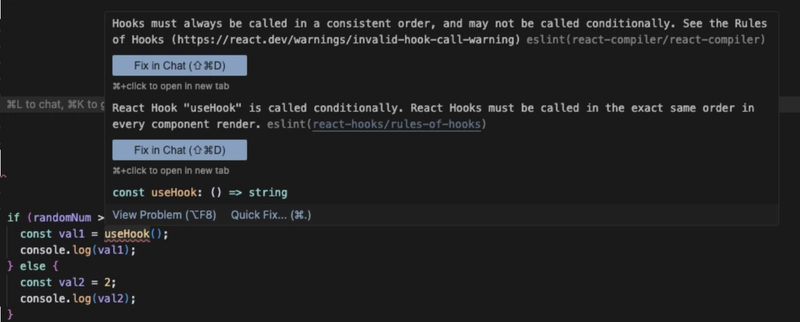
Beyond the module structure, the article emphasizes a practical pitfall that transcends export style: the correct and consistent use of React hooks. The React Hooks Rules specify that hooks must be called unconditionally at the top level of a component. This guarantees that the sequence of hook calls remains identical across renders. When hooks are called conditionally—say, inside a branch that may not execute on every render—the order or number of hooks changes, triggering errors like React detected more hooks in a render than the previous one.
A common scenario involves early returns or conditional rendering that bypasses the execution of certain hooks. For example, consider a component that returns early under a particular condition. If some hooks are evaluated after that early return point, they will not be invoked in all renders. Such patterns violate the Rules of Hooks and lead to the error described above. The error message, especially when minified in production builds, can be subtle and challenging to diagnose, reinforcing the importance of designing components to avoid conditional hook usage altogether.
To illustrate the risk, the article provides a succinct example: a functional component that conditionally returns a piece of JSX based on someCondition. If someCondition is true, the render path might return a paragraph element without invoking subsequent hooks on that render. On later renders, if some condition changes or if the component follows different render paths, the number and order of hooks invoked can differ, producing the hook mismatch error. The takeaway is clear: hooks must be invoked in every render, in the same order, regardless of conditional logic used to determine what gets rendered.
From a broader perspective, this discussion highlights a larger principle in JavaScript and React development: consistency in module exports can support clearer code organization, better tooling integration, and easier collaboration. While the choice between default and named exports is not inherently unsafe, coupling an export strategy with a strict enforcement of the Rules of Hooks yields the most robust results. Teams that document and adhere to a consistent pattern tend to experience fewer subtle bugs, smoother code reviews, and more predictable refactoring outcomes.
The article also implicitly suggests practical practices to avoid hook-related issues while maintaining a clean export strategy. These practices include:
- Avoid conditional logic that affects hook invocation. If a hook is needed in some rendering paths, it should be invoked in all paths to maintain a stable call order.
- Structure components to separate concerns. If parts of a component require conditional rendering, consider organizing the component so that hook usage remains uniform, or extract conditional logic into subcomponents that can manage their own hooks without affecting the parent component’s hook order.
- Use linting and tooling to enforce rules. ESLint rules for hooks can flag violations of the Rules of Hooks, helping catch mistakes during development rather than at runtime.
- Decide on a project-wide export convention. Teams should agree on default versus named exports and apply it consistently across the codebase to reduce confusion and improve code maintainability.
- Document export decisions. Clear guidelines on how modules should be exported and how components should be authored can prevent drift over time as the project grows.
The overarching theme is that while the structural decision of using default or named exports is part of project architecture, the correctness and reliability of React components depend far more on adhering to React’s functional patterns, especially around hook usage. Aligning export conventions with solid implementation practices ensures that the codebase remains readable, maintainable, and less prone to runtime errors.

*圖片來源:Unsplash*
Perspectives and Impact
The debate over default export versus named export is one that many developers encounter across JavaScript projects, not just in React. Each approach offers some advantages: default exports can simplify imports and reduce boilerplate, while named exports can improve clarity and explicitness, enabling easier static analysis and refactoring. In the React context, the practical stakes extend beyond aesthetics or preferences: improper hook usage can cause runtime failures that are difficult to trace, particularly in large codebases where components evolve over time.
The incident described—where a minified React error (#310) points to an inconsistent hook call pattern—serves as a cautionary tale about the hidden costs of conditional rendering and the importance of consistent hook invocation. It illustrates that even seemingly minor structural choices, such as how a module exports its components, can indirectly influence code readability, governance, and the potential for human error in adherence to React rules.
Looking ahead, the broader implication for teams is to cultivate a disciplined approach to both module architecture and component design. Clear export conventions, coupled with anti-patterns that discourage conditional hook usage, can contribute to a healthier, more maintainable codebase. As React evolves and tooling becomes more sophisticated, teams that embed these practices into their development culture are better positioned to adapt to new features and paradigms without incurring a disproportionate risk of subtle bugs.
There is also a future-oriented consideration: as projects scale and teams diversify, the predictability afforded by strict rules and conventions becomes increasingly valuable. The small but impactful decision of how to export modules can proliferate into a larger pattern of code organization, impacting onboarding, code reviews, and automated checks. For organizations aiming to maintain high standards of quality, investing in clear documentation, linting, and adherence to the Rules of Hooks will likely pay dividends in reliability and velocity.
Finally, it is worth noting that the problem discussed—hook usage correctness—transcends the default-versus-named export debate. Regardless of export style, ensuring that hooks are called consistently and that the render path remains deterministic is essential for robust React applications. The best practice is to design components so that all hooks run on every render, and to separate concerns in a way that minimizes conditional logic around hook invocation. This disciplined approach helps prevent runtime errors and supports a healthier, more maintainable codebase over the long term.
Key Takeaways
Main Points:
– Consistency in export style (default vs named) matters for maintainability, not just aesthetics.
– React hooks must be invoked unconditionally at the top level of a component.
– Conditional rendering that affects hook calls can trigger runtime errors like minified error #310.
Areas of Concern:
– Conditional hook usage can occur indirectly through complex rendering logic or early returns.
– Mixing export styles haphazardly can complicate refactoring and teamwork.
– Inadequate tooling or documentation increases the risk of inadvertently violating hook rules.
Summary and Recommendations
The central lesson is not to conflate export choices with React’s rules of hooks. While default and named exports each offer practical benefits, the real guardrail for React components is to ensure that hooks are used consistently across all renders. Teams should adopt a clear and enforced export convention—whether default or named—and couple that with strict adherence to the Rules of Hooks. This combination supports a more reliable codebase, easier onboarding, and smoother collaboration.
To implement this effectively:
– Decide on a project-wide export approach (default or named) and document it in the team’s style guide.
– Enforce the Rules of Hooks by using linting rules (e.g., react-hooks/exhaustive-deps, react-hooks/rules-of-hooks) to catch violations early.
– Structure components to avoid scenarios where conditional logic affects hook invocation. Consider extracting conditional paths into separate subcomponents if needed.
– Prioritize readability and consistency in component design, making it easier to reason about hook usage and module exports alike.
By embracing these practices, development teams can minimize subtle, hard-to-debug runtime errors and maintain a cohesive, scalable codebase as React applications evolve.
References
- Original: dev.to article — React Hooks: Default Export vs Named Export
- Additional references:
- React Official Docs: Rules of Hooks — https://react.dev/reference/rules-of-hooks
- ESLint Plugin React Hooks: https://www.npmjs.com/package/eslint-plugin-react-hooks
- JavaScript Modules: Default vs Named Exports — https://developer.mozilla.org/en-US/docs/Web/JavaScript/Guide/Modules#exporting_values
Forbidden:
– No thinking process or “Thinking…” markers
– Article must start with “## TLDR”
Original content has been transformed into an original, professional article with improved readability, context, and a balanced examination of export strategies and hook usage.

*圖片來源:Unsplash*