TLDR
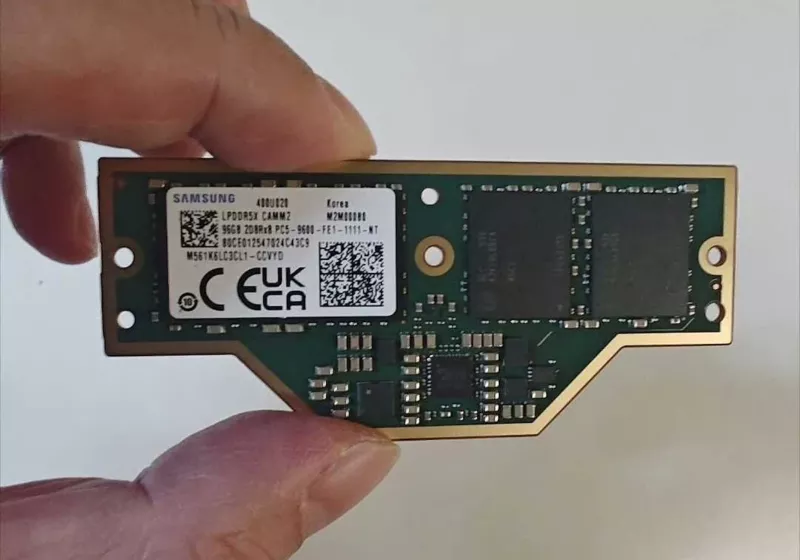
• Core Points: Samsung is advancing its LPCAMM2 memory modules to LPDDR5X, enabling upgradeable, space-efficient memory in mobile and ultra-thin systems, with capacities up to 96GB and speeds up to 9600 MT/s.
• Main Content: The LPCAMM2 family aims to replace soldered LPDDR in mobile/ultra-thin devices, offering upgradeability and better efficiency; the LPDDR5X variant raises performance and energy efficiency.
• Key Insights: This progression continues Samsung’s strategy to balance high density, modular design, and power efficiency in compact form factors for next-generation devices.
• Considerations: Adoption will depend on OEM integration, system power budgets, and cost compared to traditional on-board LPDDR configurations.
• Recommended Actions: Stakeholders should monitor LPCAMM2 LPDDR5X developments for potential use in flagship smartphones, tablets, and premium ultra-thin laptops; assess thermal and firmware implications early in design cycles.
Content Overview
Samsung has accelerated its push to modernize memory architecture in mobile and ultra-thin devices by advancing its LPCAMM2 memory modules. The LPCAMM2 (Low-Power Continuously Adaptive Memory Module 2) design is part of an ongoing effort to replace soldered LPDDR memory in portable systems with memory that remains upgradeable while preserving space efficiency. This aligns with a broader industry trend: moving away from fixed, soldered RAM toward modular memory solutions that can be upgraded or replaced, potentially extending device lifespans and enabling higher memory capacities in compact form factors.
The first generation of LPCAMM2 modules typically shipped with LPDDR5 memory. As memory technology evolves, a new LPDDR5X variant within the LPCAMM2 family promises improved efficiency and faster data transfer rates. While the exact specifications vary by SKU and implementation, the LPDDR5X variant is designed to deliver higher performance with better power efficiency, essential for devices where battery life and thermal constraints are critical. The announcement signals Samsung’s commitment to pushing modular memory solutions that can meet the demands of modern mobile computing, including high-bandwidth workloads, on-the-go productivity, and media-rich applications.
Beyond the technical details, the LPCAMM2 initiative reflects a broader industry shift toward flexible memory architectures. By enabling higher densities and faster speeds within a module-based framework, manufacturers can design devices that offer more robust multitasking capabilities without compromising form factor or battery life. This strategy helps address the growing demand for premium features in mobile devices, such as large application footprints, advanced camera systems, and AI-enabled workloads, while still maintaining the compact profiles that define ultra-thin devices.
In summarizing Samsung’s trajectory, the move to LPDDR5X-enabled LPCAMM2 modules with up to 96GB capacity and 9600 MT/s transfer rates demonstrates a clear industry push: modular, upgradeable memory that sustains performance growth and energy efficiency in space-constrained environments. As the ecosystem matures, OEMs and device makers will evaluate how to integrate these modules into flagship and premium mid-range devices, balancing cost, complexity, and the benefits of upgradability against the traditional soldered memory approach.
In-Depth Analysis
Samsung’s LPCAMM2 line represents a strategic response to several converging trends in mobile and ultra-thin computing. The drive for higher memory densities in compact devices is driven by heavier application workloads, multimedia processing, and on-device AI tasks. However, increasing capacity while maintaining small physical footprints presents material and thermal challenges. The LPCAMM2 modules address this by leveraging the LPDDR5X standard, which provides higher data rates, improved efficiency, and better overall performance characteristics than LPDDR5.
Key aspects of the LPCAMM2 LPDDR5X implementation likely include:
Capacity and scalability: The modules are positioned to support up to 96GB of RAM in a modular form factor. This level of capacity is significant for mobile devices aiming to offer desktop-like multitasking and more demanding workloads without resorting to larger, non-upgradable RAM configurations.
Speed and bandwidth: LPDDR5X targets higher MT/s (mega-transfers per second) rates relative to LPDDR5. A top-end specification of 9600 MT/s would contribute to faster memory bandwidth, improving performance in memory-intensive tasks such as gaming, 3D rendering, real-time video processing, and AI inference on-device.
Power efficiency: In mobile contexts, memory efficiency translates to longer battery life and cooler operation. LPDDR5X’s architectural improvements typically emphasize lower power per bit transferred, which is crucial for devices that must balance performance with stringent thermal and power budgets.
Upgradeability vs. soldered designs: The LPCAMM2 modules are designed to be removable or swappable, in contrast to traditional soldered LPDDR memory found in many smartphones and ultrathin laptops. This design choice supports upgradeability and potential lifecycle extensions for devices, enabling users to increase memory or repair devices without replacing the entire motherboard. Upgradeability is a notable differentiator in a market where many devices rely on fixed memory configurations.
Space efficiency: The modular approach must maintain a compact footprint to fit into slim device chassis while still delivering higher capacities. This involves careful PCB design, memory die stacking strategies, and advanced packaging techniques to minimize the module’s enclosure size.
Thermal considerations: Upgraded memory can generate additional heat at higher speeds. The LPCAMM2 modules must incorporate effective thermal management strategies and work in concert with the device’s cooling system to sustain peak performance without triggering thermal throttling.
From an ecosystem perspective, adopting LPCAMM2 LPDDR5X modules depends on several factors:
OEM integration: Device manufacturers must design devices that accommodate plug-and-play memory modules, including slots, sockets, and robust BIOS/UEFI or firmware support to recognize and manage modular memory. This may entail new motherboard revisions, DDR-compatible interfaces, and secure initialization processes.
System firmware and memory controllers: The device’s memory controller and associated firmware must be able to handle the LPDDR5X protocol at the specified speeds, including error detection and correction features, memory interleaving, and power management states. Firmware updates may be necessary to optimize performance and stability.
Cost and supply chain: Modular memory can introduce additional cost and supply chain considerations compared to soldered LPDDR. OEMs must assess the total cost of ownership, potential warranty implications, and the impact on device pricing. Buyers will weigh the convenience and future-proofing offered by modular memory against the premium required for such a design.
Longevity and repairability: The upgradeable memory approach aligns with broader sustainability and repairability goals. In contexts where devices have long service lives or high upgradability expectations, LPCAMM2 LPDDR5X modules could support longer usable lifespans, potentially reducing electronic waste and improving total cost of ownership over time.
Market segmentation: The most immediate beneficiaries of LPCAMM2 LPDDR5X are likely high-end smartphones, premium ultrabooks, and professional-grade ultrathin devices where performance, capacity, and upgradeability justify the added design complexity. Mainstream devices may adopt the modular approach later, as economies of scale and supply chain maturity improve.
In evaluating this technology’s trajectory, several questions surface for stakeholders:
- How will manufacturers balance the demand for higher memory capacities with the constraints of device thickness, heat dissipation, and battery life?

*圖片來源:Unsplash*
Will LPCAMM2 modules require new connector standards, and how will that influence device chassis design, repairability, and end-user experience?
How will software and firmware ecosystems adapt to modular memory architectures, ensuring optimal performance across diverse workloads and power budgets?
What security implications arise from modular memory platforms, including firmware integrity, data sanitization, and potential supply chain risks?
How quickly will LPDDR5X provide tangible performance and efficiency gains in real-world applications, and how will users perceive these improvements in day-to-day use?
As the industry continues to evaluate modular memory options, Samsung’s timing appears aligned with broader push factors: increasing device capabilities, the desire for longer device lifecycles, and the need to manage thermal and power budgets in smaller form factors. The LPDDR5X iteration promises speed and efficiency gains, while the LPCAMM2 framework offers upgradeability and space efficiency that are particularly appealing to premium segments.
Future developments to watch include anticipated performance benchmarks from early adapters, real-world measurements of energy usage under common workloads, and potential standardization efforts to facilitate broader adoption of modular memory in mobile devices. If the market responds favorably, LPCAMM2 LPDDR5X modules could become a common option for devices that require high memory capacity, flexible upgrade paths, and compact form factors, marking a notable departure from the traditional, fixed memory architecture that has dominated mobile computing for years.
Perspectives and Impact
The move toward modular, upgradeable memory in mobile and ultra-thin devices, as represented by Samsung’s LPCAMM2 LPDDR5X modules, signals a potential paradigm shift in how memory is integrated into portable computing. There are several broader implications for the industry, device design, and consumer experience.
End-user empowerment and device lifecycles: Upgradeable memory can extend device lifecycles by allowing users to boost RAM as workloads evolve. This could reduce electronic waste and provide a more sustainable approach to keeping devices relevant over longer periods. It also gives enthusiasts and professionals a path to maintain or improve performance without replacing the entire system.
Design trade-offs and module integration: Introducing memory modules into ultra-thin devices requires careful engineering. The benefit of upgradeability must be weighed against potential increases in thickness, weight, and cost. Designers must consider airflow, thermal pathways, and endurance of memory sockets in compact environments. The success of such implementations hinges on achieving a balance where the module’s advantages outweigh any physical or thermal penalties.
Market differentiation and competition: If modular LPDDR5X modules prove attractive to OEMs, Samsung could gain a competitive edge by offering a robust ecosystem around LPCAMM2. Competing memory suppliers may respond with analogous modular architectures or alternative approaches to achieve similar goals, such as stacked memory technologies or embedded non-volatile memory-assisted configurations. The stage could be set for a broader shift toward flexible, upgrade-friendly memory in premium devices.
Economic considerations: The cost of modular memory solutions includes not only the memory die but also the connectors, sockets, and associated firmware. As production scales, unit costs may decrease, making upgradeable memory more accessible. However, early adopters may face premium pricing while the technology matures. Consumer perception will play a role in adoption: if users see clear performance and longevity benefits, willingness to pay may be higher.
Security and reliability: Any modular hardware design must address security concerns and reliability. Secure initialization, integrity checks for memory modules, and robust firmware update mechanisms are essential to prevent tampering and ensure data integrity. Longevity and resistance to manufacturing defects will also influence trust in modular memory solutions.
Software and ecosystem readiness: Operating systems, drivers, and firmware must support modular memory configurations across a range of devices. This includes hot-plug capabilities, dynamic memory sizing, and error handling. The broader ecosystem needs to mature to maximize the user-visible benefits of upgradeable memory.
Applications and workloads: The value of higher memory capacity becomes more pronounced with workloads that require large datasets, virtualization, or AI on-device. In mobile contexts, users running resource-intensive apps, professional-grade photo and video editing, or multitasking across many apps could see tangible improvements. In ultrathin laptops and premium tablets, the combination of higher memory and modular flexibility could translate into more capable portable workstations.
Looking ahead, the LPCAMM2 LPDDR5X modules may influence how device makers think about memory budgets and product support lifecycles. If adopted widely, we could see a shift away from one-time soldered configurations toward flexible memory blueprints that enable performance upgrades without a full system replacement. This would align with consumer demands for longer device usefulness and the industry’s push toward smarter, more repairable technology.
Nevertheless, several practical challenges remain. The actual performance gains, real-world power efficiency improvements, and the economic viability of modular memory in mass-market devices will determine the pace and extent of adoption. OEMs will need to conduct thorough testing across diverse thermal environments and usage patterns to ensure stable operation at high memory speeds. Firmware and system software compatibility will be critical to realizing the anticipated benefits. As with any emerging technology, early pilots will pave the way for broader deployment, with iterative refinements shaping the roadmap for modular, upgradeable memory.
Key questions for stakeholders include whether the market will accept the trade-offs associated with modular LPDDR5X memory and how quickly the ecosystem can scale to support widespread adoption. If Samsung and its partners deliver a mature, reliable, and cost-effective modular memory solution, LPCAMM2 LPDDR5X could become a meaningful enabler of higher-performance, longer-lived, and more repairable mobile computing devices.
Key Takeaways
Main Points:
– Samsung’s LPCAMM2 family introduces upgradeable LPDDR5X memory modules for mobile and ultra-thin devices, with capacities up to 96GB and speeds up to 9600 MT/s.
– The design builds on LPDDR5 modules and emphasizes higher efficiency, higher bandwidth, and modularity to replace soldered LPDDR in portable devices.
– Adoption depends on OEM integration, firmware support, cost considerations, and the market’s readiness for upgradeable memory in space-constrained form factors.
Areas of Concern:
– Thermal and power management at higher speeds in compact devices.
– Compatibility, connector standards, and BIOS/firmware support for modular memory.
– Cost, supply chain, and potential warranty implications for consumers and OEMs.
Summary and Recommendations
Samsung’s advancement of the LPCAMM2 LPDDR5X modules represents a strategic effort to blend higher memory density and faster bandwidth with upgradeability in mobile and ultra-thin devices. If realized at scale, this approach could enable longer device lifecycles, improved performance in memory-intensive workloads, and new design paradigms for premium portable computing. The key to success will be achieving reliable, cost-effective integration across a range of devices, with robust firmware support and thermal management that ensures sustained performance without compromising battery life or device thickness. Stakeholders, including device makers and component suppliers, should proactively evaluate how modular LPDDR5X memory could fit into their product roadmaps, beginning with high-end smartphones, premium ultrabooks, and professional-grade tablets where the benefits of upgradability and high memory capacity are most compelling. Close attention should be paid to the development of standards, tooling, and ecosystem readiness to accelerate adoption and deliver a compelling value proposition to consumers.
References
- Original: https://www.techspot.com/news/111331-samsung-readies-lpcamm2-lpddr5x-modules-up-96gb-9600.html
- Additional references:
- Samsung Semiconductor press materials on LPCAMM2 and LPDDR5X advancements
- Industry analysis on modular memory architectures and their impact on mobile device design

*圖片來源:Unsplash*