TLDR
• Core Points: Silent production bugs arise from valid paths; TypeScript misses some runtime issues, especially in evolving React codebases; the never type can elevate hidden bugs to compile-time errors.
• Main Content: Real-world React bug examples show TypeScript gaps; leveraging the never type can prevent broken code from shipping by catching risky patterns earlier.
• Key Insights: The never type embodies unreachable or impossible states, enabling stronger guarantees and safer refactors.
• Considerations: Introducing never-based checks requires thoughtful design to avoid false positives and maintain code readability.
• Recommended Actions: Use never-aware patterns in critical branches, progressively introduce exhaustive type narrowing, and review complex union types in evolving code.
Product Review Table (Optional)
N/A
Content Overview
In modern software development, TypeScript and strong typing help catch many classes of bugs before they reach production. However, even with diligent typing, there are categories of issues that slip through the cracks, particularly in React applications that evolve over time. Some bugs arise not from syntax errors but from valid code paths that a project’s team failed to notice. These issues can silently ship to production, only to reveal themselves later in user environments or edge cases, leading to unpredictable behavior and the expensive process of debugging in production.
The never type in TypeScript offers a conservative, principled approach to prevent certain classes of bugs by modeling impossible states. By representing unreachable code paths or logically impossible conditions, never can help ensure that your program cannot reach certain branches or states at runtime. This article explains how a real React bug manifested in production, why TypeScript did not warn about it by default, and how leveraging the never type can turn that bug into a compile-time error, thereby improving reliability without sacrificing developer experience.
To appreciate the practical value of the never type, it helps to revisit how TypeScript handles types and how React codebases typically evolve. React apps are frequently updated with new features, refactors, and performance optimizations. These changes often introduce new unions, conditionals, and asynchronous flows. As a result, some code paths become theoretically possible but practically unreachable under certain invariants. conventional type checking can miss these subtle states, especially when the logic hinges on complex predicates, discriminated unions, or intertwined boolean flags that influence rendering decisions and side effects.
In-Depth Analysis
The never type represents values that can never occur. In TypeScript, a function that never returns (for example, one that always throws or loops indefinitely) has a return type of never. More broadly, never can be used to describe impossible branches in a type system, providing a powerful signal to the compiler: if the code can reach this point, something has gone wrong, and the type checker should flag it.
In a production React scenario, several concrete patterns can lead to gaps between what the type system allows and what the runtime actually enforces. Consider a component that renders different UI variants based on a prop that is a discriminated union of several possible states. If a particular state is added to the union but not handled explicitly in a switch statement, a developer might rely on a default case that does nothing or assumes a safe fallback. Depending on how tail calls or async effects are structured, such a default path could lead to a silent failure or an inconsistent UI, even though the code compiles cleanly.
Why might TypeScript not warn you in these cases? Because TypeScript’s control-flow analysis and exhaustiveness checks are powerful but not exhaustive. They rely on precise type narrowing and explicit coverage of all possible values in a union. When unions grow complex, or when predicates become more dynamic (for example, runtime checks based on external data or derived conditions), the compiler may treat a path as reachable, even if, in practice, that path should never be executed given the invariants of your application. This discrepancy creates a risk: code that looks valid under the type system may still produce unexpected behavior in production.
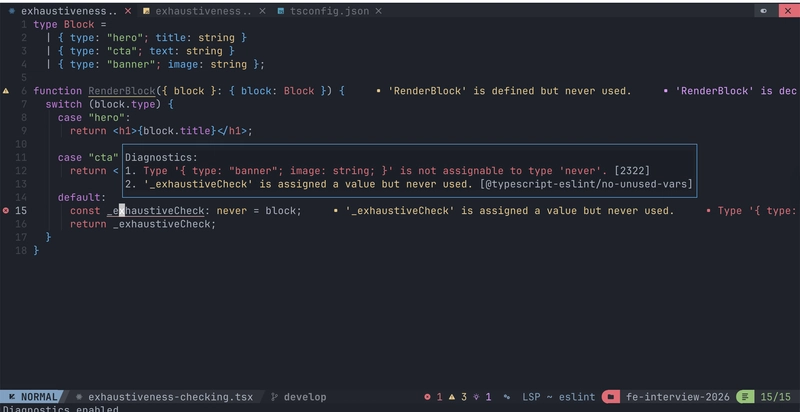
Here is where the never type proves valuable. By deliberately modeling unreachable states with never, you can encode invariants about the code paths that should never be taken. When a new state is added or a condition evolves, TypeScript’s checks against never-related branches can surface unhandled or impossible cases at compile time, rather than after deployment.
A practical approach uses exhaustive checks in switch statements and conditional chains. For example, when dealing with a discriminated union of UI states, one can write a switch over the discriminant and add a default case that calls a helper function that returns never. This ensures that if any new state is introduced, the compiler forces an update to the switch handling or reveals a reachable code path that was previously overlooked.
Implementing never-based safeguards in a React codebase often involves these steps:
– Design discriminated unions thoughtfully: clearly delineate all possible states with a mandatory discriminant field.
– Implement exhaustive switches: cover every possible discriminant value and use a default case that delegates to a never-returning function, guaranteeing compilation errors if a new variant slips in.
– Centralize error reporting: use a single, consistent mechanism to handle impossible cases, rather than scattering ad-hoc error branches throughout the code.
– Treat never as a contract: rely on never to express guaranteed impossibilities, which makes refactors safer and future changes more predictable.
A concrete example helps illustrate the concept. Suppose you have a React component that renders based on a status prop with three variants: loading, success, and error. If you later introduce a new status, such as idle, and forget to handle it in your render switch, your app could render an unintended fallback or fail in subtle ways. By encoding the render logic as an exhaustive switch and using never for the default path, TypeScript will flag the missing case at compile time, prompting the developer to update the render logic before the code can advance to production.
Beyond UI state handling, never also helps with more advanced type scenarios, such as function overloads, error handling flows, and complex data transformations where certain combinations of inputs or states are logically impossible. In these cases, never helps enforce invariants across asynchronous boundaries, data fetching logic, and side-effect management, reducing the likelihood of subtle bugs slipping into production.

*圖片來源:Unsplash*
One practical takeaway is to view never as a tool for encoding business and engineering constraints rather than as a mere runtime safeguard. When combined with robust testing strategies—unit tests for exhaustive branches and integration tests for critical flows—the never type can elevate the safety net around production deployments without imposing heavy runtime costs.
The approach does require discipline. It introduces explicit checks for impossible states, which can initially feel verbose or pedantic. Teams adopting never should balance strictness with readability, gradually introducing exhaustive checks where risk is highest, such as near critical rendering paths, data loading logic, and error handling. It’s also important to maintain clear documentation around why a particular never path exists, so new contributors understand the invariants encoded by the type system rather than assuming it is an unnecessary constraint.
Perspectives and Impact
The never type’s practical impact lies in its ability to shift some category of bugs from runtime to compile time. In production-grade React codebases, even small invariants—such as ensuring every possible status variant is explicitly handled—can dramatically reduce the risk of silent failures. The never type does not guarantee that every bug is caught, but it strengthens the contract between what the code claims to be and what it can actually do at runtime.
As codebases evolve, the risk of diverging invariants grows. Feature flags, dynamic configurations, and asynchronous data flows can complicate the truth table that determines which branches are executable. In such contexts, never helps by providing a predictable hook for exhaustiveness checks, ensuring that the compiler enforces that new variants receive explicit handling rather than silently falling back to a default path.
Future implications include broader adoption of exhaustive pattern matching within TypeScript-driven React projects. Developers may increasingly rely on never to codify impossible states in more parts of an application, including state machines, form validation paths, and API response mappings. This trend aligns with a broader move toward stronger type safety and better guarantees around code behavior, particularly in large teams where onboarding and refactoring introduce subtle inconsistencies.
However, there are caveats. Introducing never-based checks can make code more verbose and harder to skim, especially for junior developers unfamiliar with advanced type scripting concepts. Teams should invest in onboarding materials, practical examples, and linting rules that guide when and how to use never effectively. It’s also essential to ensure that false positives are minimized by validating the assumptions behind exhaustive checks and avoiding overly aggressive constraints that could hinder legitimate code paths under rare but plausible circumstances.
In sum, the never type offers a principled mechanism to catch and prevent a class of production bugs that TypeScript alone may miss. For React applications that continually evolve, never serves as a guardrail that enforces exhaustive handling of all possible states, reduces the surface area for silent failures, and promotes safer refactors.
Key Takeaways
Main Points:
– Production bugs often arise from valid but unexamined code paths rather than syntax errors.
– TypeScript may miss some runtime invariants, especially in evolving React codebases.
– The never type can transform certain bugs into compile-time errors by modeling impossible states.
Areas of Concern:
– Increased code verbosity and potential readability challenges.
– Risk of false positives if exhaustiveness checks are misapplied.
– Requires thoughtful design and developer education to be effective.
Summary and Recommendations
To reduce the likelihood of silent, production-time bugs in React applications, teams should consider incorporating the never type into their TypeScript strategy. This involves designing discriminated unions with clear invariants, implementing exhaustive switches with a never-based default path, and centralizing error handling for impossible states. While this approach may introduce some upfront complexity, it pays off by catching missing case analyses during development rather than after deployment. Pair these type-based safeguards with solid testing practices—unit tests for exhaustive branches and integration tests for critical user flows—to create a robust safety net that helps maintain reliability as codebases grow and evolve.
By treating never as a deliberate contract about impossible states, teams can reduce the chance that valid, but overlooked, code paths ship to production. This disciplined approach fosters safer refactors, clearer intent, and more resilient React applications.
References
- Original: https://dev.to/kelvynthai/how-the-never-type-prevents-broken-code-in-production-3ci
- Additional references:
- TypeScript Handbook on never: https://www.typescriptlang.org/docs/handbook/2/functions.html#never
- TypeScript Exhaustiveness checking in switch statements: https://www.typescriptlang.org/docs/handbook/2/narrowing.html
- React patterns for discriminated unions: https://www.typescriptlang.org/docs/handbook/advanced-types.html#discriminated-unions

*圖片來源:Unsplash*