TLDR
• Core Points: A Spring Bean is a Java object instantiated, configured, and managed by the Spring IoC container, i.e., a POJO under Spring control.
• Main Content: A bean is a POJO that Spring creates, stores, injects dependencies into, manages lifecycle for, and destroys at shutdown.
• Key Insights: Not every POJO qualifies as a Spring Bean; the distinction lies in Spring’s management and lifecycle handling.
• Considerations: Proper bean definitions and lifecycle configuration are essential for predictable behavior and testability.
• Recommended Actions: Define beans via configuration (XML, Java config, or annotations), manage scopes, and leverage container features for dependency injection and lifecycle hooks.
Content Overview
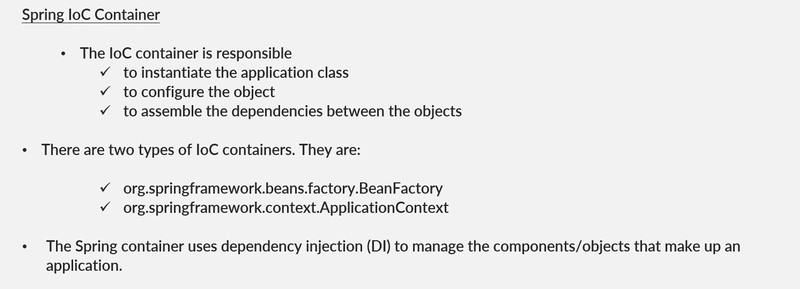
Spring is a comprehensive framework that simplifies Java application development by promoting loose coupling and easier testability through dependency injection. Central to its architecture is the concept of a Spring Bean. A Spring Bean is not merely any Java object; it is a Java object that is instantiated, configured, and managed by the Spring Inversion of Control (IoC) container. Put differently, a Bean is a POJO (Plain Old Java Object) that exists under the governance of the Spring container.
A common point of confusion is the statement that a Bean is a POJO. While all Beans are POJOs, not every POJO becomes a Bean. The defining criterion is whether the object is created and managed by the Spring container, including how its dependencies are provided, how its lifecycle is controlled, and how it is destroyed when the application shuts down. This approach enables Spring to orchestrate complex object graphs and lifecycles with minimal manual wiring.
The process by which the Spring container treats a class as a Bean includes several steps:
– Creation: The container instantiates the bean when needed, such as at startup or on demand, depending on its scope and configuration.
– Configuration: After creation, the container configures the bean by setting its properties, fulfilling dependencies, and applying any necessary initialization logic.
– Dependency Injection: The container injects other required components (dependencies) into the bean, promoting loose coupling and easier testing.
– Lifecycle Management: The container governs the bean’s lifecycle, creating it, managing its state, and invoking lifecycle callbacks as defined by the developer.
– Destruction: When the application context shuts down, the container properly destroys beans, calling any destruction callbacks and releasing resources.
This lifecycle model is a core benefit of the Spring framework. It abstracts away much of the boilerplate associated with object creation and dependency wiring, allowing developers to focus on business logic rather than wiring and resource management. The result is a modular, testable, and scalable application architecture.
In practice, Spring supports multiple ways to define beans and their lifecycles:
– Component Scanning and Annotations: A class annotated with @Component (or @Service, @Repository, or @Controller) becomes a candidate for Bean creation. Spring scans for these annotations and registers the resulting objects as beans in the application context. This approach emphasizes convention over configuration and reduces manual XML bean definitions.
– Java-Based Configuration: A Java class annotated with @Configuration defines methods annotated with @Bean. Each such method produces and configures a bean instance, and Spring manages these beans within the application context. This method offers strong type safety and refactor-friendly configurations.
– XML Configuration: Traditional XML files define bean elements, specifying class names, properties, constructor arguments, and lifecycle callbacks. While less common in modern Spring applications, XML configuration remains a valid and useful option in certain scenarios or legacy projects.
– Scopes and Lifecycle Callbacks: Beans can be defined with various scopes (singleton, prototype, request, session, etc.) depending on the application’s needs. Additionally, developers can specify initialization methods (via @PostConstruct, init-method) and destruction methods (via @PreDestroy, destroy-method) to customize lifecycle behavior.
– Dependency Injection Mechanisms: Spring supports constructor-based, setter-based, and field-based injection (the latter typically via reflection frameworks). Constructor injection is often preferred for mandatory dependencies and immutability guarantees.
Understanding the distinction between a POJO and a Spring Bean clarifies why Spring is described as an IoC container. The IoC principle means that the container is responsible for instantiating objects, wiring their dependencies, and controlling object lifecycles. By doing so, Spring reduces coupling between components and provides a centralized mechanism for managing resources, configuration, and lifecycle concerns across the entire application.
In addition to lifecycle and injection, Spring’s IoC container enables several other capabilities:
– Profiles and Conditional Configuration: Beans can be selectively loaded based on runtime conditions or environment profiles, enabling flexible deployment across environments.
– Lazy Initialization: Beans can be created lazily, on first use, to improve startup time and resource utilization when appropriate.
– AOP and Cross-Cutting Concerns: The container can apply aspects to beans, enabling concerns like logging, security, and transactions to be managed declaratively without cluttering business logic.
– Resource Management: The container can manage resources such as database connections, thread pools, and other expensive resources, often integrating with Spring’s Data Access and Transaction management modules.
The practical implication for developers is that by relying on the Spring container, you can write business logic that is decoupled from concrete implementations and lifecycle concerns. This leads to more testable units, easier configuration changes, and simplified application maintenance.
In-Depth Analysis
The concept of a Spring Bean emerges from the need to manage complexity in large Java applications. In traditional programming, developers manually instantiate objects, wire dependencies, and manage lifecycles. As an application grows, this manual wiring becomes error-prone and difficult to maintain. Spring addresses these challenges by introducing the IoC container, which is responsible for object creation and management.
Key ideas behind Spring Beans and the IoC container include:
– Inversion of Control: Rather than objects creating or managing their own dependencies, the container provides those dependencies. This inversion of control is a fundamental design shift that promotes loose coupling and easier testing.
– Dependency Injection: A core mechanism by which the container supplies required collaborators to a bean. Injection can occur via constructor parameters, setter methods, or field injection, depending on configuration and design preferences.
– Lifecycle Management: The container not only creates and injects dependencies but also governs lifecycle events. Developers can hook into initialization and destruction phases to perform resource setup or cleanup, ensuring predictable resource management.
– Scope and Lifecycle Granularity: Beans can be scoped to match the needs of the application. Singleton scope means a single shared instance per container, whereas prototype or other scopes create new instances per request or per lifecycle.
– Platform-Independent Configuration: Spring supports multiple configuration strategies, which lets teams adopt the approach that best fits the project, whether that is annotation-driven, Java-based configuration, or XML-based configuration.
Not all Java objects should be beans. The defining criterion is whether Spring should manage the object’s lifecycle and dependencies. A bean is a POJO that has been registered with the Spring container and is subject to its lifecycle and injection rules. This management yields several practical benefits:
– Consistent Dependency Wiring: Objects receive their dependencies in a consistent, centralized manner, reducing boilerplate code and avoiding overheating of the application with manual wiring.
– Testability: Because dependencies are injected rather than created internally, components are easier to test in isolation with mock implementations.
– Maintainability: Centralized configuration makes it simpler to swap implementations, adjust lifecycles, or modify how dependencies are provided.

*圖片來源:Unsplash*
The lifecycle of a bean in the Spring container typically follows a sequence:
1. Instantiation: The container creates the bean instance. Depending on the scope, this can happen at startup or lazily when first requested.
2. Population: The container injects dependencies and sets properties as specified in configuration.
3. Initialization: If an initialization method is defined (either via annotations or XML/Java config), the container invokes it. This phase is ideal for performing setup tasks that require injected dependencies.
4. Use: The bean participates in the application’s operation as designed.
5. Destruction: Upon container shutdown, the container calls any defined destruction methods to release resources and perform cleanup.
The practical impact of these behaviors is most evident in applications with rich object graphs, where the container’s ability to manage lifecycles and dependencies reduces the risk of resource leaks and circular dependencies. When used correctly, the IoC container enables scalable architectures where components can evolve independently while maintaining a coherent wiring strategy.
Understanding the difference between a user-defined POJO and a Spring Bean is essential for effective Spring development. A POJO is a simple Java object with no framework-specific concerns. A Spring Bean, by contrast, is a POJO that has been registered with the Spring container and is controlled by it. The same class could be used as a POJO in a standalone context or as a bean within a Spring application, depending on how the object is instantiated and managed.
In addition to the core concepts, modern Spring development embraces several related topics that complement Bean management:
– Dependency Injection Annotations: Annotations such as @Autowired and @Inject simplify dependency wiring and improve readability by expressing intent directly in code.
– Java-Based Configuration: Styles of configuration using @Bean methods in @Configuration-annotated classes provide a strongly-typed, refactor-friendly approach to bean definitions.
– Profiles and Conditional Beans: Spring’s support for profiles and conditional bean creation enables dynamic behavior across different deployment environments.
– Testability and Mocking: Spring’s IoC model is particularly conducive to unit testing, allowing tests to focus on behavior rather than wiring.
– Spring Boot: In practice, many Spring projects use Spring Boot to auto-configure and simplify bean creation, packaging, and deployment, further reducing boilerplate and accelerating development.
Perspectives and Impact
The approach of Spring Beans and the IoC container has influenced how modern Java applications are designed and deployed. By abstracting object creation and lifecycle management, developers can craft more modular code with clear separation of concerns. This architectural pattern has several notable implications:
– Scalability: As applications grow, the decoupled components interact through well-defined interfaces and container-managed dependencies, supporting maintainability and evolution.
– Testability: Dependency injection makes it easier to substitute mock implementations during testing, leading to more reliable and faster test suites.
– Configurability: Centralized bean definitions enable flexible configuration changes without altering business logic, aiding in deployments across environments.
– Resource Management: The container’s lifecycle management helps ensure resources are created and released in a predictable manner, reducing the risk of leaks and contention.
Looking forward, the Spring ecosystem continues to evolve with improvements in performance, tooling, and developer experience. Advances in reactive programming, cloud-native patterns, and microservice architectures all intertwine with the IoC container’s capabilities. While the core ideas remain stable, practical usage evolves with new features, such as advanced conditional configuration, richer lifecycle hooks, and better integration with modern build and deployment pipelines. The overarching impact is a framework that helps teams build robust, maintainable, and scalable Java applications by centralizing and standardizing how objects are created, wired, and managed.
Key Takeaways
Main Points:
– A Spring Bean is a POJO managed by the Spring IoC container, created, configured, and lifecycle-controlled by the container.
– Not every POJO is a Bean; management by Spring is the distinguishing factor.
– The container handles creation, dependency injection, lifecycle events, and destruction, enabling loose coupling and easier testing.
Areas of Concern:
– Misunderstanding of scope can lead to unexpected lifecycles or resource usage.
– Overreliance on container magic without explicit configuration may reduce clarity and testability.
– Mixing configuration approaches without coherence can lead to maintenance challenges.
Summary and Recommendations
In summary, Spring Beans form the backbone of Spring’s Inversion of Control model. By ensuring that objects are created, configured, and managed by the Spring container, developers gain consistent dependency wiring, lifecycle control, and resource management across the application. To maximize benefits:
– Define beans using clear configuration strategies (annotations, Java config, or XML) and align with project needs.
– Choose appropriate scopes to match usage patterns (singleton for shared services, prototype for independent instances, and web-related scopes for requests or sessions).
– Leverage lifecycle callbacks and initialization/destruction methods to handle resource setup and cleanup reliably.
– Use dependency injection to promote loose coupling and ease testing, favoring constructor injection for mandatory dependencies.
– Integrate with Spring Boot or other Spring projects to simplify configuration, auto-configuration, and deployment.
By following these practices, teams can build more modular, maintainable, and scalable Java applications that leverage the full power of Spring’s IoC container and Bean lifecycle management.
References
- Original: https://dev.to/phoenix_238501d86d417e/spring-beans-context-2ijm
- Spring Framework Reference Documentation: https://docs.spring.io/spring-framework/docs/current/reference/html/
- Spring Boot Reference Guide: https://docs.spring.io/spring-boot/docs/current/reference/html/

*圖片來源:Unsplash*