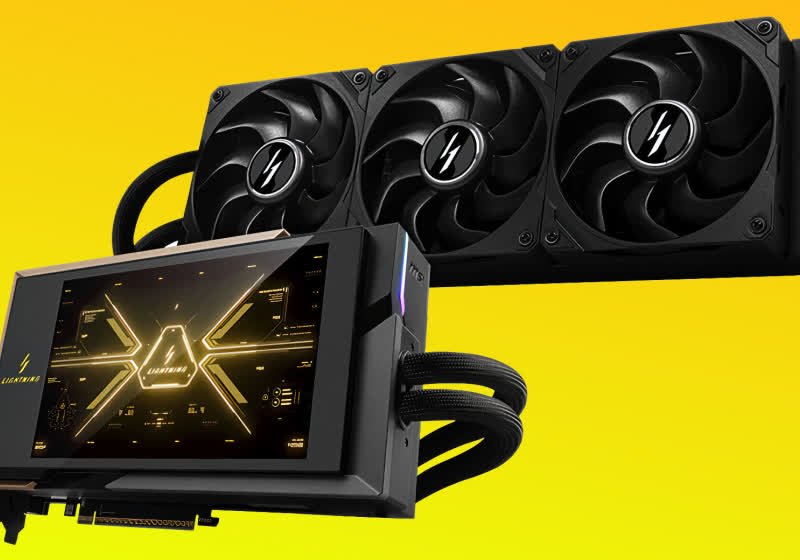
TLDR
• Core Points: MSI’s Lightning line tops its GPU lineup; the RTX 5090 Lightning Z targets extreme overclockers, offering up to 1,000W power and a premium price via a purchase lottery.
• Main Content: The RTX 5090 Lightning Z is positioned as MSI’s flagship graphics card with extreme performance potential, requiring entry into a draw for purchase due to limited supply and high demand.
• Key Insights: High-end GPUs increasingly rely on limited allocations and lotteries to manage demand; power limits and cooling solutions are central to sustaining performance in extreme overclocking scenarios.
• Considerations: Buyers must navigate draw-based procurement, premium pricing, and the potential reality of limited supply despite the card’s capabilities.
• Recommended Actions: Interested enthusiasts should monitor MSI announcements, understand the entry process for the draw, and compare against other top-tier options and cooling considerations before committing.
Content Overview
MSI’s Lightning series has long represented the apex of the company’s graphics card engineering, with the Z suffix marking the pinnacle of capability within the lineup. The new RTX 5090 Lightning Z continues this tradition, designed for extreme overclocking enthusiasts, professional benchmarks, and users who demand the utmost in GPU performance. This latest flagship from MSI promises extraordinary power delivery, advanced cooling, and a construction that emphasizes stability under aggressive tuning. However, accessibility is limited by a purchase model that relies on a lottery-style draw, rather than open sales, reflecting the card’s rarity and the high demand from the most dedicated segment of the PC hardware community. The combination of a purportedly massive 1,000W power envelope and a price tag of around $5,090 underscores the card’s position as a niche, premium product intended for users who push the limits of current graphics technology.
Beyond the specs and the draw mechanism, the RTX 5090 Lightning Z represents a broader trend in the high-end GPU market: limited availability, strategic distribution models, and a focus on extreme performance per watt and per dollar in specialized use cases. For manufacturers, these approaches help manage supply chain realities and demand spikes that accompany new generations, while still signaling prestige and exclusivity to enthusiasts. For buyers, it means weighing the allure of top-tier performance against the challenges of obtaining the product and the substantial investment involved.
In the following sections, we examine the RTX 5090 Lightning Z’s design philosophy, expected performance envelope, cooling architecture, power delivery, and the lottery-based purchasing approach. We also consider the implications for the broader enthusiast landscape, including how such products influence benchmarking expectations, resale markets, and the trajectory of high-end GPU development.
In-Depth Analysis
The RTX 5090 Lightning Z is conceived as MSI’s most elite graphics card, designed to extract maximum performance from NVIDIA’s latest architecture. The “Lightning” branding has historically signaled not just raw speed but a carefully engineered balance of core count, memory bandwidth, and overclocking headroom. The Lightning Z variant carries the top-tier ambitions of the line, often featuring overbuilt power delivery, enhanced cooling, and substantial factory and manual tuning headroom. The emphasis is on pushing the card to its limits in capable hands, with the expectation that users will engage in manual tweaking to unlock higher-than-stock performance levels.
One of the most notable aspects of the RTX 5090 Lightning Z is its power envelope. Reports and official disclosures position the card as capable of drawing up to approximately 1,000 watts under extreme overclocking or tightly tuned cooling conditions. This magnitude of power delivery is well beyond standard consumer GPU designs and necessitates advanced power delivery systems, highly capable VRMs, and robust cooling solutions to prevent thermal throttling or component stress. For enthusiasts, this translates into the potential for substantial performance gains when the card operates within its ideal thermal and electrical parameters. For the wider market, however, it also highlights the ongoing arms race among premium GPUs, where higher power budgets can unlock more substantial performance uplifts in professional-grade workloads, synthetic benchmarks, and gaming at the highest settings and resolutions.
Cooling innovation is a critical partner to the RTX 5090 Lightning Z’s power strategy. Extreme power consumption generates significant heat, which, if not managed effectively, can erode performance and shorten component lifespans. MSI’s approach typically blends high-capacity air or liquid cooling with meticulous heat sink design, strategic vapor chamber layouts, and heat pipe networks designed to spread heat efficiently across a large cooling surface. Moreover, the physical build of Lightning cards tends to reflect a focus on rigidity and durability, with reinforced frames and high-grade materials intended to support their substantial weight and the demands of extreme clocks. The end result is a card that is designed to maintain peak performance across extended benchmarking sessions and demanding overclocking experiments, rather than merely delivering a few extra frames in standard gaming scenarios.
In terms of performance, the RTX 5090 Lightning Z is expected to deliver top-tier results across gaming, rendering, and compute workloads. The combination of NVIDIA’s latest architecture with MSI’s high-end engineering typically yields improvements in rasterization, ray tracing, and AI-accelerated tasks, particularly when paired with fast memory and optimized BIOS profiles. However, the actual realized gains depend heavily on cooling, power delivery headroom, driver maturity, and software tuning. The card’s true potential is often realized only in the hands of users who invest considerable time in overclocking, bandwidth tuning, and thermal optimization, rather than in stock out-of-the-box performance. This is consistent with MSI’s historical positioning of the Lightning series as a platform for enthusiasts to push hardware beyond the defaults provided by reference designs.
A distinguishing factor of this product is the purchasing model. The RTX 5090 Lightning Z is not sold through a typical first-come, first-served approach. Instead, MSI and its distribution partners have adopted a draw-based system, where interested buyers submit entries for a chance to purchase the card. This approach helps manage the constraints associated with limited supply, mitigates scalping pressures, and creates a sense of exclusivity around the flagship model. For consumers who want this card, participation in the draw is a prerequisite to even be considered for a purchase. The outcome is not guaranteed, and even successful entries may still face supply constraints at the point of sale. This model mirrors broader trends in the high-end PC hardware market, where limited-edition or premium components are often allocated through lotteries or controlled release events.
From a price perspective, the RTX 5090 Lightning Z’s $5,090 price point positions it well beyond mainstream GPUs, even within the premium tier. The high price aligns with its position as a utility for extreme overclockers and professional-grade enthusiasts who can justify the expense through performance, benchmarking leadership, or specialized workloads. For many enthusiasts, the price would be seen as a barrier, reserving access for those with substantial budgets and dedicated interests in pushing hardware to its upper limits. The cost of ownership also includes potential ancillary investments in cooling infrastructure, power supply capabilities, and case modifications to accommodate the card’s dimensions and heat output.
In addition to these hardware considerations, buyer education is essential. Potential Lightning Z buyers should assess their existing system compatibility, including power supply capacity, motherboard PCIe slot availability, radiator or case space for the card’s dimensions, and the overall thermal design of their PC. The 1,000W power figure is not a casual spec; it requires a carefully selected power supply with ample headroom, as well as an effective cooling plan. Moreover, users must consider the electrical infrastructure of their environment, including safe handling of high-current power connections, adequate circuit protection, and professional installation where necessary.
Market implications of a draw-based distribution model for a card of this caliber include anticipation of fluctuating resale values and a tiered secondary market. When a limited number of units are released through lottery systems, buyers who secure a card can potentially retain strong resale value if demand remains high. However, market dynamics can vary, and price stability may be influenced by new product announcements, changes in supply chain conditions, or shifts in consumer interest. The presence of a premium, scarce product like the RTX 5090 Lightning Z can also elicit broader discussions about the value proposition of expensive GPUs, particularly as software and game engines evolve to leverage increasingly powerful hardware in novel ways.
Finally, it is important to place this product within the broader trajectory of GPU development. The RTX 5090 Lightning Z represents a snapshot of aggressive performance ambitions and the willingness of manufacturers to invest in bespoke cooling, power delivery, and chassis integration to accommodate extreme overclocking capabilities. This trend can influence how future generations of GPUs are engineered, including the balance between raw performance, efficiency, and practical usability for the average consumer. It also highlights the ongoing tension between accessibility and exclusivity in the high-end PC market, where the most advanced components remain out of reach for many users while continuing to drive innovation and benchmarking culture.

*圖片來源:Unsplash*
Perspectives and Impact
The RTX 5090 Lightning Z’s existence and the accompanying draw-based purchase model have several substantive implications for different segments of the tech ecosystem. For enthusiasts and professional overclockers, the card embodies the pinnacle of what is possible within current silicon and cooling technology. It provides a tangible target for benchmarking groups, water-cooling enthusiasts, and modders who enjoy pushing hardware to its absolute limits. The card’s potential performance, when paired with compatible platforms and optimized software, can yield impressive results in synthetic tests and in certain high-demand gaming scenarios. The enhanced power delivery and cooling systems are increasingly essential as GPUs push higher clock speeds and larger memory bandwidth requirements, especially in the context of real-time ray tracing and AI-assisted workloads.
From a market perspective, MSI’s draw-based release strategy helps manage expectations and reduce scalping pressures by distributing the limited supply in a controlled manner. This approach can create excitement and a sense of exclusivity that drives interest among early adopters and collectors, while also maintaining a level of fairness for legitimate buyers who participate in the draw. Nevertheless, the lottery system can be frustrating for potential buyers who miss out, highlighting a trade-off between accessibility and scarcity that is common in the premium hardware space.
For the broader ecosystem, the RTX 5090 Lightning Z can influence content creation, game development, and professional pipelines by providing a reference point for the kind of performance that premium systems can deliver. Developers may tailor experiences to leverage high-end GPUs more effectively, while content creators may benefit from higher framerates, faster rendering times, and improved real-time visualization capabilities. On the supply side, the draw-based release approach may shape inventory planning, partnerships with distributors, and the allocation of resources to marketing and support for flagship products. It may also encourage competitors to explore similar distribution mechanisms for their own premium offerings, potentially leading to broader adoption of controlled-release models in the high-end segment.
The card’s introduction also invites reflection on the ongoing evolution of cooling technologies and power infrastructure required for extreme GPUs. As GPUs scale in performance, manufacturers invest in more sophisticated cooling architectures, power delivery solutions, and chassis integration concepts. This may accelerate the adoption of advanced liquid cooling solutions in high-end systems, as well as the engineering of motherboards capable of supporting intense power requirements without compromising stability. For consumers, these developments underscore the importance of future-proofing systems not just for current games but for the potential of new software paradigms and workloads that demand sustained peak performance.
Looking ahead, the RTX 5090 Lightning Z could serve as a catalyst for further innovation in the high-end segment. If the draw-based distribution model proves effective in balancing demand with supply, we may see more premium GPUs adopting similar approaches, potentially spreading to other product families such as professional-grade accelerators or limited-edition collaborations. Conversely, if the model leads to persistent frustration due to missed entries or limited total supply, manufacturers might refine their release strategies to better satisfy the most dedicated fan bases while maintaining the prestige associated with flagship products.
In sum, the RTX 5090 Lightning Z embodies a strategic blend of extreme performance potential, exclusive access, and premium pricing. It reflects both the technical aspirations of GPU engineers and the market dynamics that govern the sale of top-tier hardware. For those who secure a unit, the card represents not just raw speed but a gateway to benchmarking leadership, competitive overclocking, and a showcase piece for high-end PC builds. For the broader community, it signals ongoing trends toward greater specialization in the enthusiast space, where the most capable components are available to a smaller, highly engaged subset of buyers.
Key Takeaways
Main Points:
– The RTX 5090 Lightning Z is MSI’s top-tier flagship designed for extreme overclocking and enthusiasts.
– It supports up to approximately 1,000W power under tuned conditions and demands advanced cooling.
– Availability is allocation-based through a purchase draw, not open sale, with a high price.
Areas of Concern:
– Access is limited by lottery, which may leave interested buyers unfulfilled.
– The $5,090 price places the card well outside mainstream affordability.
– Real-world performance benefits depend heavily on cooling, power delivery, and manual optimization.
Summary and Recommendations
The RTX 5090 Lightning Z represents a bold statement from MSI about the upper bounds of graphics card performance and the lengths to which premium brands will go to satisfy a dedicated enthusiast audience. Its 1,000W power envelope and elite cooling requirements are a reminder that pushing silicon to the extreme involves more than just a faster GPU core—it requires a holistic approach to power delivery, thermal management, and system integration. The draw-based sale model aligns with the card’s exclusivity, aiming to balance demand against constrained supply while minimizing opportunistic buying frenzies. For buyers, the decision to pursue this card hinges on several factors: their willingness to participate in a lottery, their ability to support and integrate robust cooling and power solutions, and their justification of the investment given the card’s limited open-market accessibility and high price.
If you are an enthusiast considering this flagship, you should first assess your current system’s capacity to handle a 1,000W GPU and ensure your power supply, case, and cooling are prepared for such demands. Research the draw process, track MSI’s official communications, and understand the terms of entry, including any regional limitations and timelines. Compare the RTX 5090 Lightning Z against other top-tier GPUs in terms of performance gains, thermals, and total cost of ownership to determine whether the upgrade aligns with your goals, whether for gaming at ultra settings, content creation workloads, or professional benchmarking. Finally, consider the broader market implications of such limited, premium releases—how they influence resale markets, future product strategies, and the expectations of high-end enthusiasts.
In conclusion, while the RTX 5090 Lightning Z may not be for every buyer, it serves as a focal point for discussions about the future of flagship GPUs: the balance of extraordinary performance, exclusive access, and the practical considerations that accompany owning a truly premium graphics card in today’s market.
References
- Original: https://www.techspot.com/news/111324-want-5090-msi-rtx-5090-lightning-z-youll.html
- Additional reference 1: NVIDIA official press materials on RTX 5090 architecture and feature set
- Additional reference 2: MSI Lightning product line overview and historical performance benchmarks
- Additional reference 3: Market analysis on draw-based hardware releases and consumer impact

*圖片來源:Unsplash*