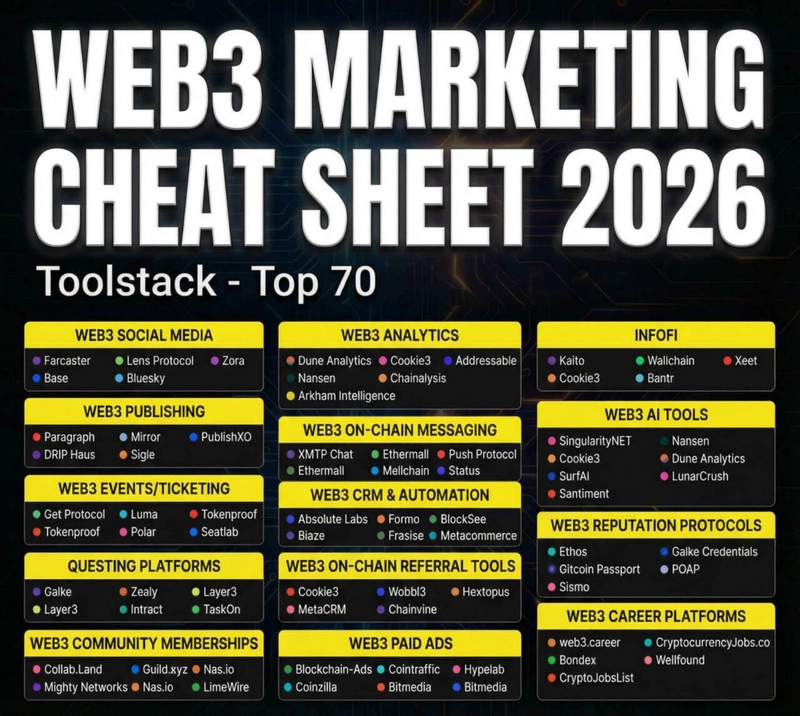
TLDR
• Core Points: Marketing in Web3 is foundational infrastructure—identity, data, messaging, reputation, distribution, and liquidity shape growth.
• Main Content: Builders can’t treat Web3 marketing as Web2 with crypto logos; success hinges on integrated stack decisions that align with on-chain realities.
• Key Insights: The future of Web3 marketing is about system design, interoperability, and durable signals beyond vanity metrics.
• Considerations: Fragmented social graphs, evolving data privacy, and regulatory uncertainty require robust, adaptable playbooks.
• Recommended Actions: Map your stack, prioritize trust and liquidity, invest in cross-channel identity, and measure signals that reflect on-chain behavior.
Content Overview
Web3 marketing has evolved beyond channel optimization into infrastructure design. In 2026, effective marketing for crypto projects is inseparable from the underlying technology and ecosystem you’re building. Rather than chasing traditional growth hacks, successful teams focus on constructing a coherent stack that integrates identity, data, messaging, reputation, distribution, and liquidity across on-chain and off-chain contexts. This article lays out how Web3 marketing actually functions for builders today, emphasizing practical, non-hype guidance grounded in real-world deployment and operation.
Web3 marketing infrastructures must contend with fragmented social graphs, decentralized participation, and a landscape where user data lives on-chain, off-chain, or in hybrid forms. The shift from Web2-centric thinking to a stack-based approach means teams must design systems that preserve user trust, enable seamless participation, and sustain liquidity and network effects. The “marketing” function, in this sense, is less about pushing messages through a single funnel and more about building durable primitives that support organic growth, credible reputation, and resilient distribution.
In-Depth Analysis
Web3 projects now operate in an ecosystem where traditional marketing levers are incomplete without a robust technical foundation. This creates a paradox: growth can be rapid when the stack is well designed, yet misalignment between technology and marketing signals can erode trust and waste resources. The following sections outline the core components of the Web3 marketing stack as of 2026 and how they interlock to drive measurable, sustainable outcomes.
Identity and credentials
In a decentralized environment, identity is not a single login or a marketing handle. It spans on-chain addresses, verified credentials, reputation scores, and governance participation. Builders should design identity primitives that respect user privacy while enabling trustable attribution. This often means leveraging verifiable credentials, identity dashboards that harmonize on-chain activity with off-chain profiles, and consent-driven data sharing. A strong identity layer helps marketers tailor messages to cohorts that actually participate and contribute, rather than broad audiences that rarely convert into meaningful liquidity or governance activity.
Data and signals
Web3 marketing relies on signals across multiple domains: on-chain transactions, staking, liquidity provisioning, governance votes, and off-chain engagement such as content creation and community discussions. The challenge is unifying these signals into actionable insights without compromising user privacy or decentralization principles. Teams should invest in data architectures that support event streams, at-a-glance dashboards, and risk-aware attribution models. The goal is to convert diverse signals into reliable indicators of engagement, trust, and value creation, not merely vanity metrics like followers or impressions.
Messaging and positioning
In decentralized ecosystems, messaging must reflect real value exchange and demonstrated behavior, not just promises. Clear articulation of token utility, governance rights, and product-market fit helps align community incentives with project milestones. Messaging should be consistent across on-chain communications (e.g., protocol updates, governance discussions) and off-chain channels (social media, blogs, media). Authenticity matters more than clever slogans; credible narratives emerge when they are substantiated by transparent roadmaps, verifiable milestones, and observable on-chain activity.
Reputation and trust
Reputation in Web3 is earned through transparent governance participation, security auditing, incident response, and consistent delivery of promises. Marketing cannot fake trust; it must cultivate it through open communication, auditable processes, and reliable performance. Projects should foster a culture of openness, publish post-mortems, and share security practices publicly. Reputation also depends on how well a project handles feedback, bug reports, and community governance—areas where constructive engagement can compound credibility.
Distribution and reach
Distribution in Web3 extends beyond paid ads and SEO. It includes liquidity mining programs, participation in decentralized exchanges, cross-chain bridges, and strategic partnerships with other protocols. A well-designed distribution stack incentivizes early participation, aligns user incentives with protocol growth, and sustains long-term liquidity. Timing, cadence, and governance-driven events (like proposals and upgrades) can serve as predictable channels for attention and participation, if orchestrated with care.
Liquidity and incentives
Liquidity is the lifeblood of many Web3 projects. Marketing strategies that fail to address liquidity risk leaving users with slippage and poor execution are likely to underperform. Marketers must coordinate with product and treasury teams to ensure appropriate incentive models, reward structures, and risk management. Transparent telemetry about incentives, a clear path to governance, and predictable reward cadence are essential to maintain user confidence and ongoing participation.
The real-world orchestration
A successful Web3 marketing stack doesn’t rely on a single channel or a loud launch. It requires cross-functional alignment among product, growth, security, legal, and community teams. The stack should support a feedback loop: on-chain behavior informs off-chain messaging, which in turn shapes product roadmaps and governance decisions. This requires robust instrumentation, governance-friendly processes, and a culture that values proven results over hype.
Social graphs are fragment
The social graph in Web3 is not a single, centralized map of connections. It is a mosaic of communities across disparate platforms, wallets, and networks. This fragmentation demands interoperability and consent-based data sharing. Teams need to ensure that community management tools and content distribution strategies respect user privacy while enabling meaningful engagement across threads, communities, and governance forums. In practice, this means configuring dashboards that can pull signals from multiple sources, normalize them, and present coherent narratives and opportunities for participation.
The maturation of tooling
As the ecosystem matures, the tooling around Web3 marketing becomes more capable. There is a growing emphasis on on-chain analytics, governance tooling, secure onboarding flows, and privacy-preserving data infrastructure. This tooling maturation supports more accurate attribution, better measurement of token- and liquidity-driven activity, and more reliable methods for evaluating community sentiment. Teams should stay alert to evolving standards, such as improved identity frameworks and interoperable data schemas, which can reduce fragmentation and friction.
Regulatory and risk considerations
Regulatory environments around crypto and digital assets continue to evolve. Marketing teams must navigate jurisdictions that impose restrictions on disclosures, promotions, and incentives. A stack-based approach helps in this regard by enabling compliance at the architectural level: data pipelines that segregate sensitive information, governance processes that require explicit consent, and transparent reporting that aligns with regulatory expectations. Proactive risk management—such as security audits, incident response plans, and clear user disclosures—becomes a core component of the marketing stack.

*圖片來源:Unsplash*
Measuring success in a Web3 marketing stack
Traditional marketing metrics like reach, engagement, and clicks remain relevant, but they must be reframed in a Web3 context. Success is increasingly about how effectively on-chain signals translate into meaningful outcomes: liquidity depth, user retention, governance participation, protocol upgrades adoption, and long-term token utility. Measurement requires instrumentation that respects privacy while providing actionable insights. Dashboards should integrate on-chain metrics (transactions, wallet activity, staking participation) with off-chain engagement (content consumption, community proposals), enabling teams to correlate marketing actions with real economic activity.
The cultural shift
For teams transitioning from Web2 to Web3 marketing, the hardest part is culture. Marketing in a decentralized environment demands humility, transparency, and a willingness to engage with communities that may challenge the project. It also requires a long-term view: short-term spikes in attention are less valuable than steady, credible participation in governance, development, and ecosystem-building. The stack approach reinforces this by aligning incentives across disciplines and creating shared goals that extend beyond immediate marketing wins.
Future directions
Looking ahead, Web3 marketing will continue leaning into stack-oriented design, with greater emphasis on interoperable identity, privacy-preserving analytics, and modular governance. Projects that succeed will be those that build resilient identity ecosystems, transparent data practices, and incentives that align user behavior with healthy, long-term ecosystem growth. The most effective teams will be those that treat marketing as an ongoing engineering discipline—structuring their stacks to learn from data, adapt to new tools, and cultivate durable trust.
Perspectives and Impact
The shift toward stack-based Web3 marketing has broad implications for the industry. First, it raises the bar for accountability. Projects that promise growth without delivering on-chain utility or credible governance risk eroding trust. Second, it elevates the importance of collaboration across technical, legal, and community domains. The marketing function becomes a shared responsibility, embedded in product design, governance, and security practices. Third, it encourages a more patient approach to growth. While token-driven incentives can deliver quick liquidity bursts, sustainable health depends on continuous value creation, rigorous risk management, and a transparent roadmap.
From a practitioner’s standpoint, the most impactful moves in 2026 involve designing for liquidity and credibility from day one. This means establishing robust onboarding experiences that connect users to meaningful on-chain activity, creating clear incentive structures that reward helpful participation, and building reputation programs that people can verify through on-chain and off-chain signals. It also means cultivating cross-chain interoperability where possible, so that users can engage with ecosystems without being locked into a single protocol or silo.
The ecosystem benefits when projects invest in open standards and shared tooling. Interoperable identity, standardized data schemas, and common governance interfaces reduce fragmentation, enabling communities to move fluidly between projects and networks. This not only lowers the barrier to entry for new participants but also reinforces trust as users encounter familiar mechanisms across multiple contexts. In turn, healthier cross-project collaboration can accelerate liquidity formation, reduce redundancies, and stimulate more robust network effects.
Impact on investment and platform design
Investors are increasingly scrutinizing the quality of a project’s Web3 marketing stack. A mature stack demonstrates a coherent strategy for identity, data, messaging, and liquidity, supported by transparent governance and measurable on-chain impact. Platforms that facilitate cross-project collaboration, secure onboarding, and privacy-preserving analytics are likely to attract more ecosystem participants and capital. For startups, this translates into clearer product-market fit signals, reduced marketing waste, and more predictable growth trajectories.
Operationalizing stack-based marketing
To operationalize this approach, teams should:
– Map the full stack: identify the essential components across on-chain and off-chain channels, from identity and data to reputation and liquidity.
– Align incentives with product milestones: ensure token mechanics and reward programs reinforce desired behaviors that contribute to long-term ecosystem health.
– Invest in trustworthy data instrumentation: build privacy-respecting analytics that can attribute activity to meaningful actions, not mere vanity metrics.
– Foster transparent governance practices: publish decisions, share roadmaps, and invite community participation in a verifiable manner.
– Prioritize interoperability and standards: adopt interoperable identity and data standards to reduce fragmentation and facilitate cross-project participation.
– Develop incident response and security culture: integrate security audits and governance processes into marketing routines so trust remains intact even during incidents.
– Measure outcomes beyond vanity metrics: emphasize on-chain liquidity, retention, participation in governance, and protocol adoption as primary indicators of success.
Case studies and practical illustrations
While this article does not present exhaustive case studies, several patterns emerge from successful Web3 projects. For example, projects that combined a clear on-chain utility with transparent governance and measurable liquidity programs tended to demonstrate more durable user engagement. Experiments in cross-chain distribution, coordinated incentive campaigns tied to governance milestones, and open post-mortems contributed to stronger credibility and sustained participation. The best performers also maintained honest communication during setbacks, reinforcing trust with the community rather than concealing problems.
Future-proofing your Web3 marketing approach
The landscape will continue to evolve as new standards, tools, and regulatory expectations emerge. Teams should design for adaptability, enabling their stacks to absorb new platforms and data sources without sacrificing user privacy or decentralization principles. Emphasizing modularity—where components can be upgraded or swapped without destabilizing the whole stack—will help projects stay resilient in the face of change. Above all, a successful Web3 marketing strategy in 2026 and beyond will be driven by a commitment to real value creation, transparent governance, and durable, trust-based participation.
Key Takeaways
Main Points:
– Web3 marketing is infrastructure: identity, data, messaging, reputation, distribution, and liquidity are intertwined.
– Treat marketing as a stack-building exercise, not a Web2 growth play with crypto branding.
– Fragmented social graphs and evolving tooling demand interoperable, privacy-preserving architectures.
– Reputation and trust are earned through transparent governance and reliable delivery.
– Sustainability hinges on liquidity alignment, credible incentives, and long-term ecosystem health.
Areas of Concern:
– Fragmented data sources and privacy considerations complicate attribution.
– Regulatory uncertainty can disrupt marketing incentives and compliance.
– Over-reliance on token incentives may create short-term bursts without lasting value.
Summary and Recommendations
In 2026, Web3 marketing has shifted from channel-centric tactics to holistic stack design. Builders must integrate identity, data, messaging, reputation, distribution, and liquidity into a unified architecture that supports on-chain activity and off-chain engagement. This approach mitigates wasteful spending and builds sustained trust, facilitating durable growth through credible participation and governance-driven momentum. To implement this, teams should map their full stack, align incentives with product milestones, invest in privacy-respecting data instrumentation, and prioritize transparent governance and interoperability. By treating marketing as an engineering discipline—one that learns from data, adapts to new tools, and preserves user trust—Web3 projects can achieve resilient, long-term ecosystem health.
References
- Original: https://dev.to/krisvarley/web3-marketing-in-2026-the-stack-builders-actually-use-2783 (source article)
- Additional references:
- Open standards for identity and verifiable credentials
- Privacy-preserving analytics in decentralized ecosystems
- Governance best practices and post-mortems in Web3 communities

*圖片來源:Unsplash*